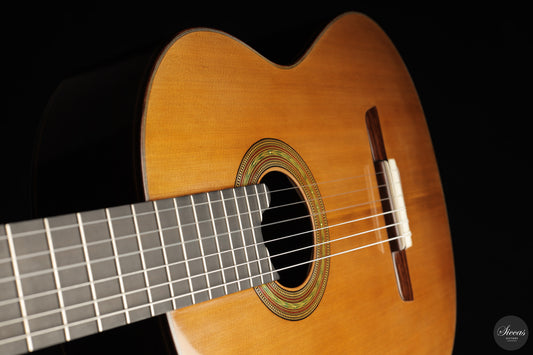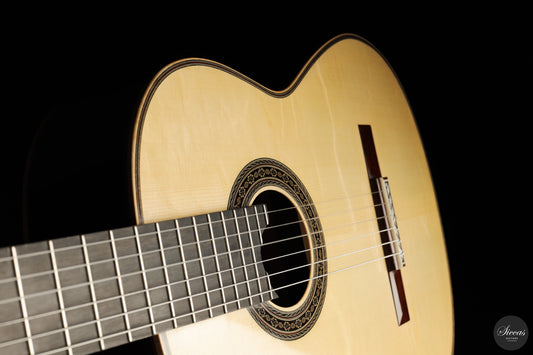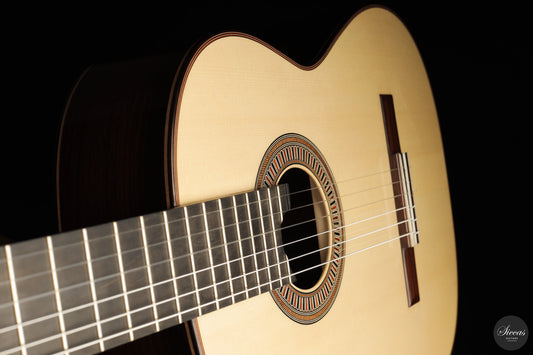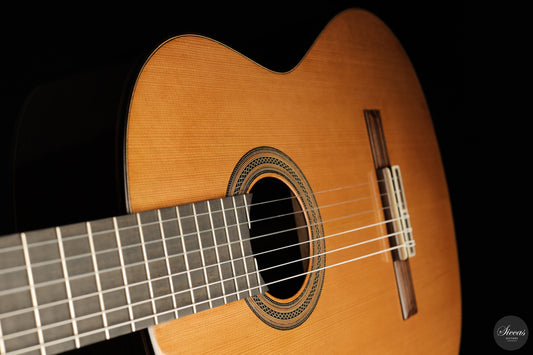

Johan Sarens is one of Belgium's most respected classical guitar makers, working from his atelier in Mechelen with a philosophy rooted equally in musical sensitivity and the exacting craft of the Spanish masters. As both a trained guitarist and a luthier, Sarens occupies a rare position in the world of classical guitar making: he understands the demands of the concert stage from the inside, and that knowledge shapes every decision he makes at the workbench. His instruments are known for their warm, balanced tone, their responsiveness under the fingers, and a projection that serves equally well in intimate recital halls and large concert venues.
Biography and Training
Johan Sarens was shaped by music from birth. His father was a guitarist and his grandfather a luthier, so the twin pursuits of playing and building were woven into his upbringing from the very beginning. He went on to study jazz guitar at the Royal Conservatory of Brussels, gaining a deep understanding of harmony, phrasing, and the physical relationship between player and instrument. Alongside his conservatory studies, he trained in guitar construction at the CMB — the Centre for Musical Instrument Making in Puurs, Belgium — one of the foremost schools for instrument building in the Flemish region.
This dual formation set Sarens apart from many of his peers. Where some luthiers come to guitar making through woodworking traditions alone, Sarens arrived with a performer's ear already calibrated to the subtlest tonal qualities. He established his workshop in Mechelen, where he continues to build instruments entirely by hand. In 2017 he was awarded the Gouden Bootschaaf — the Golden Fingerplane — by the CMB, a distinction given to instrument makers for exceptional craftsmanship and their commitment to passing on knowledge of the trade. Since 2021 he has also taught classical guitar making at the CMB, ensuring that the tradition he absorbed finds its way to a new generation of Belgian luthiers.
Construction Philosophy
The guiding principle behind every Sarens guitar is simplicity of means applied with maximum care. He works in the tradition of the Spanish masters — the same lineage that runs from Antonio de Torres through Ignacio Fleta and beyond — and keeps machine involvement to a strict minimum. Every element that defines the voice of the guitar is shaped and tuned by hand. The soundboards are graduated with great precision, and the bracing geometry is chosen to suit the specific tonal character of each piece of wood rather than applied as a fixed template.
All Sarens guitars receive a French shellac polish finish. This choice reflects both an aesthetic preference and an acoustic one: French polish adds minimal mass to the soundboard and allows the wood to vibrate as freely as possible. The result is an instrument that feels alive under the fingers from the first note, with a responsiveness and dynamic range that heavier lacquer finishes can suppress.
Sarens also builds flamenco guitars alongside his classical instruments, applying the same handcraft discipline to the lighter, percussive demands of that tradition. Whether building for the concert classical repertoire or for the flamenco stage, his aim remains constant: to produce a guitar that inspires the musician and allows full expressive freedom.
Signature Models
Sarens works across several distinct model types, each reflecting a different facet of his approach to tone and construction. His lattice-braced guitars represent his most technically ambitious work — instruments built with a carbon fibre and spruce lattice beneath the soundboard that yields exceptional volume, projection, and sustain while keeping the overall weight of the top remarkably low. These guitars are particularly well suited to the demands of modern concert performance, where projection and tonal evenness across all registers are paramount. For players interested in understanding the technical principles behind this kind of construction, the guide to fan-braced, double-top, and lattice guitars provides useful context.
Among his most celebrated models is the 1917 Garcia, a meticulous tribute to a historical Enrique Garcia guitar — instrument number 187 — from 1917, which resides in a prestigious private collection in Paris. Garcia, the Barcelona-based maker who brought the Milanese tradition into dialogue with Spanish construction methods, produced instruments of remarkable clarity and balance. Sarens' interpretation of that instrument draws on his deep familiarity with historical construction while adding the refinements demanded by contemporary concert use. The result is a guitar that bridges past and present with unusual grace.
His fan-braced traditional models complete the range, offering players who prefer a warmer, more intimate sound the same handcraft quality in a more classical tonal profile. Across all models, the rosettes are kept deliberately understated — a visual restraint that mirrors his broader philosophy of letting the sound speak.
Notable Players and Reception
Sarens guitars have attracted serious attention from concert guitarists across Europe. His instruments have been played at recitals and featured in guitar specialist dealerships that cater to professional musicians, a sign of the confidence the professional community places in the consistency and quality of his work. The relatively small annual output of his one-man atelier means that each guitar receives the full measure of his attention, and players who acquire one find instruments that reward extended exploration over years of use.
His reputation within Belgium and beyond has grown steadily since the mid-2000s, aided by his presence at guitar festivals and his position as a teacher at the CMB. Students who pass through his classes encounter not only practical instruction in woodworking and acoustics but also the broader philosophy that connects great guitar making to great guitar playing — a tradition shared with builders such as Daniel Friederich and Robert Bouchet, whose own careers demonstrated that the luthier's art is inseparable from a deep love of music.
Legacy and Place in Contemporary Lutherie
Johan Sarens represents a strain of European guitar making that insists on the primacy of the hand, the ear, and the musician's perspective. In an era when production efficiency exerts pressure even on small workshops, he maintains an approach that traces its lineage directly to the Spanish masters while engaging fully with modern construction techniques such as lattice bracing. His dual career — as practising luthier and teacher — places him in a long tradition of makers who understood that knowledge of instrument building must be shared to remain alive.
The Gouden Bootschaaf award he received in 2017 was, in this sense, a recognition not only of the quality of his guitars but of his role in sustaining the culture of fine instrument making in Belgium. As his instruments continue to find homes with serious players, and as his students carry his methods forward into their own workshops, the Sarens name takes on the weight of a genuine legacy in the landscape of contemporary classical guitar making.
Browse available Johan Sarens guitars → in the Siccas Guitars collection.