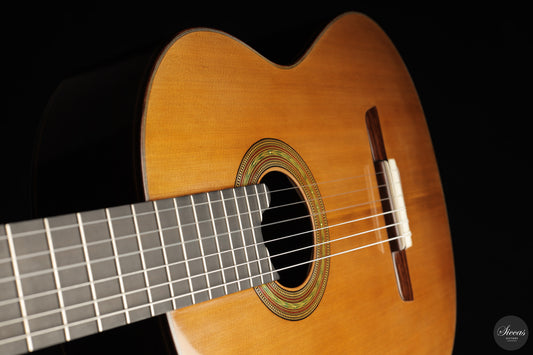
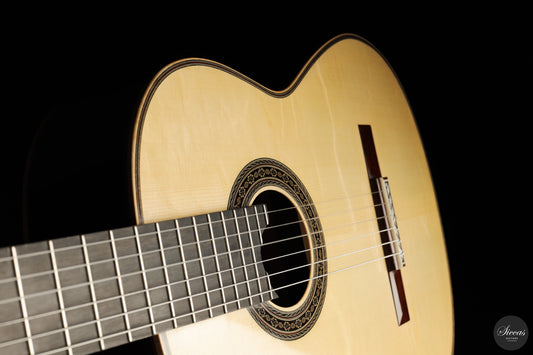
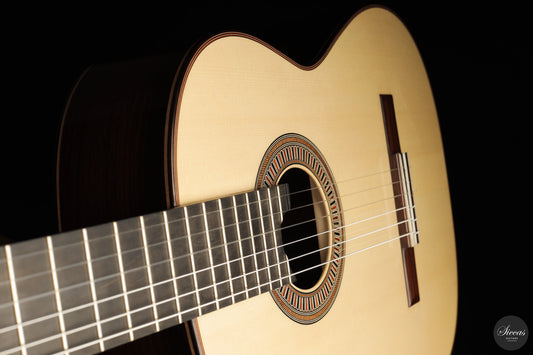
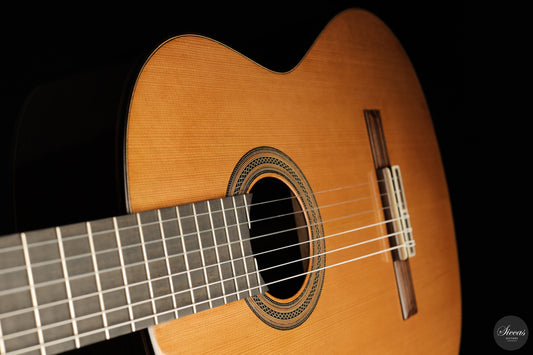
Kristof Meeus is one of the most quietly compelling figures in contemporary classical guitar making. Working from his workshop in Moortsele, in the East Flemish heartland of Belgium, he builds concert instruments that carry the measured elegance of the Spanish Granada tradition while embracing the acoustic possibilities unlocked by lattice bracing. His path to lutherie was unconventional — shaped by academic study, institutional mentorship, and an intellectual curiosity that has taken him across Europe in search of the finest historical instruments. The result is a body of work that earns the attention of serious players and collectors alike, and a growing presence at the world's leading guitar dealerships.
Biography & Training
Meeus did not arrive at guitar making through the usual apprenticeship route. Before picking up a plane or a chisel, he completed a Master's degree in Sociology — a background that arguably sharpened his ability to observe, analyse, and question the conventions of his craft. In 2006 he enrolled at the Centre for Musical Instrument Building (CMB) in Puurs, Belgium, one of the most respected lutherie schools in the country. There he trained alongside Walter Verreydt, a highly regarded Belgian luthier, absorbing the fundamentals of classical guitar construction in a rigorous, workshop-based environment.
By 2012 Meeus had established himself as an independent maker, building instruments on his own terms. His reputation grew steadily, and in 2016 the CMB invited him to return — this time as a teacher, a role that reflects the depth of expertise he had developed in just a decade. Teaching at the institution that had trained him gave Meeus a further opportunity to articulate and refine his philosophy of construction, engaging with a new generation of aspiring luthiers.
Alongside his formal training, Meeus pursued a self-directed education through extensive travel. He studied collections and sought out conversations with influential European makers including Gabriele Lodi, Lorenzo Frignani, Bruno Marlat, Antonio Marín, and Rafael Moreno. He also drew inspiration from the aesthetic legacy of the early twentieth-century Spanish master Enrique Garcia, whose rosette designs have informed some of Meeus's own decorative choices. This broad immersion in the European lutherie tradition gave him a perspective that reaches far beyond any single school or method.
Construction Philosophy
At the core of Meeus's work is a commitment to handcraft within the Granada tradition — the Spanish method of building a guitar on a solera, working from the neck outward, that has defined classical guitar construction for over a century. Every instrument he produces is built entirely by hand, without the use of CNC routing or industrial shortcuts. Yet Meeus is not a purist in the restrictive sense: he is equally drawn to the acoustic potential of lattice bracing, and a significant part of his output employs this modern structural approach.
His lattice-braced tops use a spruce framework reinforced by cedar inlays at each crossing point, a combination chosen to balance stiffness and resonant flexibility. The result is an instrument capable of producing the full dynamic range demanded by the concert stage — powerful projection, a singing treble register, and bass strings with warmth and definition. The spruce lattice design also tends to yield a particularly transparent, articulate sound that suits players who work in a wide repertoire, from Baroque transcriptions to contemporary commissions. Understanding the physics behind these choices is explored in depth in the guide to fan-braced, double-top and lattice guitars.
Meeus applies French polish as a final finish — a labour-intensive, traditional technique that leaves the soundboard acoustically free and visually luminous. His material choices are carefully considered: spruce or cedar tops, Indian rosewood for back and sides, and precision hardware such as Kris Barnett tuning machines. Every component is selected to serve the instrument's voice rather than its appearance, though the aesthetic refinement of his work — including rosettes that echo the decorative elegance of historical makers — is unmistakable.
Signature Models
Meeus works in relatively small numbers, producing concert-grade instruments that vary in scale length and tonal character to suit individual players. His lattice models, built at the standard 650 mm scale with a 52 mm nut width, have attracted particular attention for their balance of power and clarity. A reduced 64 cm (640 mm) scale version — exemplified by instruments such as his 2025 No. 38 — offers players with smaller hands or a preference for a more intimate response a compelling alternative without any sacrifice of tonal sophistication.
Each guitar is numbered sequentially, a practice that underlines the individual attention given to every instrument and allows players and collectors to trace the evolution of his work across time. The air body resonance of his instruments is carefully tuned — typically pitched around E or F — to ensure the body amplifies the string's fundamental frequencies with maximum efficiency.
Notable Players
As a maker whose work has been stocked and reviewed by leading international dealers, Meeus guitars have found their way into the hands of professional concert guitarists who demand instruments of the highest level. While the specific names of players who have adopted his instruments are not always publicly documented, the consistent quality of his output — and the endorsement implicit in featuring his instruments across multiple platforms — speaks clearly to the regard in which he is held within the professional guitar world. His guitars are regularly reviewed and demonstrated by performing guitarists, whose recorded assessments have highlighted the singing sustain, dynamic responsiveness, and tonal balance that characterise his best work.
Legacy
Kristof Meeus represents a thoughtful, European contribution to the ongoing conversation about what a classical guitar can and should be. He has absorbed the lessons of the great Spanish and Italian traditions — the lineage that runs through makers explored in the overview of classical guitar makers, from the innovations of Ignacio Fleta to the structural experiments of the lattice pioneers — and brought to them a Flemish maker's precision and an academic's habit of questioning received wisdom.
His dual role as maker and teacher at the CMB ensures that his influence will extend beyond his own workshop. Students who train under him are learning not only technical skills but a philosophy: that historical knowledge and modern innovation are not opposites, but partners in the search for the ideal instrument. In a field where reputation is built slowly and instrument by instrument, Meeus has earned a place among the most respected makers working in Europe today. His instruments, built one at a time by hand in a small Belgian workshop, carry that seriousness with them into the concert hall.
For those interested in how modern makers have pushed the acoustic boundaries of the classical guitar, the story of double-top guitar pioneers offers a compelling parallel to Meeus's own lattice work.
Browse available Kristof Meeus guitars → in the Siccas Guitars collection.