
Leonardo de Gregorio – Roman Tradition Meets Modern Mastery
Leonardo de Gregorio occupies a quietly exceptional place in contemporary classical guitar making. Born in Rome on 27 February 1977, he arrived at lutherie through a serious career as a concert guitarist, bringing to the workbench an intimate understanding of what players actually need from an instrument. Since completing his first guitar in 2000, he has built a reputation for instruments that combine the warmth and proportion of the Italian tradition with the sonic projection demanded by today's concert stage.
From Conservatory to Workshop: A Musician's Path into Lutherie
De Gregorio's musical formation was rigorous and broad. He studied under Gianluca Persichetti and graduated with distinction from the "A. Casella" Conservatory in L'Aquila. His training continued through advanced courses with Bruno Battisti D'Amario, Massimo Delle Cese, and Arturo Tallini at the International Music Academy in Rome, and he attended masterclasses with internationally celebrated figures including Roland Dyens, David Russell, and the Assad Duo. As a performer, he was part of the guitar ensemble founded and directed by Arturo Tallini, and together with guitarist Andrea Pace he formed the duo "Libra," which won recognition at the national Giulio Rospigliosi competition in the chamber music category. His recordings include collaborative work with composers Nicola Piovani and Antonio Di Pofi, as well as guitar contributions to the soundtrack of the RAI 1 television series Un medico per amico.
This depth of musical experience is not incidental to his lutherie — it is foundational. When de Gregorio speaks about voicing a top or adjusting the flexibility of a brace, he does so as someone who has spent thousands of hours reading the physical response of an instrument through his fingertips. The transition from performer to maker was, in his own telling, a natural extension of an already profound engagement with the guitar as an object.
Construction Philosophy: Italian Lightness and Structural Intelligence
De Gregorio draws consciously on the lineage of Italian guitar making, a tradition rooted in proportion, lightness, and musical sensitivity. Makers such as Gaetano Vinaccia and Giovanni Battista Fabricatore established centuries ago that structural simplicity and elegance are not merely aesthetic choices but acoustical ones — and de Gregorio treats these principles as a living inheritance. He also looks outward to the broader canon of classical lutherie, citing Antonio de Torres and Hermann Hauser as formative influences, much as makers across Europe have done since the nineteenth century. This places him in dialogue with the wider story explored in our overview of classical guitar makers.
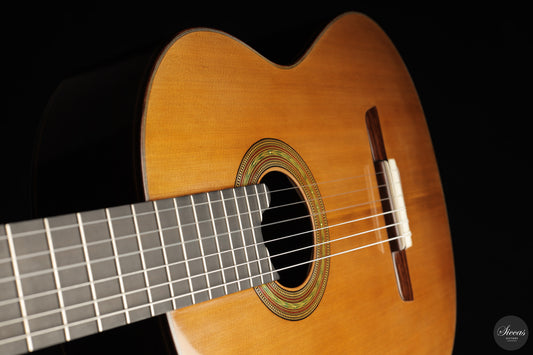
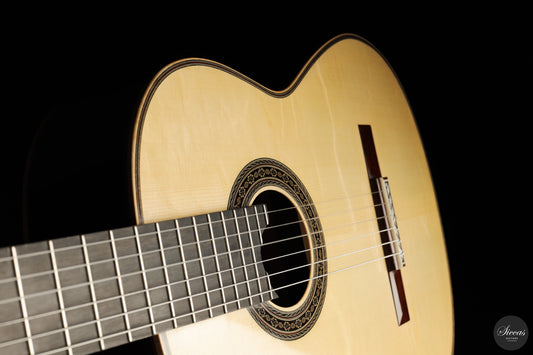
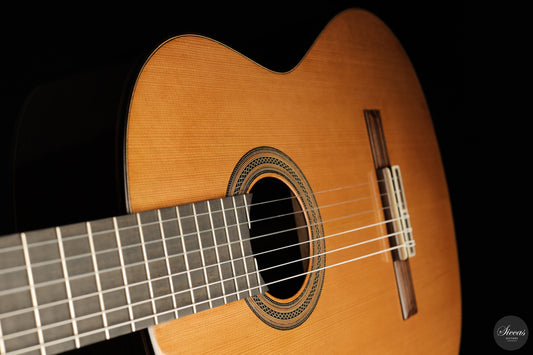
His primary construction approach relies on fan bracing, though he insists that the placement of the braces is only a starting point. What matters is the precise adjustment of angles, heights, and layout relative to each individual top — because, as he explains, bracing controls how energy spreads across the soundboard, and every piece of wood behaves differently. He works with spruce and cedar tops, selecting each plate for its tap-tone characteristics before committing to a build. Back and sides are typically Indian rosewood, though he has also worked with other tonewoods including Brazilian rosewood for special editions.
For his double-top instruments, de Gregorio uses two very thin outer layers — usually spruce or cedar — bonded to a Nomex honeycomb core. The goal is a top that achieves flexible responsiveness with structural stability: the Nomex absorbs compression while the outer skins carry vibrational energy across the surface with unusual efficiency. The result is an instrument capable of impressive dynamic range and projection without sacrificing the warmth and singing sustain that distinguish great concert guitars. Those curious about the broader development of this construction method can explore the story of double-top guitar pioneers.
The REG Series: Collaboration with Romano Gambacorta
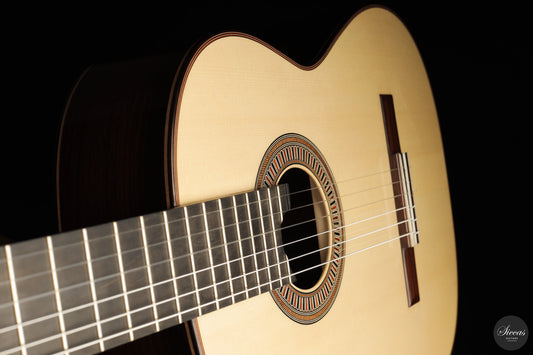
One of the most distinctive strands of de Gregorio's recent work is his ongoing collaboration with fellow Roman luthier Romano Gambacorta, which has produced the REG Limited Edition series. These instruments — the initials standing for Romano, Eduardo (a shared workshop reference), and Gambacorta — bring together two complementary sensibilities: de Gregorio's lightweight, flexible approach to top construction and Gambacorta's meticulous attention to tonal projection and clarity. The guitars are built using carefully selected Alpine spruce tops and, in certain editions, Brazilian rosewood back and sides, with a hybrid bracing system that integrates elements of both makers' individual techniques.
The REG series is explicitly limited in production, with each instrument numbered within its edition year. This scarcity is not a marketing device but a reflection of the time and attention each guitar demands. Collectors and professionals alike have taken note: the series represents one of the more interesting experiments in collaborative lutherie currently underway in Italy, echoing in some ways the spirit behind the remarkable Italica project, in which twenty Italian master luthiers united around a single instrument.
Recognition and the Italian Context
In 2016, de Gregorio was awarded the historic "La Ruota d'Oro" prize by the Rotary Club of Rome, recognising his significant contribution to the enhancement of Italian artistic craftsmanship. The award reflects how his work is perceived not only within the specialist world of lutherie but also in the broader cultural life of the city where he was born and continues to work. Rome has historically been a hub for Italian guitar culture, and de Gregorio is one of the figures helping sustain that tradition into the present.
His instruments have reached players across Europe and beyond, finding homes with serious amateurs and professionals who value the combination of tonal sophistication and physical ease that distinguishes his work. The guitars are consistently described as responsive and effortless to play — a quality that de Gregorio, as a former performer himself, identifies as the essential criterion of a successful instrument. He has spoken about the difference between a guitar that requires a player to work against it and one that amplifies even small gestures, and it is clear that he builds with the second ideal firmly in mind. This concern for the performer's experience connects his approach to the traditions of makers such as José Luis Romanillos, who similarly understood lutherie as a form of service to the musician.
Legacy in Progress
Leonardo de Gregorio is a maker still in the middle of his career, and the full arc of his contribution to classical guitar lutherie remains to be written. What is already clear is that his instruments stand comfortably within the lineage of the great European classical guitar makers — drawing on the lessons of fan-braced and double-top construction while adding his own voice to a conversation that stretches back to Torres and beyond. The combination of serious musical training, deep engagement with Italian craft tradition, and a willingness to collaborate and experiment makes him one of the more compelling figures in contemporary lutherie.
Browse available Leonardo de Gregorio guitars → in the Siccas Guitars collection.