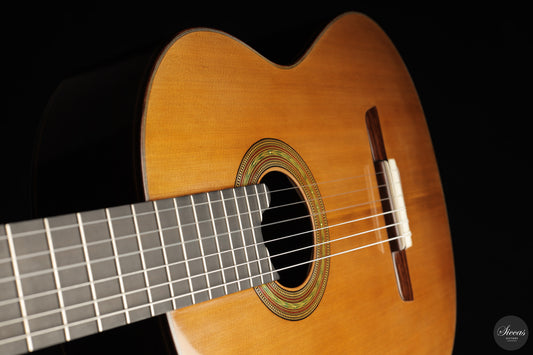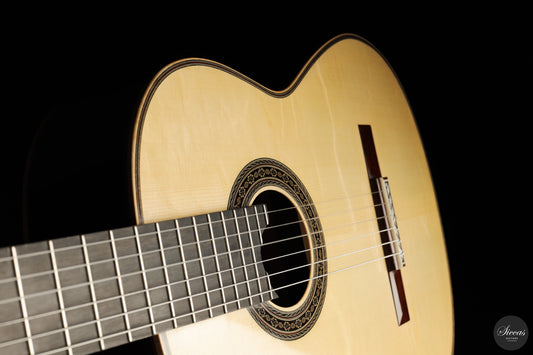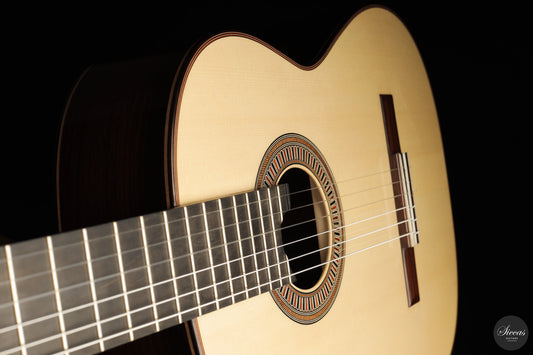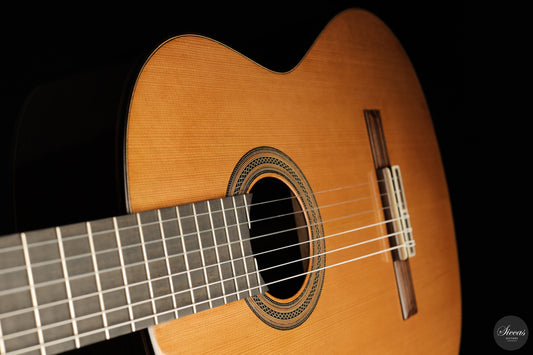

Among the foremost classical guitar makers working in Germany today, Michel Brück occupies a singular position. Born in 1965 into a family with three generations of woodworking craftsmen, he grew up with an instinctive feel for timber and the patience that fine instrument-making demands. His guitars — above all his celebrated double-top models — are so consistently in demand worldwide that buyers routinely wait up to ten years from the moment of ordering before the instrument reaches their hands. That waiting list is not a curiosity; it is a testament to the level of trust the international concert and collector communities have placed in his work.
Biography & Training
Brück discovered his passion for the classical guitar at sixteen. His parents supported his early musical education, and he went on to receive formal training at the Justus-Liebig University in Giessen, where he deepened both his theoretical understanding of acoustics and his practical sensitivity to the instrument. The transition from enthusiast to maker came in 1986, when he began a full apprenticeship as a luthier. Three years later, in 1989, he built a guitar under the direct mentorship of José Luis Romanillos — the Spanish master whose instruments and writings have shaped a generation of European makers. Brück has spoken warmly of the impression that experience left on him, describing it as formative both technically and philosophically.
By 1991 he had established his own independent workshop in Königsberg, a historic small town in Bavaria. Working there in relative quietude, he spent the early years of his career studying the great historical instruments — the guitars of Antonio de Torres, Santos Hernández, and Hermann Hauser I — and building in those traditional styles. His stated ambition during this period was to understand what gave old European guitars their distinctive warmth and singing character before attempting anything new.
Construction Philosophy
At the heart of Brück's approach is a desire to reconcile two worlds that are sometimes presented as opposites: the tonal character of old European instruments and the projection and dynamic range demanded by the modern concert stage. He has described his goal as achieving "a fusion of old and new — the unique tonal quality of old European guitars in combination with the power and dynamics of an outstanding, new technique." This is not a purely rhetorical ambition; it shapes every decision he makes at the workbench, from wood selection to bracing geometry.
After the turn of the millennium, Brück became increasingly drawn to the possibilities of double-top construction. The technique — in which two thin layers of tonewoods sandwich a core of Nomex or similar composite material — allows a maker to create a soundboard that is both lighter and stiffer than a conventional top, opening up a wider dynamic range and greater sensitivity. Brück's adoption of this method was not a sudden pivot but a gradual process of experimentation, always anchored in the traditional values he had absorbed from his Torres and Hauser studies. For a broader overview of how this technology developed in the hands of different makers, see our guide to fan-braced, double-top and lattice guitars.
The tonal signature Brück pursues is one of balance and depth: choir-like basses, full round singing trebles, and a warmth in the midrange that connects both registers. He favours combinations of cedar or spruce tops with East Indian or Brazilian rosewood backs and sides, and works across scale lengths typically ranging from 63.5 cm to 65 cm, allowing him to tailor an instrument to the physical needs and musical preferences of individual players. He hand-makes approximately one guitar per month, a pace that reflects both the care invested in each instrument and the reason his order book extends so far into the future.
Relationship with the Tradition
To understand Brück's place in the broader landscape of classical guitar making, it helps to trace the lineage he belongs to. His time building under Romanillos connected him directly to a tradition that runs back through the Spanish school — through Robert Bouchet and the Parisian masters, and further still to Torres himself. Yet Brück did not simply replicate what he had learned. The German workshop tradition, with its emphasis on structural precision and reproducibility, inflected his practice in ways that distinguish his instruments from purely Spanish-lineage guitars. This synthesis — Mediterranean warmth filtered through central European craft rigour — is one of the qualities that players and collectors find so compelling in his work.
His engagement with double-top technology also places him in conversation with other German and European makers who have pushed the technique forward. The double-top guitar pioneers Matthias Dammann and Gernot Wagner were among the first to demonstrate what the construction could achieve at the highest concert level, and Brück's subsequent work has contributed further evidence of the technique's expressive range.
Signature Models and Materials
Brück does not produce named model lines in the commercial sense. Each guitar is numbered and conceived as an individual instrument, with the choice of tonewoods, scale length, and bracing pattern discussed directly with the client. His instruments are built entirely by hand in his Karlsruhe workshop, with no subcontracting of components. The cedar-topped models tend toward a darker, more immediately responsive sound — warmth and depth from the first note — while his spruce-topped guitars often offer a broader dynamic range that opens further with playing time. Both variants share the transparency and singing sustain that are the hallmarks of his mature style.
The numbered series, which had reached instrument 197 by 2016 and continued into the high 200s in subsequent years, gives some sense of the pace and consistency of his output. Players who acquire a Brück guitar typically describe a sense of effortless projection combined with an intimacy of tone that makes the instrument rewarding both on stage and in the practice room.
Legacy and Standing
Michel Brück is widely regarded as one of the finest active luthiers in Germany and among the most significant European classical guitar makers of his generation. The combination of a deep historical grounding — reaching back through Romanillos to the Spanish roots of the instrument — and a thoughtful engagement with modern double-top construction has produced a body of work that speaks to players at every level. The decade-long waiting lists his instruments command are unusual even in a field where fine makers are always in demand, and they reflect a reputation built entirely on the quality of what leaves his workshop.
For a dealer committed to representing the world's finest makers, Brück's instruments are a natural and important part of the inventory. His guitars invite comparison with the great names of the twentieth century while remaining distinctly his own — instruments of substance, warmth, and rare musical intelligence.
Browse available Michel Bruck guitars → in the Siccas Guitars collection.