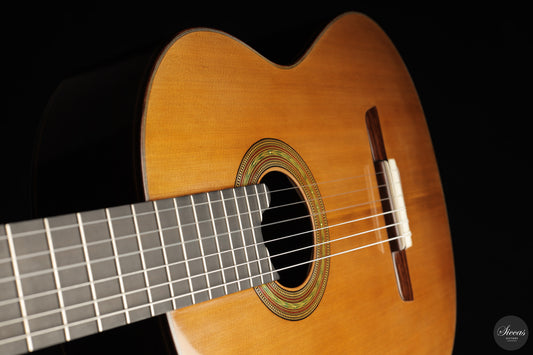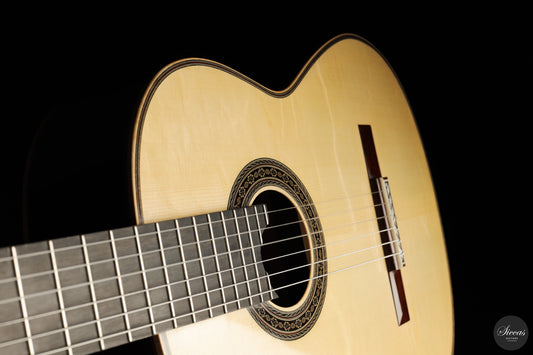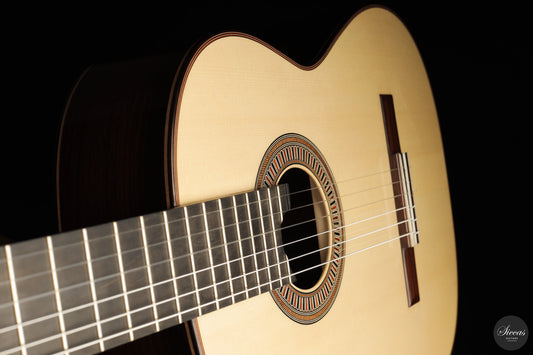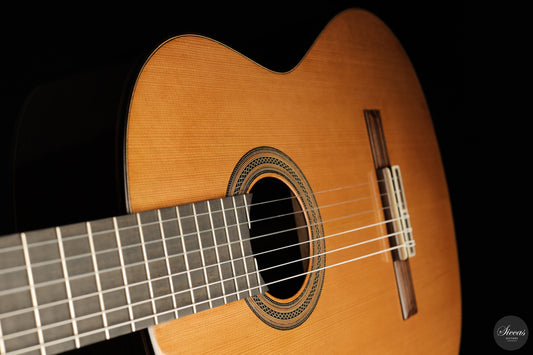

Michele Della Giustina is one of Italy's most quietly distinguished classical guitar makers — a craftsman who has spent more than three decades refining an approach that draws equally from the traditions of the great masters and the acoustic demands of the modern concert stage. Born in Vittorio Veneto in 1962 and now working from a forest house in the mountain province of Belluno in the Veneto region, Della Giustina has built over 420 instruments that have found their way into the hands of musicians across four continents. His is a practice shaped by patient material selection, deep acoustic knowledge, and a genuine philosophical commitment to the idea that a guitar's inherent limitations are precisely what give it its charm.
Biography and Training
Della Giustina's path into lutherie was not the conventional one. He graduated with a degree in classical guitar performance from the Udine Conservatory in 1990, giving him a performer's understanding of what a concert instrument must deliver before he had made a single one himself. He began crafting guitars professionally in 1991, guided in his earliest work by Maestro Carlo Raspagni, whom he credits as his first and most formative mentor. That foundation in playing informed everything that followed: Della Giustina has always built instruments from the perspective of someone who understands how a guitar feels in the hands as well as how it sounds in a hall.
A pivotal encounter followed when Della Giustina met the distinguished Japanese luthier Kazuo Sato. The connection opened doors to the Niibori Guitar Music Academy in Tokyo, one of Japan's most prestigious guitar institutions, and led to a lasting collaboration that brought his work to a new audience. In 2003 he was invited to present a conference on guitar making at the Academy's Tokyo headquarters, and he later mentored a Japanese student, Hiroyuki Arai, in his Belluno workshop. The relationship with Japan — a country that has long held Italian craftsmanship in the highest regard — became one of the defining threads of his international career, and his instruments are today among the most sought-after by Japanese concert guitarists.
His international presence continued to grow throughout the 2000s. He appeared at Guitar Foundation of America Conventions in Montreal in 2004 and in Columbus-Atlanta in 2006, where he was introduced to the East Coast guitar community in part through the efforts of NBC journalist Ramon Zayas. In 2007 he traveled to China as a guest of Maestro Danny Yeh, presenting a conference on lutherie at the Shanghai Conservatory during the Quindao Guitar Festival. In 2023 he was honored as a guest speaker at the National Music Institute in Krakow, Poland, during an event dedicated to the classical guitar — a recognition of a reputation that had, by then, spread well beyond Italy's borders.
Construction Philosophy
At the heart of Della Giustina's approach is a conviction that the luthier's primary task is to understand wood — not merely to work with it. He personally selects and cuts Latemar Spruce from the Nova Levante forestry station in the Dolomites, then allows the timber to age naturally for several years before incorporating it into a guitar. This patience with materials is not incidental to his method; it is the method. The tonal identity of a Della Giustina instrument begins in the forest, long before a single joint is glued.
His stated philosophy is to combine traditional methods with an awareness of what the modern concert stage demands. He draws inspiration from the study of past master luthiers — figures whose work he regards as essential reference points — while resisting any nostalgic desire simply to replicate what came before. This places him in a lineage that connects to the great European tradition of classical guitar makers, while maintaining a distinctly contemporary voice. He pursues, as he has put it himself, "a modern sound" that remains "balanced, avoiding extremes." He believes that the charm of the guitar lies in its inherent limitations, and that the luthier's art is in working within those limits to achieve something that transcends them.
For those interested in how different bracing and construction approaches shape an instrument's voice, Della Giustina's work sits in productive dialogue with the broader conversation around fan-braced, double-top, and lattice construction. His double-top models — such as the instrument available in the Siccas Guitars collection — represent his engagement with contemporary building techniques applied to a distinctly Italian tonal sensibility.
Signature Models and Materials
Della Giustina builds across several distinct concepts, each reflecting a different aspect of his tonal thinking. His primary concert instruments use carefully aged Latemar Spruce tops with traditional tonewoods for the back and sides, producing the balanced, projecting sound for which he is best known. A second line, which he describes as his "Italian concept," pairs spruce with maple — a combination that connects his work to Italy's deep tradition in stringed instrument making and produces a brighter, more immediate response with strong upper-partial definition.
He has also developed a more experimental direction: guitars featuring Sinker Cedar tops combined with Bog Oak back and sides. Sinker Cedar — timber recovered from riverbeds where it has lain submerged for decades or centuries — offers exceptional tonal maturity, while Bog Oak, similarly aged through submersion, brings a density and resonance that few conventional tonewoods can match. These instruments represent a bridge between the ancient and the modern that is entirely characteristic of Della Giustina's sensibility: materials with deep histories placed in service of contemporary concert demands.
His double-top guitars extend this philosophy further, combining the acoustic benefits of a composite soundboard construction with his personal approach to voicing and graduation. The result is an instrument capable of the dynamic range and projection that large concert halls require, while retaining the intimacy and nuance that make classical guitar playing compelling at close range. Luthiers working in this space, such as those profiled in our article on double-top guitar pioneers, share a commitment to material innovation in service of musical expression — and Della Giustina belongs squarely in that conversation.
Notable Players and International Reach
Over more than three decades, Della Giustina's guitars have reached musicians in Japan, the United States, China, South Korea, Taiwan, Vietnam, Colombia, Brazil, and across Europe. Among the guitarists known to play his instruments is the Slovenian concert guitarist Uroš Barič, who has written about the qualities of his Della Giustina guitar with evident affection. The breadth of that geographic distribution speaks to the universality of what his instruments offer: a tonal character that works across repertoires and playing styles, from Baroque transcriptions to contemporary concert works.
His instruments are handled by prestigious guitar salons worldwide, including Siccas Guitars, where his concert and double-top models are offered to players seeking the best of contemporary Italian lutherie. The connection between the Italian luthier tradition and the international concert world is also explored in our feature on the collaborative project Italica, which brought together twenty Italian master luthiers — a context that helps place Della Giustina's work within a broader national tradition of excellence.
Teaching and Legacy
Teaching has been a consistent thread throughout Della Giustina's working life. He has guided approximately twenty students in the construction of their own guitars within his Belluno workshop, transmitting not only practical skills but the underlying philosophy of patient, material-conscious lutherie that defines his own practice. Since 2014 he has also served as curator of "El Siglo de Oro de la Guitarra Española," an antique guitar collection owned by GuitArt Magazine — a role that connects his contemporary work to the historical instruments that, studied carefully, reveal the deepest truths about how a classical guitar is meant to sound and respond.
The legacy of Michele Della Giustina is still being written. With more than 420 instruments distributed across the world, a teaching practice that ensures his methods will outlast him, and an ongoing engagement with new materials and techniques, he represents Italian lutherie at its most considered and most alive. His work stands as evidence that the classical guitar is not a finished instrument — that there remains, in the hands of makers willing to do the work, real discovery still to be made.
The broader context of his achievement can be appreciated alongside the work of other modern European masters. Articles on Daniel Friederich and José Luis Romanillos illuminate the tradition within which Della Giustina is working — and the standard against which his instruments can be measured.
Browse available Michele Della Giustina guitars → in the Siccas Guitars collection.