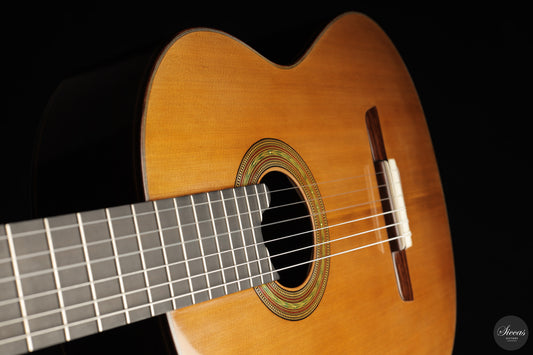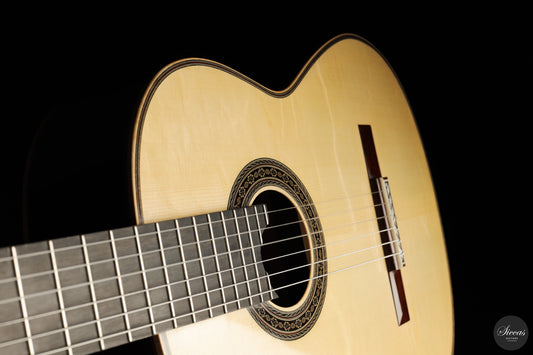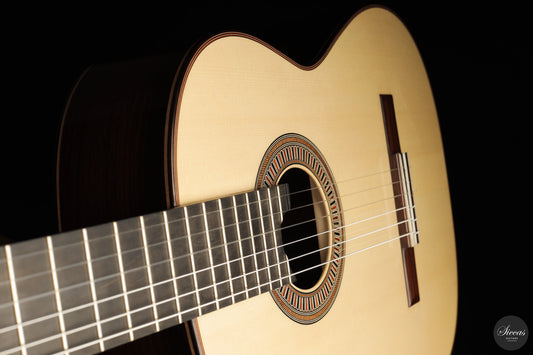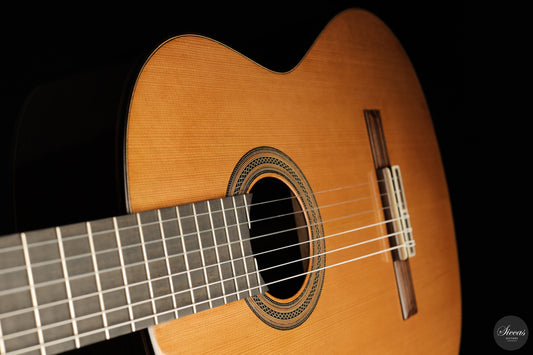

Mirko Migliorini – Italian Luthier Bridging Tradition and Acoustic Science
Mirko Migliorini is one of Italy's most distinctive voices in contemporary classical guitar making — a craftsman whose instruments are shaped as much by physics and acoustical measurement as by the centuries-old Spanish tradition he reveres. Working from his workshop in Airuno, a small town in the Lecco province of northern Italy, Migliorini has spent more than two decades building concert guitars that are immediately recognisable for their intensity of sound, their dynamic range, and the precision that underpins every constructional decision. His career is a rare example of a luthier who refuses to separate hand skill from scientific rigour.
Formation and Early Years
Migliorini's path to lutherie began at the age of sixteen, when an encounter with a fine instrument set him on a course he has never abandoned. That early passion led him to Milan's Civica Scuola di Liuteria, one of the most respected lutherie schools in the world, where he completed his formal training in 2002. The school gave him a foundation in classical construction methods, but Migliorini supplemented his studies by attending workshops with established luthiers and by hands-on work restoring and studying historic instruments. In his own account, handling masterpieces by Torres, Hauser, Bouchet, Fleta, Guadagnini, Panormo, and Romanillos taught him things that no classroom could replicate — the way historic makers solved acoustic problems through intuition that he could now interrogate through measurement. He launched his professional career in 2001, even before his formal graduation, and began teaching lutherie in 2015, passing on a discipline that had defined his adult life.
Construction Philosophy and the Role of Science
What separates Migliorini from many of his contemporaries is a thoroughgoing commitment to acoustic physics as a guide to every constructional choice. He employs modal analysis and frequency response measurements throughout the building process, treating each millimetre of the soundboard not as a matter of feel or habit but as a variable with calculable acoustic consequences. This does not mean his guitars sound clinical — on the contrary, his stated ambition has always been to build instruments with a personal, recognisable voice, one characterised by intensity, immediacy of response, balance across all registers, and the ability to support the performer under concert conditions. The science, in his view, is simply the most reliable path to that expressive goal.
His material choices reflect the same dual allegiance to tradition and innovation. For soundboards he works with Italian spruce from Val di Fiemme — the same region that supplied tone wood to Stradivari — as well as Swiss and German spruce and high-quality Canadian cedar. Back and sides are built from Indian and Ceylonese rosewood, Honduran mahogany, and, for a select number of instruments, stocks of Brazilian rosewood aged up to fifty years. All his tonewoods are seasoned for between fifteen and fifty years before use. For his double-top models he incorporates Nomex, the aramid-fibre honeycomb material first developed for the aerospace industry. By sandwiching a Nomex core between two thin cedar or spruce skins, he achieves a soundboard that is lighter and more flexible than solid wood while retaining stiffness in the directions that matter acoustically — a technique explored by a number of double-top guitar pioneers and one that Migliorini has made distinctively his own. His fan-bracing layouts and Spanish-style neck joint place him clearly within the Iberian tradition, even as his workshop methods extend well beyond it. Those curious about how these structural choices compare across the field of contemporary making will find useful context in the broader survey of fan-braced, double-top, and lattice guitars.
Models and the Single Concert Concept
Migliorini builds to a single concert model — a considered decision that reflects his conviction that a luthier's voice is most clearly expressed through depth of refinement rather than breadth of output. Within that one model, however, he offers a meaningful range of choices in tonewoods, bracing geometry, and finish so that each guitar becomes a collaboration between maker and player. The result is an instrument that is unmistakably a Migliorini — balanced, immediate, rich in overtones — yet tailored to an individual performer's needs and preferences. His numbered series, which has run through more than four hundred instruments, provides a documented record of that evolving conversation between maker, material, and musician. This kind of focused, single-model discipline has long been associated with the great Italian lutherie tradition, of which Migliorini is a proud inheritor; the collaborative spirit animating Italian guitar making more broadly is captured in the Italica project, which brought twenty Italian masters together around a single instrument.
Recognition and the Players Who Trust His Instruments
Migliorini's reputation has grown steadily through competition success, institutional recognition, and the endorsement of professional performers. In 2001, the year he completed his studies, he received Third Prize at the 5th International Guitar Making Competition of Baveno — an early signal that his work was already operating at an international standard. Two decades later, in 2021, he was awarded the prestigious Chitarra d'Oro (Golden Guitar) at the 26th International Guitar Conference of Milan, one of the most significant honours in Italian lutherie. His guitars have been played and sound-tested by Judicaël Perroy, the French virtuoso and 1997 Guitar Foundation of America competition winner, whose association with Migliorini's instruments speaks to their suitability for the highest levels of concert performance. Migliorini's workshop has also been featured by Homo Faber, the Michelangelo Foundation's platform for exceptional European craftsmanship, placing him within a broader cultural conversation about the role of hand skill and material intelligence in contemporary making.
Legacy and Place in Contemporary Lutherie
Migliorini belongs to a generation of Italian makers who have absorbed the lessons of the Spanish masters — the builders who shaped the modern classical guitar from Torres onwards — and returned them through the lens of northern Italian precision and scientific curiosity. His work is not a departure from tradition but a deepening of it: the same commitment to expressive sound that drove Daniel Friederich to reinvent bracing geometry in Paris, or that has led successive generations of makers to question every received assumption about how a soundboard should behave. What Migliorini adds to this lineage is a particular transparency of method — a willingness to explain, measure, and teach the principles behind his decisions — that makes his workshop in Airuno not only a site of production but a living argument for the union of art and science in the service of music.
Browse available Mirko Migliorini guitars → in the Siccas Guitars collection.