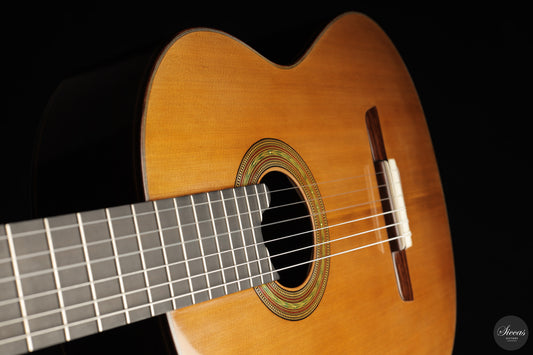
Pete Beer – Scottish Luthier and Pioneer of Sustainable Guitar Making
Pete Beer is one of Britain's most distinctive voices in contemporary classical guitar making — a craftsman who combines deep reverence for the classical tradition with an uncompromising commitment to environmental responsibility. Based in the village of Blairmore in Argyll, Scotland, Beer builds each instrument entirely by hand, one at a time, with a level of attention and integrity rarely matched in the modern workshop. His guitars have attracted serious players and collectors who value both their tonal authority and the principles behind their making.
From Glasgow Tenement to Argyll Workshop
Beer's path to lutherie began, as many do, with curiosity rather than a formal plan. His first attempt at building — a chambered electric guitar, assembled after work in his Glasgow tenement flat — was quickly ended by complaints from the neighbours below. The ambition, however, remained. In 2001 he enrolled at Clyde College in Glasgow, where he undertook a two-year Stringed Instrument Repair course, gaining the foundational skills that would define the next phase of his life. He went on to earn a first-class honours degree in Musical Instrument Technology from London Metropolitan University, graduating in 2006 with the academic grounding to match his practical instincts.
After his studies, Beer moved to Gloucestershire to open his first professional workshop, later relocating to Somerset before returning home to Argyll in 2014. He built his current workshop in Blairmore, a small village on the Cowal peninsula overlooking the Firth of Clyde — a setting that seems entirely in keeping with the quiet, unhurried seriousness of his approach to the craft. Since 2019, he has shared his knowledge as a part-time teacher at Glasgow Clyde College, passing on the same skills and values that shaped his own development.
Traditional Methods in a Modern Workshop
Beer describes his approach as broadly traditional, and the term is not an empty one. He works predominantly with hand tools, uses hide glue throughout, and finishes his instruments with French polish — a time-consuming technique that remains the gold standard among classical guitar makers for the way it allows the wood to vibrate freely. He even splits his braces rather than sawing them, following the grain of the timber to maximise stiffness and structural integrity. Every wooden component of each guitar is made by Beer himself; only the machine heads are bought in.
This devotion to craft extends to his choice of tonal systems. Beer is a committed advocate of the solid-topped, fan-braced guitar — the system refined by Antonio de Torres in the nineteenth century and carried forward by the great luthiers of the twentieth. He understands fan bracing not as a constraint but as a language, one capable of subtle and powerful expression through careful control of stiffness distribution, mass, neck angle, and the doming of the soundboard. His approach sits firmly within the lineage of classical guitar makers who regard the Torres tradition as the foundation rather than the ceiling.
The Concert Model and Friederich Influence
Beer's principal instrument is his Concert model, designed to meet the full demands of the contemporary performer. It is built for power and headroom — the capacity to absorb a wide dynamic range without breaking up — while remaining responsive across the entire register. The soundboard features asymmetric bracing, and the neck is constructed as a continuous piece extending to the soundhole, providing robust support in the upper register and contributing to the guitar's characteristic clarity and sustain.
A notable influence on Beer's construction philosophy is the work of Daniel Friederich, the French luthier whose innovations in guitar architecture helped define the modern concert instrument. Beer has adopted the technique of doubled sides — a feature associated with Friederich — which adds mass and resonance to the body while improving structural stability. He has also drawn on specific top thickness patterns developed in the Friederich tradition to enhance volume and projection. This dialogue between the Spanish classical tradition and the innovations of mid-twentieth-century French lutherie is one of the qualities that gives Beer's instruments their distinctive voice.
Beer also builds a Torres model based closely on the work of Antonio de Torres, working directly from the plan of SE114 — the guitar that belonged to Francisco Tárrega himself. It is a project that reveals much about Beer's instincts as a maker: the willingness to go back to the source, to understand what made the originals exceptional, and to bring that understanding forward into new instruments.
Sustainability and the Future of Tonewood
Perhaps the aspect of Pete Beer's work that has drawn the widest attention is his pioneering approach to sustainable tonewoods. He is believed to be the world's first luthier to have built nylon-stringed classical guitars — including a Torres model — with back and sides of Forest Stewardship Council certified African blackwood. The timber was sourced through the Sound and Fair Project, an initiative linking forest-dependent communities in Tanzania with musicians worldwide through a certified chain of custody.
Beer's assessment of African blackwood as a tonewood is unequivocal: in his view, it is among the finest replacements for Brazilian rosewood available to the contemporary maker. The material demands careful handling due to its exceptional hardness and density, but Beer argues that the sonic results — particularly the clarity, warmth, and sustain it lends to the instrument — more than justify the additional effort. His work in this area connects naturally to broader questions about material choices in contemporary guitar construction and the long-term viability of the tonewoods on which the instrument has historically depended.
This is not mere virtue signalling. Beer's commitment to FSC-certified materials reflects a deeper conviction that the making of fine instruments must be reconciled with responsible stewardship of the natural world. In an industry that has long depended on increasingly scarce tropical hardwoods, his work represents a serious and practical engagement with one of lutherie's most pressing challenges.
Legacy and Standing
Pete Beer occupies a distinctive position among contemporary British luthiers: a maker of uncompromising craft standards who has also pushed the boundaries of what responsible instrument-building can look like. His guitars are numbered sequentially — a quiet testament to the care invested in each one — and by the mid-2020s he had completed well over a hundred instruments. Each one is the product of a single maker working alone, at pace dictated by the wood and the work rather than by commercial pressure.
Among the generation of luthiers working today in Britain and further afield, Beer stands alongside makers who have found in the classical guitar tradition a framework both for technical mastery and for wider reflection on craft, materials, and responsibility. His dialogue with the makers who came before him — Torres, Friederich, and the broader tradition represented by figures such as Robert Bouchet — is carried forward not through imitation but through a thoughtful and deeply personal vision of what the classical guitar can be.
For players seeking an instrument built with rare integrity — one that carries the full weight of the classical tradition while pointing toward a more sustainable future for lutherie — a Pete Beer guitar represents one of the most compelling choices available from a British workshop today. His instruments are played by serious musicians who value tone, craftsmanship, and the knowledge that the materials in their hands were sourced with care for the communities and forests that produced them.
Browse available Pete Beer guitars → in the Siccas Guitars collection.