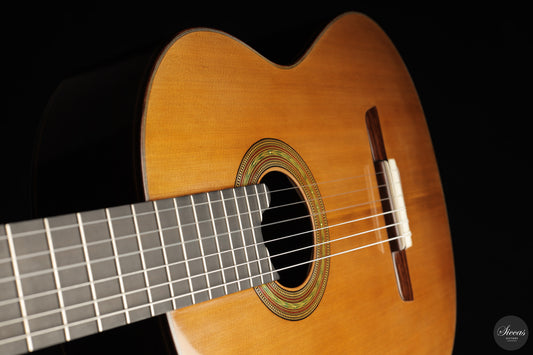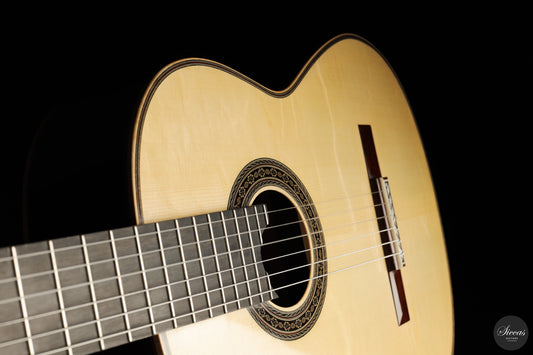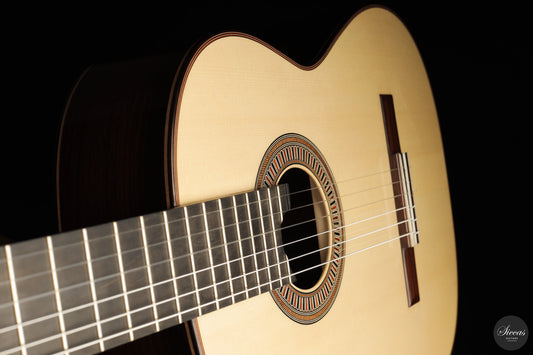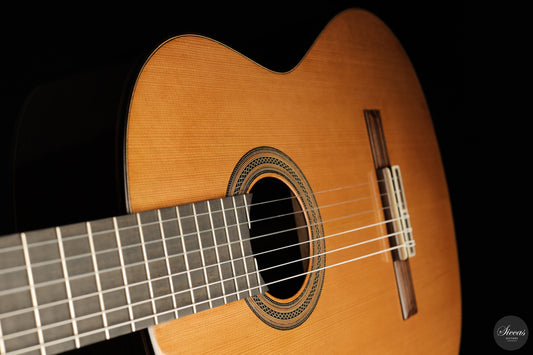

Simon Ambridge is one of Britain's most quietly celebrated classical guitar makers — a craftsman whose instruments are sought by discerning players around the world for their tonal purity, elegant construction, and deeply considered musicality. Working from a studio nestled within the Dartmoor National Park in Devon, southwest England, Ambridge builds only ten to twelve guitars per year, a deliberate choice that places quality at the absolute centre of his practice. His guitars have earned the admiration of players at the highest level, and his name is spoken with reverence among connoisseurs of the traditional Spanish-school instrument.
Biography & Training
Born in London in 1951, Simon Ambridge came from a family of cabinet makers whose roots in the craft stretch back to the eighteenth century. That ancestral connection to fine woodworking left its mark early: Ambridge grew up with an innate feel for timber and joinery that would later find its fullest expression in guitar building. He went on to study graphic design at the Bath Academy of Art and the Royal College of Art — a training in visual form and proportion that, looking back, seems almost perfectly suited to the design of musical instruments.
His interest in guitars began in the early 1960s, when the pop music boom was sweeping Britain and a cheap burgundy acoustic with f-holes was enough to spark a lifelong fascination. For many years, however, guitar making remained a passionate side interest alongside a successful furniture-making business in London. In 1978 he built his first acoustic guitar, modelled on a Martin 0045, and shortly afterwards constructed a small Torres-style classical with the guidance of Kevin Aram, who would himself go on to become a respected luthier. Yet it was a full decade before Ambridge could devote himself entirely to instrument making.
The turning point came with his move to Devon and the award of a setting-up grant from the Crafts Council of Great Britain — a selection made by a panel that included José Luis Romanillos, David Rubio, and Paul Fischer, three figures of enormous stature in British and international lutherie. In 1991 he received further recognition through awards from the David Canter Memorial Fund and Southwest Arts. By 1995 he had established his workshop on the Dartington estate in South Devon, home to the internationally renowned Dartington Summer School — an environment where music, craft, and artistic ambition are woven together in the landscape itself.
Construction Philosophy
Ambridge's approach to guitar building is rooted in a deep study of the great historical instruments that defined the classical guitar's voice. His primary inspirations are Antonio de Torres, Santos Hernández, and Hermann Hauser I — makers whose instruments set the standard for power, balance, and singing tone across more than a century of concert performance. Like these forebears, he works with fan bracing derived from the Torres system, carefully tuning the top's vibrational response to produce a strong fundamental and full-bodied projection.
One of the defining convictions of his craft is that loudness and projection are not the same thing. As Ambridge has noted, guitars that sound particularly loud in the room do not always carry well in a concert hall. He aims instead for an instrument with a natural, unforced projection — one that fills the space without strain and that rewards a player's musical sensitivity rather than merely their physical power. This philosophy places him firmly in the tradition of classical guitar makers for whom the concert hall, and not the workshop, is the ultimate testing ground.
His soundboards are typically European spruce, with backs and sides of Brazilian or Indian rosewood, and occasionally flamed or bird's-eye maple for players with particular tonal preferences. Necks are made from South American mahogany or cedar, and the finish throughout is French polish using Luna pale shellac — a choice that keeps the wood's own voice alive and unencumbered. Fingerboards are of ebony, often tapered on the bass side to suit individual players, and frets are cut with computer-aided precision for absolute accuracy across the neck. The bridge uses a twelve-hole tying system that ensures a consistent break angle across all strings, contributing to the evenness of response for which his instruments are known.
Every guitar Ambridge builds is customised to the requirements of its player. Fingerboard width, neck profile, string spacing, and scale length can all be adjusted, and optional features such as a twentieth fret or a radiused fingerboard are available on request. In this respect his practice belongs to a tradition of intimate, player-centred lutherie that has always distinguished the finest makers from the broader range of classical guitar construction.
Signature Models
Ambridge builds primarily in three distinct models, each tracing a different lineage within the classical guitar's history. His Concert Guitar draws on Torres, Santos Hernández, and Hauser I, blending the warmth of the Spanish school with his own refinements of scale, bracing geometry, and tonal tuning. The Hauser Model is based directly on measurements he took in 2008 from a 1940 Hauser I guitar — one of the most revered instruments of the twentieth century — and is designed for tuning to E or E-flat, making it particularly suited to the concert repertoire of that era. The Torres Model takes its inspiration from the research of José Luis Romanillos, whose definitive study of Torres guitars remains the essential scholarly reference for any maker working in that tradition.
Inlays on each instrument are individually handcrafted and vary from guitar to guitar, with wheat-sheaf herringbone purfling patterns that echo the decorative sensibility of Torres himself. The result is that no two Ambridge guitars are identical — each one is a distinct object made for a specific player at a specific moment, and bearing the subtle marks of that particular act of making.
Notable Players
Perhaps the most striking testament to Simon Ambridge's standing in the world of classical guitar is that the final guitar commissioned by Julian Bream — arguably the greatest British classical guitarist of the twentieth century — was an Ambridge. That a musician of Bream's stature and discernment should turn to a Devon workshop for his last commissioned instrument is a mark of exceptional artistic recognition. The guitarist and educator John Mills also played an Ambridge guitar, on loan for a recital — a further indication of the esteem in which these instruments are held by professionals at the highest level.
leading specialists whose director described Ambridge as "a connoisseur's guitar maker" building "one of the most sublime traditionally braced classical guitars in the world today," has handled his instruments for international buyers across North and South America, Europe, Asia, and Australia. That international reach, from a small workshop producing barely a dozen guitars a year, is a measure of the reputation these instruments have earned on their own terms.
Legacy
Simon Ambridge represents a strand of British lutherie that is both rare and quietly influential: the independent, traditionally schooled maker who works outside the main centres of guitar-making commerce, producing a small number of instruments of the very highest quality each year. His guitars do not chase fashion or novelty. They are rooted in the Spanish tradition, informed by decades of study and practice, and shaped by a philosophy that places musicality — and the player's needs — above all other considerations.
In this he stands alongside the great independent makers of his generation, practitioners for whom the craft itself is the point and for whom each guitar is a considered, individual act of making. Makers such as Daniel Friederich in France and Robert Bouchet before him worked in the same spirit: slowly, carefully, with complete attention to the instrument in hand. Ambridge's guitars, built in a studio within Dartmoor National Park and finished in French polish by hand, carry that same spirit into contemporary practice — and into the hands of players who know exactly what they are holding.
Browse available Simon Ambridge guitars → in the Siccas Guitars collection.