Yunah Park is one of the most quietly remarkable figures in the contemporary classical guitar world — a South Korean luthier working out of a small workshop in Madrid's Malasaña neighbourhood, producing handmade concert instruments in the purest tradition of the great Spanish guitar makers. She is believed to be the only Korean woman in the world who earns her living making classical Spanish guitars, and her instruments have earned the attention of musicians and collectors who prize both their tonal depth and their exquisite craftsmanship. Her story is one of dedication, displacement, and a profound love for the guitar that ultimately led her away from the stage and toward the workbench.
Biography & Training
Yunah Park was born and raised in Seoul, South Korea, where she first took up the guitar at the age of sixteen. What began as a passion grew into a serious vocation: she went on to complete a Bachelor's degree in classical guitar in Korea before accepting a scholarship that brought her to Santiago de Compostela in Spain. She later enrolled at the Conservatorio Superior de Música Óscar Esplá in Alicante, where she earned a second degree in classical guitar performance under the tutelage of guitarist Nacho Rodes.
It was during her years as a professional guitarist that Park began to develop a keen interest in the instruments themselves — an interest sharpened, in part, by her own experience of forearm injuries sustained through playing. She found herself drawn not only to the music a guitar could produce, but to the physical object itself: its construction, its resonance, the choices a maker makes that determine how an instrument will respond in a performer's hands. That curiosity would eventually reshape the course of her life entirely.
After settling in Madrid as a guitar teacher, Park sought out an apprenticeship in lutherie — no easy task in a craft that has always jealously guarded its traditions. She eventually found her mentor in Ángel Benito Aguado, a master luthier of the Madrid school who was looking for an apprentice to carry on his knowledge before retirement. Under his guidance, Park entered a thorough and traditional formation: she began with instrument repair and restoration, progressed to historical study of the great Spanish guitar-making systems, and worked through the design of original plans and templates before building her first complete instrument under the maestro's watchful eye. That first guitar was built in the most traditional Spanish style — a clear statement of intent from a maker who would remain faithful to those roots throughout her career.
Construction Philosophy
Yunah Park's approach to guitar making is grounded in the classical Spanish tradition, but it is never merely imitative. Her stated aim is to combine the characteristic colour and warmth of historic Spanish guitars with the ergonomic demands of the modern performer: comfortable fingerboards, deep and projecting basses, and a treble range that is bright without being brittle, flexible enough to phrase with nuance on the concert stage. She works exclusively with natural wood — no synthetic materials feature in any of her instruments — and every component of each guitar is shaped and finished by her own hands.
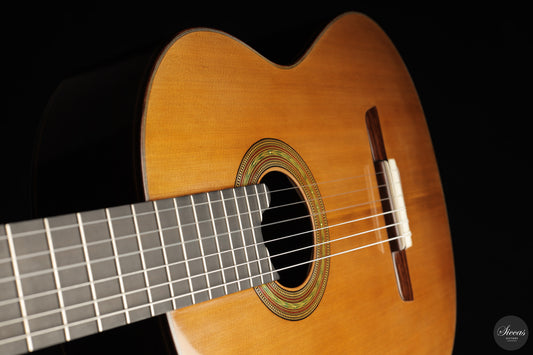
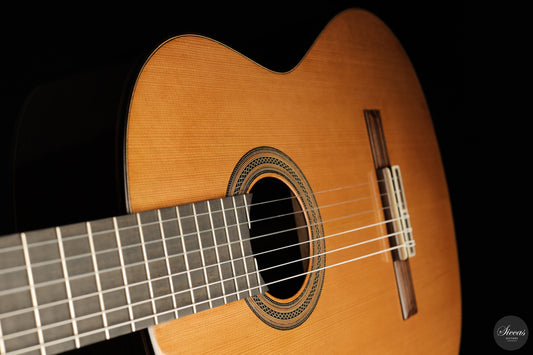
Park produces only eight or nine guitars each year. Each instrument takes between two and a half and three months to complete, from the selection of tonewoods through to the final coat of French polish. The woods she chooses are evaluated not only for their acoustic properties — elasticity, resonance, responsiveness to the player's touch — but also for their visual beauty, since she considers the aesthetic dimension of an instrument inseparable from its musical integrity. Her 2025 concert model, for example, features a cedar top over Indian rosewood back and sides, a 650 mm scale, 52 mm nut width, and Kris Barnett tuners, finished in French polish — a specification that places it firmly within the lineage of great Madrid concert guitars while delivering the projection and tonal clarity that today's performers require. Her guitars are noted for their air body frequency tuning, their quick response to right-hand attack, and the far-reaching quality of their sound in larger venues.
She works in complete silence, believing that music in the workshop distracts from the intense concentration the craft demands. It is a small but telling detail: for Park, making a guitar is itself an act of listening.
For a broader understanding of the construction approaches that distinguish the finest classical instruments, the guide to fan-braced, double-top, and lattice guitars offers useful context on how different structural choices shape the sound a luthier ultimately achieves.
Signature Models
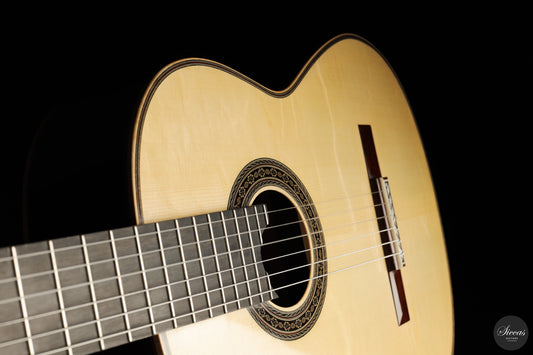
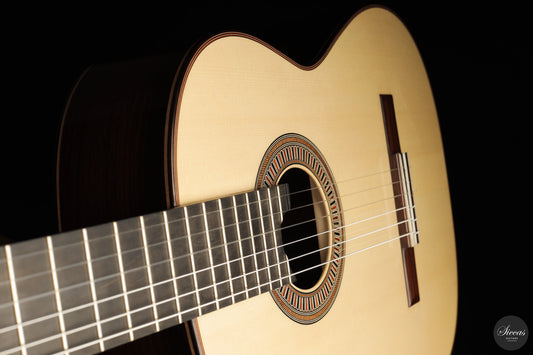
Park currently offers two principal concert models — one with a spruce top and one with a cedar top — alongside a historically informed model inspired by the great Madrid maker Santos Hernández, whose 1924 instruments remain among the most revered in the classical guitar canon. The Santos Hernández-inspired model reflects Park's deep engagement with the history of Spanish guitar making and her conviction that the finest instruments of the early twentieth century still have much to teach contemporary builders.
Her concert models are built to professional specifications and are designed to meet the demands of the international recital stage: sufficient volume and projection to hold a large hall without amplification, tonal balance across all registers, and the kind of immediate responsiveness that allows a skilled performer to shape each phrase with precision. The distinctive double-sided construction that features in some of her models is said to enhance both projection and tonal clarity — an example of Park's willingness to investigate approaches that go beyond strict tradition when she is convinced they serve the instrument's musical purpose.
Notable Players & Recognition
Yunah Park's instruments have attracted the interest of musicians and collectors who seek guitars that combine historical authenticity with modern performance capability. Her guitars have appeared in the catalogues of respected dealers across Europe and are regularly acquired by professional performers. Park has spoken openly about her musical idol, the late Julian Bream — one of the towering figures of the twentieth-century classical guitar — and has said that, if she could choose one person to have played one of her instruments, it would have been him. That aspiration speaks to the seriousness of her artistic ambitions and the company in which she believes her guitars belong.
Her presence in Madrid's Malasaña neighbourhood — the same district where Ángel Benito Aguado taught her the craft — keeps alive a tradition of independent, workshop-based lutherie that is increasingly rare in an industry dominated by larger-scale production. The overview of classical guitar makers on this site offers a broader picture of the tradition within which Park has chosen to situate her work, a lineage that runs through figures such as Daniel Friederich and José Luis Romanillos.
Legacy
What makes Yunah Park's story so compelling is not simply the quality of her instruments — remarkable as that quality is — but the journey that produced them. She crossed continents, changed disciplines, overcame the barriers that have historically made lutherie an almost exclusively male and exclusively Spanish preserve, and established herself in the heart of Madrid as a maker whose work commands genuine respect. In doing so, she has expanded the boundaries of who can carry a tradition forward and demonstrated that the classical Spanish guitar is a living form, capable of being adopted and advanced by someone who came to it from the outside with open eyes and patient hands.
Her guitars stand as proof that deep engagement with tradition need not mean repetition: they honour the past while serving the present, and they are made by someone who understands, from her own experience as a performer, exactly what a guitarist needs when the stage lights go up. To learn more about how concert guitarists practice and the demands they place on their instruments is to understand why Park's particular combination of musicianship and craft is so valuable.
Browse available Yunah Park guitars → in the Siccas Guitars collection.