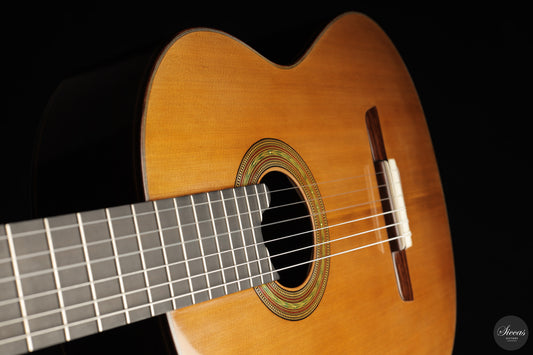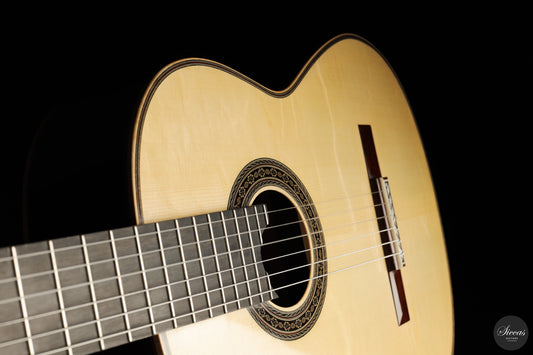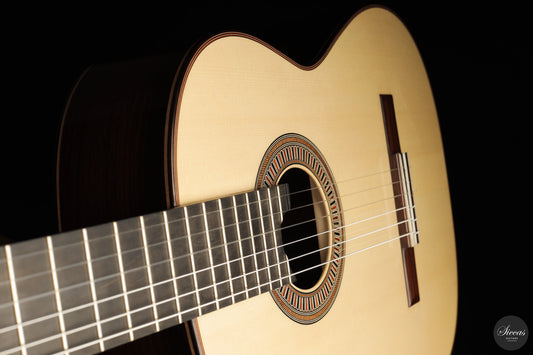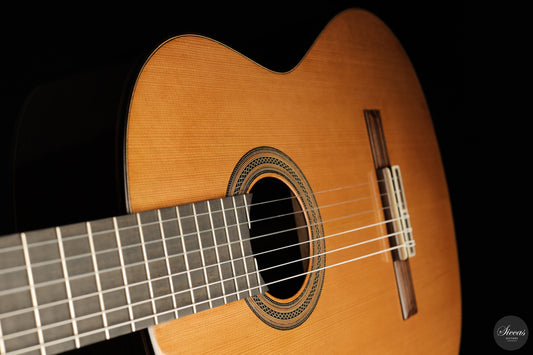

Astrid Mertens plays a piece by a composer whose name deserves to be far better known than it is: the Fantasía sobre el Paño, also called El punto de la Habana, by Julián Arcas. She performs it on a 2009 double-top guitar by Antonius Müller.
Julián Arcas – the link between Torres and Tárrega
Julián Arcas (1832–1882) occupies a position in guitar history that few players realise. He was a Spanish virtuoso who toured the country as a soloist and wrote more than fifty original works for the instrument alongside numerous transcriptions. But his importance runs deeper than his catalogue.
Arcas was one of the teachers of the young Francisco Tárrega in Barcelona in the second half of the 1860s — that is, he stood at the source of the tradition from which the entire modern Spanish school flows. And he worked directly with the luthier Antonio de Torres, influencing the design of the soundboards on the instruments that became the template for the modern classical guitar.
Both threads of the guitar as we know it — its repertoire and its physical form — pass through the same man. That is a rare thing, and it is why Arcas is worth more than a footnote.
About the Fantasía sobre el Paño
The Fantasía is built on a Spanish folk song that had unusual reach. The same melody was used by Manuel de Falla as El paño moruno, the opening number of his Siete canciones populares españolas, and it had already attracted Mikhail Glinka during his Spanish travels.
Arcas treats it in the nineteenth-century manner: theme and variations of increasing brilliance, with the folk melody surfacing again and again through the figuration. The habanera rhythm gives the piece its swing — the title's alternative name points to Havana, and to the constant traffic of music between Spain and Cuba in that century.
The Guitar: Antonius Müller, 2009
Antonius Müller is a German luthier whose double-top instruments are prized for combining modern power with a warm, traditional voice. The pairing is deliberate here: nineteenth-century Spanish repertoire on a modern concert instrument, which gives the variations more projection than any guitar Arcas himself would have played. Our double-top guitar guide explains what the construction contributes.
Watch the Performance
For more Spanish repertoire, explore our article on Francisco Tárrega and our overview of famous classical guitar pieces.