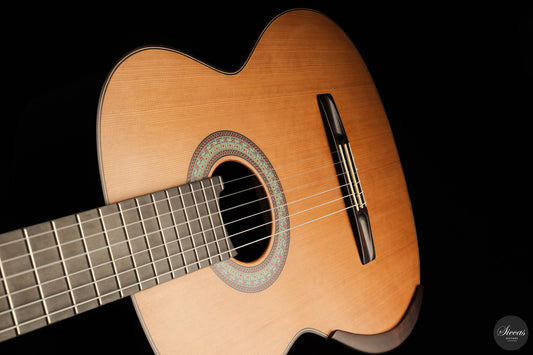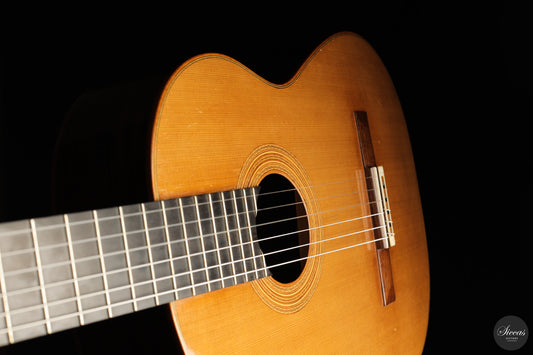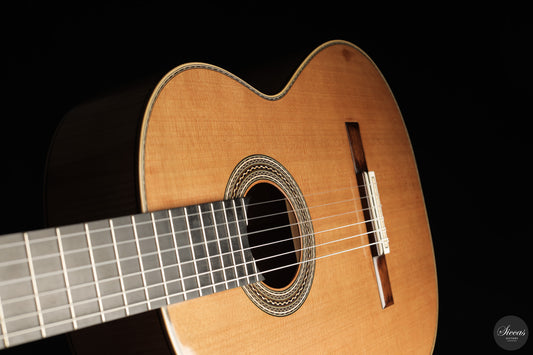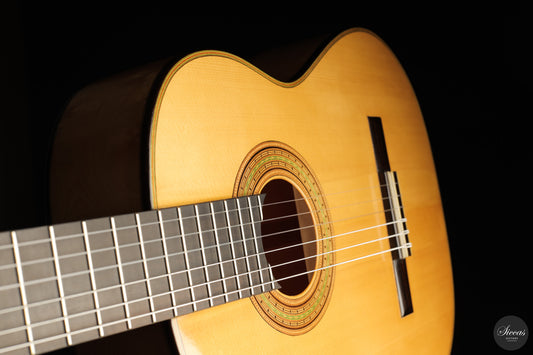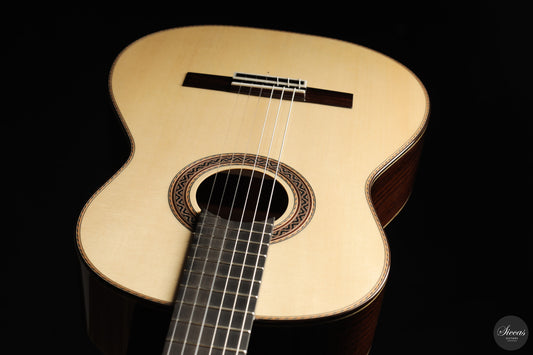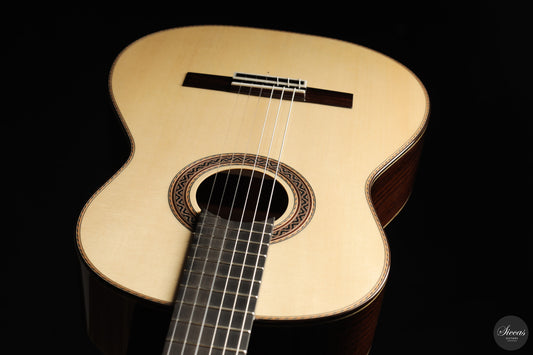

Paco Santiago Marín – Granada Master Luthier
The southern Spanish city of Granada has been synonymous with classical guitar building for well over a century. From the workshops tucked into narrow streets in the shadow of the Alhambra to the modern ateliers that carry that tradition into the twenty-first century, Granada luthiers have shaped the sound of the concert stage worldwide. Paco Santiago Marín stands squarely within that tradition — a craftsman whose instruments carry the warmth, resonance, and tonal depth that have made the Granada school a benchmark for players and collectors alike.
At Siccas Guitars we have had the pleasure of handling instruments by Paco Santiago Marín, and in this article we want to share what makes his work special: the lineage he draws on, the construction choices he makes, and why his guitars deserve serious attention from anyone searching for a concert-level Spanish instrument.
The Granada School of Guitar Making
To understand the instruments of Paco Santiago Marín it is necessary to understand the city that shaped him. Granada occupies a unique position in the history of the classical guitar. While Madrid and Seville each contributed important builders, it was Granada that crystallised a recognisable regional style — one defined by a particular approach to bracing, by the use of Spanish cedar and spruce in combination, and above all by a tonal aesthetic that prizes warmth, sustain, and a singing quality in the upper register.
The origins of the Granada school reach back into the nineteenth century, when craftsmen working in and around the Albaicín district began supplying guitars to the flamenco communities of Andalusia as well as to the emerging concert repertoire championed by figures such as Francisco Tárrega. By the mid-twentieth century, the tradition had deepened into something truly distinctive. Builders active in the city brought international attention to Granada's workshops and established the reputation that endures to this day.
What sets Granada guitars apart from the instruments associated with the Madrid school? The most frequently cited difference is structural. Granada builders traditionally use a solera — a slightly domed construction board — that imparts a gentle arch to the guitar top. This contrasts with the flatter tops more common in other traditions. The result, according to players who have spent time with both approaches, is a guitar that responds with particular immediacy to a light touch, producing complex overtones and a slightly darker fundamental tone. For the classical guitarist, these qualities translate into expressive flexibility: the same instrument can deliver intimate pianissimo passages with clarity and sustain while still projecting convincingly in a concert hall.
Paco Santiago Marín absorbed these principles as part of his formation as a luthier in the Granada area. His instruments reflect the school's values while incorporating the refinements that come from decades of practical experience building for professional players.
Craftsmanship and Construction
Building a concert-level classical guitar is an exercise in controlled compromise. Every decision — from the selection of tonewoods to the precise graduation of the top — involves trade-offs between different acoustic properties, and no two builders weigh those trade-offs in exactly the same way. What distinguishes a luthier of the calibre of Paco Santiago Marín is not adherence to a formula but rather the depth of understanding that allows him to make those decisions consistently and to adapt them to the specific requirements of each commission.
Experienced builders develop what might be called an acoustic intuition: an ability to assess a piece of wood by tapping it, flexing it, and listening to it, and to predict with considerable accuracy how it will behave once built into a guitar. This kind of knowledge cannot be taught in a classroom or learned from a book; it comes only from building many instruments over many years, paying close attention to the relationship between construction choices and tonal outcomes. Paco Santiago Marín's guitars reflect this accumulated knowledge at every stage of their making.
Tonewoods
The tonewoods used in a classical guitar are the primary determinants of its voice. For the soundboard — the single most important acoustic component — Paco Santiago Marín works with carefully selected spruce and cedar. European spruce, prized for its stiffness-to-weight ratio and its capacity to open up over time, produces a bright, articulate tone with strong projection. Cedar, softer and more immediately responsive, yields a warmer sound from the first note. The choice between the two is often a matter of the player's preference and playing context: spruce rewards players who want long-term tonal development; cedar suits those who need an instrument that responds generously from the outset.
For the back and sides, the traditional Granada choice has been cypress for flamenco instruments and rosewood for classical concert models. Rosewood contributes depth, sustain, and a complexity of harmonic content that has made it the default choice for serious concert work for generations. The combination of a spruce top with rosewood back and sides produces a guitar that is capable of the full dynamic and timbral range demanded by the concert repertoire, from the intimate voice-leading passages in a Renaissance fantasia to the orchestral textures of a Rodrigo concerto reduction.
The sourcing of tonewoods has become an increasingly complex matter for contemporary luthiers. Certain highly prized species are now subject to international trade restrictions, and responsible builders must navigate a regulatory landscape that requires careful documentation of the provenance of materials. Paco Santiago Marín, like other serious makers working in the Spanish tradition, sources his materials with care for both quality and sustainability.
Bracing and Internal Architecture
The bracing pattern — the arrangement of wooden struts glued to the underside of the soundboard — is perhaps the most consequential single decision a luthier makes. It determines how the top vibrates, how energy is distributed across the plate, and ultimately how the guitar projects and sustains. The traditional fan-bracing system associated with Antonio de Torres Jurado and refined by generations of Spanish builders remains the foundation of Paco Santiago Marín's approach. Within that framework, however, the specific geometry, height, and tapering of individual braces, as well as the placement of the harmonic bar below the soundhole, are points where a skilled luthier exercises considerable judgment.
Torres, working in the mid-nineteenth century, is generally credited with establishing the acoustic principles that underlie the modern classical guitar. His insight that a large, lightly-built top, supported by an appropriate fan-bracing pattern, was capable of producing exceptional projection and tonal richness set the template for virtually all subsequent Spanish guitar building. The challenge for later builders has been to work creatively within that template — to understand deeply why Torres's approach works and to build on that understanding rather than simply copying his designs.
The interaction between the bracing and the top graduation — the varying thickness of the soundboard across its surface — is what separates a merely competent instrument from a great one. Too stiff and the top resists the player's input; too flexible and it collapses dynamically under pressure. Paco Santiago Marín's experience building both classical and flamenco instruments has given him a particularly refined sense of this balance. Flamenco guitars, built for percussive attack and a dry, immediate response, demand a top that is more lightly built than its classical counterpart; classical instruments, optimised for sustain and tonal complexity, require a different set of tolerances. Moving between the two disciplines deepens a luthier's intuitive understanding of the acoustic principles involved.
Finishing and Detail Work
The finish on a classical guitar is not merely cosmetic. A heavy lacquer coat can damp the vibration of the top and back, robbing the instrument of resonance. Spanish luthiers have traditionally favoured French polish — a labour-intensive process involving the application of shellac dissolved in alcohol — precisely because it produces an extremely thin, hard surface that does not impede the wood's acoustic behaviour. The process requires many sessions of careful application, cutting back, and buffing, and it demands a controlled environment and considerable skill to execute well.
The results are visually distinctive: French-polished guitars have a depth and luminosity that synthetic lacquers rarely match, and the finish itself becomes part of the instrument's aesthetic identity. There is also a practical advantage: French polish can be repaired relatively easily by a skilled technician, whereas cracked or peeling synthetic finishes are considerably more difficult to restore without compromising the guitar's appearance.
Beyond the finish, the quality of a guitar is expressed in countless small decisions: the precision of the neck joint, the accuracy of the nut and saddle slotting, the consistency of the fret levelling, the quality of the tuning machines. These details collectively determine the instrument's playability — how easily it can be set up with low action, how stable it remains across changes in temperature and humidity, how reliably it holds its tuning. Paco Santiago Marín's instruments are notable for the care applied at every stage of construction, a quality that becomes evident the moment you pick one up and begin to play.
Classical and Flamenco Models
One of the distinguishing features of Paco Santiago Marín's workshop is the range of instruments he produces. While many luthiers specialise exclusively in either classical or flamenco guitars, Marín builds both, a practice that places him in a long Granada tradition of makers who understood the two forms as complementary rather than competing.
Classical Guitars
The classical guitars from the Marín workshop are designed for the full concert repertoire. They offer the projection, sustain, and tonal complexity that professional players require, together with the responsiveness to subtle dynamic variation that separates a great instrument from a merely capable one. Players working through the standard repertoire — from the Renaissance and Baroque transcriptions that open any serious study of the instrument to the major twentieth-century works by Rodrigo, Villa-Lobos, and Britten — will find in a Marín classical guitar an instrument capable of meeting every demand the music makes.
The tonal character of Marín's classical instruments aligns with the Granada aesthetic: warmth in the bass, clarity in the treble, and a balanced midrange that allows the inner voices of polyphonic writing to be clearly differentiated. These are not guitars that impose a single sonic personality on everything played through them; they respond to the player's intentions and adapt to the music at hand. This quality of musical intelligence is what the best Spanish luthiers have always aimed for, and it is what makes instruments from the Granada school so enduringly sought after by serious players.
For an overview of the historical repertoire these guitars are built to serve, see our article on famous classical guitar pieces.
Flamenco Guitars
The flamenco guitar is a different instrument in almost every respect that matters acoustically, yet it shares with the classical guitar the same basic architecture. Where the classical guitar prioritises sustain and tonal richness, the flamenco instrument demands immediacy, percussive attack, and a characteristic brightness that cuts through the sound of the dancer's feet and the singer's voice. Achieving this requires different construction choices: lighter tops, lower action, and often cypress rather than rosewood for the back and sides.
Paco Santiago Marín's flamenco instruments honour these requirements. They are built to be played hard, to respond instantly to a golpe or a picado run, and to produce the dry, focused tone that distinguishes authentic flamenco guitar sound from any other. At the same time, they carry the quality of construction and the attention to detail that characterises everything from the Marín workshop — these are not utility instruments but serious works of craft, as worthy of a performer's consideration as any classical model.
Browse our current selection of flamenco guitars at Siccas Guitars.
Paco Santiago Marín and the Spanish Lutherie Tradition
Spanish guitar building has never been a solitary enterprise. The great luthiers of the past two centuries worked within communities — in family workshops, in shared streets, in the informal networks of knowledge exchange that connected masters with apprentices and peers with peers. This social dimension of lutherie is part of what gives regional schools their coherence: the Granada style is recognisable precisely because knowledge, techniques, and aesthetic values were transmitted not just within individual workshops but across an entire community of makers over several generations.
Paco Santiago Marín is part of this living tradition. His work connects backward to the builders who established the Granada school's international reputation and forward to the players who will carry these instruments through the concert halls and recording studios of the coming decades. In this sense, every guitar he builds is simultaneously a personal artistic statement and a contribution to a collective cultural project that has been underway for well over a century.
The players who have defined the classical guitar repertoire — from Francisco Tárrega, whose transcriptions and original compositions established the instrument's concert credentials in the late nineteenth century, to Andrés Segovia, who brought it to the world's major stages in the twentieth — consistently relied on Spanish instruments. That tradition continues today. Read more about the great classical guitarists who have shaped the instrument's history.
Why Granada Luthiers Matter for Today's Players
The proliferation of factory-built classical guitars at various price points has made the instrument more accessible than ever before. This is genuinely good news for the classical guitar community: more players means more listeners, more teachers, and more demand for the concert repertoire. But as players advance and begin to demand more from their instruments, the question of lutherie quality becomes increasingly central.
A concert-level instrument by a skilled Spanish luthier like Paco Santiago Marín is not simply a better version of a factory guitar. It is a qualitatively different object, built with a different set of priorities and a different relationship to the player. Mass-produced instruments are designed to consistent specifications, optimised for the median player. A handmade guitar by a master luthier is built as an individual object, with decisions made in response to the specific characteristics of the tonewoods available and often in dialogue with the specific needs of the commissioning player.
The acoustic difference is real and significant. A well-made handmade guitar opens up tonally over years of playing; the resonance deepens, the projection increases, and the instrument seems to learn the player's touch. Factory instruments rarely develop in this way. For the serious student or the advancing player, the investment in a quality handmade guitar represents not just an improvement in immediate playability but a long-term relationship with an instrument that will grow with them.
If you are at the stage where you are considering your first serious instrument, read our guide to how long it takes to learn classical guitar and think about how an instrument of this quality might accelerate your development.
The Guitar as a Cultural Object
There is a dimension to the classical guitar that goes beyond acoustics and craft, and it is worth considering when thinking about instruments from the Granada tradition. The guitar — particularly the Spanish guitar in its flamenco and classical forms — is a cultural object as well as a musical one. It carries within it the history of the communities that produced it, the musical traditions that shaped its development, and the social contexts in which it has been played.
For Granada, this means a connection to the Moorish architectural heritage of the Alhambra, to the Romani communities of the Sacromonte whose flamenco traditions gave the instrument some of its most expressive techniques, and to the broader Andalusian culture that has long placed music at the centre of social life. A guitar built in Granada is not just an acoustic machine; it is an object that participates in a cultural conversation that stretches back centuries.
This is not mere romanticism. It has practical implications for the luthier's work. A maker who is embedded in a living cultural tradition brings to their instruments a set of references, aspirations, and aesthetic values that cannot be replicated by someone working outside that tradition. The best Granada guitars sound the way they do in part because of the musical culture that surrounds their making — the flamenco performances, the concert recitals, the informal gatherings where guitars are played and evaluated by people who have spent their lives listening to and playing these instruments.
Acquiring a Paco Santiago Marín Guitar
Instruments by Paco Santiago Marín are available at Siccas Guitars. Our team has examined and played every guitar we offer, and we are happy to provide detailed information about the specific tonal characteristics, playability, and condition of individual instruments. We can arrange video demonstrations for customers who are not able to visit us in person, and we work with players worldwide to ensure that the right instrument reaches the right hands.
When considering a guitar at this level, we encourage players to think carefully about their repertoire priorities, their preferred tonal balance, and the kind of playing context — studio, concert hall, teaching — in which the instrument will primarily be used. These factors all bear on which specific model and configuration will serve best, and our team is equipped to help navigate those questions.
Browse our full selection of classical guitars at Siccas Guitars, including instruments from leading Spanish and international luthiers.
The Role of the Luthier in the Classical Guitar World
It is worth pausing to consider what the luthier's role actually is in the broader ecology of classical guitar culture. The instrument-builder occupies a position that is at once technical, artistic, and historical. Technically, the luthier must master an enormous range of skills: woodworking, acoustics, finishing, hardware selection, and more. Artistically, the luthier must develop a personal voice — a set of aesthetic values and construction priorities that make their instruments recognisable as their own. Historically, the luthier is a custodian and transmitter of a tradition that stretches back centuries.
These three dimensions are not always easy to hold in balance. The pressure to produce instruments efficiently, the demands of a market that rewards certain tonal characteristics over others, the difficulty of sourcing traditional tonewoods as old-growth forests become scarcer — all of these create real tensions that serious luthiers must navigate. The fact that makers like Paco Santiago Marín continue to produce instruments of the highest quality within these constraints is a testament to the depth of their commitment to the craft.
The relationship between luthier and player is also worth noting. The best concert instruments are not produced in isolation; they emerge from a dialogue between the maker's knowledge and the player's needs. When a professional guitarist commissions an instrument, they bring specific requirements — a preference for a particular tonal balance, a need for a specific string length, a desire for a certain kind of response — and the luthier must translate those requirements into physical decisions about materials and construction. This collaborative dimension of lutherie is part of what makes it an art form as well as a craft.
Granada and the Living Legacy of Spanish Guitar Building
Granada today remains one of the world's most important centres for classical guitar building. The city supports a community of active luthiers working in a range of traditions, from strict adherence to nineteenth-century methods to more experimental approaches that incorporate new materials and construction techniques. What unites them is a shared commitment to acoustic excellence and to the values that have defined the Granada school since its emergence.
Visitors to Granada can explore this tradition directly. The city's instrument workshops, while not always open to casual visitors, are part of a broader cultural landscape that includes the Alhambra, the flamenco caves of the Sacromonte, and the living oral tradition of cante jondo. For the classical guitarist, a visit to Granada is an encounter with the source of an instrument that has shaped their musical life.
For those who cannot make the journey, the instruments that emerge from Granada workshops carry something of the city's character with them. A guitar by Paco Santiago Marín, wherever it is played — in a concert hall in Tokyo, a recording studio in New York, a teaching room in London — carries within its wood and its voicing the accumulated knowledge and aesthetic values of the Granada tradition. That connection to place and history is part of what gives these instruments their special quality.
Explore the historical and musical connections further in our article about Francisco Tárrega, the composer and guitarist whose work did so much to establish the classical guitar's concert repertoire, and in our piece on Recuerdos de la Alhambra — perhaps the most famous piece in the entire guitar canon, and one with an obvious connection to the city that produced the school Paco Santiago Marín works within.
Conclusion
Paco Santiago Marín represents the Granada school of guitar making at its finest: a luthier whose instruments combine technical excellence with a deep rootedness in the Spanish lutherie tradition. His classical and flamenco guitars offer players of all levels — from the advancing student to the professional concertist — an instrument built with the kind of care and knowledge that only comes from genuine mastery of the craft.
At Siccas Guitars, we are proud to offer instruments by Paco Santiago Marín alongside the work of other leading Spanish and international luthiers. Whether you are looking for your first serious concert instrument or adding to a collection that already includes fine guitars, we invite you to explore what the Marín workshop has to offer.
Contact our team for more information about availability and the specific characteristics of individual instruments. We are always happy to talk guitars.
Understanding the Builder's Role in Long-Term Tonal Development
While playing time and environmental conditions shape a guitar's acoustic trajectory after it leaves the workshop, the foundation of that trajectory is laid by the luthier. The choices a builder makes at every stage of construction — from wood selection and graduation to bracing geometry and finishing — determine the range within which tonal development can occur. A poorly constructed guitar does not simply develop slowly; it may develop in undesirable directions, or reach an early ceiling beyond which further improvement is minimal.
The selection and graduation of the top is perhaps the most consequential decision. A luthier assessing a piece of tonewood is not only evaluating its present acoustic properties but making a prediction about how those properties will evolve. Experienced builders develop an intuitive sense for this: they can feel the stiffness and tap-tone a plank, assessing not just its current resonant character but the quality of the wood's internal structure as an indicator of its ageing potential.
The thickness graduation of the top — the precise thinning of the plate from the centre outward, and the subtle variations in thickness across different zones of the soundboard — has direct implications for long-term development. A top that is graduated to work optimally in its new state may sound very different ten or twenty years later, as the wood's properties change. The best builders graduate their tops with the ageing process in mind, leaving slightly more stiffness in the wood than would be optimal immediately, anticipating that the wood will relax and lose stiffness over time.
The Finishing and Its Impact on Acoustic Development
The finish applied to a classical guitar — whether traditional French polish (shellac) or a modern lacquer — has a measurable effect on the instrument's acoustic properties and on how those properties change over time. French polish, which has been the traditional finish for classical guitars for centuries, is both thinner and more acoustically transparent than modern lacquer finishes. It allows the wood to breathe more freely, which may facilitate the exchange of moisture and the chemical processes associated with ageing.
French polish also changes over time in ways that can benefit the acoustic properties of the instrument. The shellac becomes more elastic as it ages, conforming more closely to the movements of the wood and damping vibration less than a thick, rigid lacquer film would. Many luthiers and players argue that instruments finished in traditional French polish develop acoustically more freely than those finished in harder, more impermeable modern finishes.
This is one reason that fine classical guitars continue to be finished in French polish despite the availability of more durable and easier-to-apply alternatives. The acoustic advantages, combined with the aesthetic qualities of a well-executed shellac finish, justify the additional labour and the need for more careful maintenance.
The Science Behind "Playing In" a New Guitar
The concept of "playing in" a new guitar — spending concentrated time playing it regularly in the months after purchase to accelerate its tonal development — has a solid physical basis in everything described in this article. When you play a new guitar intensively, you are initiating and accelerating all three of the primary mechanisms of acoustic improvement: vibration is driving resin crystallisation, conditioning the cellulose microfibrils, and beginning to relieve the internal stresses in the bracing structure.
The rate of improvement in the early life of a guitar is typically faster than at any later stage. This is because the wood is starting from its most "raw" acoustic state — the changes are most dramatic when there is the most room for change. Players who commit to intensive playing of a new instrument in its first year often report hearing noticeable changes in as little as a few months: the instrument begins to open up, the tone becomes fuller and more complex, and the response feels more immediate.
The practical advice from this is clear: when you acquire a new classical guitar, play it as much as possible in the early months. Do not put it in a case and save it for special occasions — use it daily, across its full range, for sustained practice and performance sessions. The early investment of playing time yields returns that compound over decades.
Playing scales, arpeggios, and repertoire that covers all registers of the instrument is particularly valuable in the playing-in process. Exercises that explore the full range of the bass strings — such as the slow bass lines of Renaissance and Baroque transcriptions — help to develop the lower resonances. Tremolo pieces, scales in the higher positions, and arpeggiated passages all contribute to the conditioning of the treble register. A balanced practice diet that covers the full range of the instrument is the most efficient approach to acoustic development.
The Legacy of the Great Instrument Builders and Their Ageing Instruments
The historical instruments of the great classical guitar builders represent the clearest available evidence for what acoustic ageing can achieve. Antonio de Torres Jurado, the nineteenth-century Spanish luthier who is widely credited with establishing the modern form of the classical guitar, built instruments whose surviving examples continue to be played and admired more than a century and a half after their construction. The acoustic qualities of these instruments — preserved by serious players and institutions across Spain and the wider world — demonstrate that exceptional construction combined with consistent playing and careful maintenance can produce tonal qualities of extraordinary beauty.
The Torres guitars that survive in playable condition typically feature his characteristic spruce tops, fan-braced in the pattern he refined over decades of building. The wood of these instruments has undergone all of the changes described in this article — resin crystallisation, cellular conditioning, stress relief in the bracing — to a degree that represents, in acoustic terms, the fullest expression of the process. Playing one of these instruments is, by all accounts, an experience that exceeds what any contemporary instrument can offer.
Later builders who followed in Torres's tradition — including the great makers of the twentieth century — built on these principles with their own refinements, and the finest surviving instruments of each generation demonstrate the same trajectory: exceptional construction, followed by decades of playing and careful maintenance, producing instruments of extraordinary acoustic quality. This is the inheritance of the classical guitar tradition, and it is an inheritance that continues to grow with every year that fine instruments are well played and well cared for.
The appreciation of this tradition, and the understanding of the science that underlies it, enriches not only the collector's experience but the player's relationship with every instrument they touch. Whether you are playing a new guitar or a vintage one, understanding that the wood beneath your fingers is a living acoustic system — one that is responding to your playing and developing in response to it — changes the experience of playing in a subtle but profound way. The guitar is not merely an object; it is a participant in the music, shaped by its history and shaping the music in return.