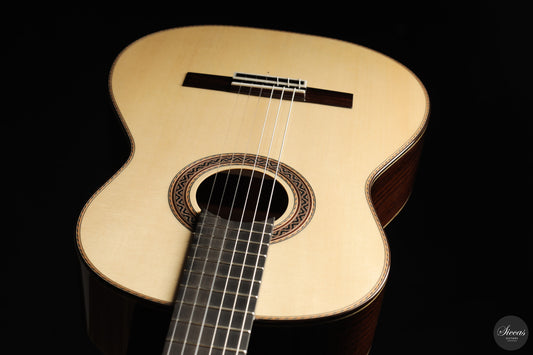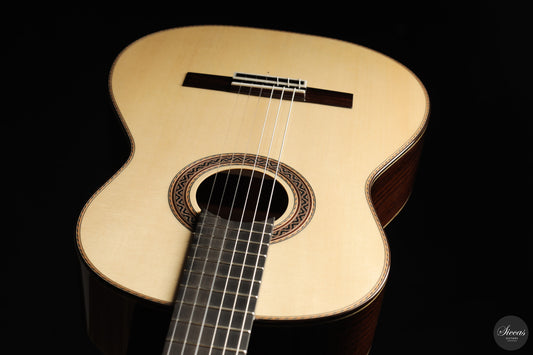

In this concert video by Siccas Guitars, French classical guitarist Gaëlle Solal presents an interpretation of Capricho Catalán by Isaac Albéniz. The recording brings together a distinctive work from the Spanish repertoire with a clear, differentiated reading and highlights the tonal possibilities of a modern classical guitar.
Gaëlle Solal – A French Guitarist on the International Stage
Gaëlle Solal is among the internationally established classical guitarists of her generation. Born in France, she has built a reputation as a versatile and thoughtful interpreter whose concert programs reflect a broad stylistic range. Her work as a performer spans classical repertoire, Spanish music, and contemporary compositions, placing her firmly among the leading figures of the instrument today.
Solal is a laureate of the prestigious Prix Ysaÿe, one of the most respected distinctions in the classical music world. This recognition underlines the seriousness and depth with which she approaches the guitar repertoire. Her playing is marked by rhythmic precision, clear articulation, and a strong sense of musical structure — qualities that are immediately apparent in this recording.
Her programs are often characterized by stylistic openness, combining classical repertoire with music from Spain and Latin America. In this recording, Solal focuses on subtle contrasts of tone color and dynamics — elements that are essential to the expressive character of Albéniz's music. The result is an interpretation that feels both considered and immediate, balancing structural clarity with genuine musical feeling.
For those interested in exploring the broader landscape of classical guitar performance, the great classical guitarists page provides a rich overview of the instrument's most influential voices across different eras.
Isaac Albéniz and Capricho Catalán
Isaac Albéniz (1860–1909) is one of the defining figures of late nineteenth-century Spanish music. A child prodigy who studied at the Royal Conservatory of Madrid and later in Brussels and Leipzig, he developed a compositional language deeply rooted in Spanish folk idioms, dance forms, and regional color. Although Albéniz composed primarily for piano, his music has become a central part of the classical guitar repertoire through numerous transcriptions and arrangements.
Capricho Catalán belongs to his collection España, Op. 165, a set of six pieces evoking different regions and moods of Spain. Written in 1890, the work draws on the musical traditions of Catalonia, blending dance-like elements, shifting moods, and a clearly defined melodic line. The piece alternates between rhythmically driven passages and more lyrical, cantabile sections, giving it a vivid expressive range.
The version performed here is based on an arrangement by Selina Copley, which makes full use of the guitar's idiomatic possibilities while respecting the pianistic origins of the piece. Rhythmic accents alternate with cantabile passages, giving the work its distinctive character and allowing the performer to demonstrate a wide palette of tonal and dynamic expression.
Albéniz's music occupies a special place in the guitar world. Works such as Capricho Árabe — another beloved piece from the same era — show how naturally Spanish piano music translates to the guitar, and why it continues to attract performers of the highest caliber.
The Instrument: Reza Safavian 2025
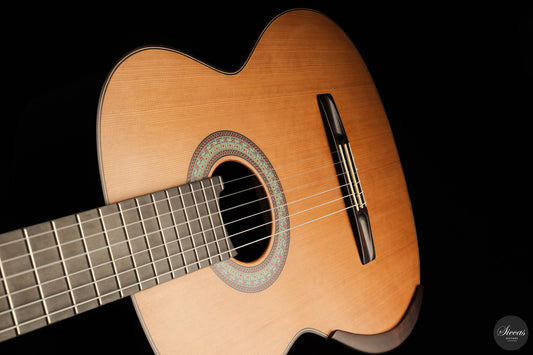
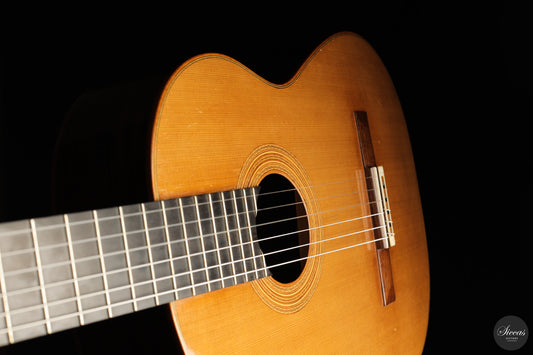
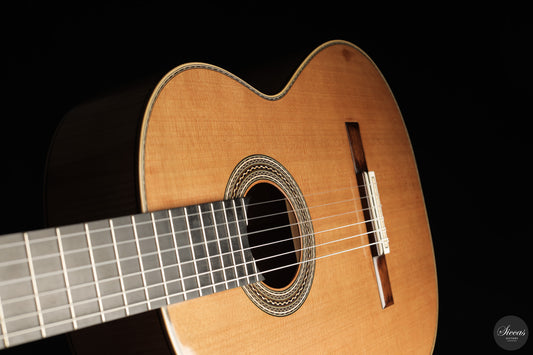
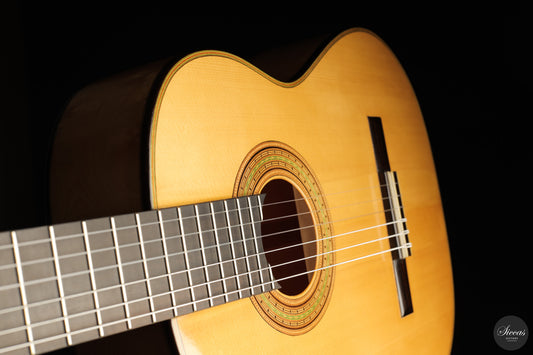
For this performance, Gaëlle Solal plays a Reza Safavian classical guitar built in 2025. Reza Safavian is a contemporary luthier whose instruments are known for their refined construction, tonal balance, and responsiveness across all registers. The guitar used in this recording supports clear separation of voices and an even response throughout the range of the instrument.
In rhythmically driven passages in particular, the guitar allows precise realization of musical detail — a quality that is essential for music like Capricho Catalán, where articulation and timing define the character of the piece. The combination of modern construction and controlled tonal development provides a stable foundation for the nuanced interpretation that Albéniz's music requires.
The choice of a contemporary instrument for this recording is itself a statement: modern classical guitar building has reached a level of refinement that allows it to serve the most demanding repertoire without compromise. Those interested in exploring the current field of fine classical guitars can browse the classical guitars collection at Siccas Guitars.
Recorded at Siccas Guitars
The video was recorded at Siccas Guitars in Freiburg, Germany, and documents a focused musical interpretation in a clear acoustic setting. Siccas Guitars has established itself as one of Europe's leading dealers and curators of fine classical guitars, hosting a series of concert recordings that bring together accomplished performers and exceptional instruments.
These recordings serve a dual purpose: they document musical interpretations of lasting value, and they offer listeners an unobstructed impression of playing style, sound, and repertoire. The acoustic environment is chosen to let the instrument speak naturally, without excessive studio treatment, allowing the listener to hear both the performer's interpretation and the tonal character of the guitar as they would in a concert hall.
The Spanish repertoire occupies a central place in these recordings. From Albéniz to Francisco Tárrega — whose Recuerdos de la Alhambra remains one of the most beloved works in the guitar canon — Spanish music offers performers and instruments alike an ideal vehicle for expression.
Capricho Catalán in Context: Spanish Music on the Guitar
The Spanish guitar repertoire is one of the richest and most varied in the classical world. From the Romantic-era piano transcriptions of Albéniz and Granados to the original compositions of Tárrega and Sor, the guitar has served as a natural vehicle for Spanish musical identity for more than two centuries.
Capricho Catalán sits within this tradition as a work that captures regional character through musical means — rhythm, melody, and harmonic color — rather than literal quotation. Its dance-like energy and lyrical passages make it an ideal showcase for a guitarist who wishes to demonstrate both technical command and musical sensitivity.
Gaëlle Solal's reading is notable for its clarity of intention. Each section of the piece is given a distinct character, and the transitions between them feel natural rather than abrupt. The Reza Safavian guitar responds to this approach with the kind of tonal flexibility that a performance of this quality demands.
For context on related works and composers in this tradition, the articles on Agustín Barrios and famous classical guitar pieces offer further reading on the broader repertoire that surrounds and informs Albéniz's music.
Music, Interpretation, and Instrument in Context
This recording with Gaëlle Solal shows how Spanish repertoire, a considered interpretation, and a contemporary classical guitar interact to produce something greater than the sum of its parts. Capricho Catalán gains a clear and structured presence through Solal's differentiated reading and the tonal qualities of the Reza Safavian guitar.
The Prix Ysaÿe laureate brings to this performance the discipline and musical intelligence that have defined her career, and the result is a recording that rewards attentive listening. Whether encountered as an introduction to Albéniz, an exploration of Gaëlle Solal's playing, or simply as a fine example of classical guitar performance, this video offers genuine musical value.