
La Catedral by Barrios – The Cathedral of Classical Guitar Music
Few works in the classical guitar repertoire carry the weight, beauty, and ambition of La Catedral by Agustín Barrios Mangoré. Composed in 1921 and revised in 1938, this three-movement masterpiece stands as a monument to the expressive potential of the classical guitar — a true cathedral built from notes rather than stone. For players and listeners alike, encountering La Catedral is one of the defining moments in a life spent with classical music.
If you have ever wondered what the classical guitar is truly capable of — in terms of depth, poetry, and technical brilliance — La Catedral answers that question completely.
Agustín Barrios Mangoré: The Composer Behind La Catedral
Agustín Barrios Mangoré (1885–1944) was a Paraguayan guitarist and composer widely regarded as one of the greatest figures in the entire history of classical guitar. Born in San Juan Bautista de las Misiones, Paraguay, Barrios was a prodigious talent from childhood. He studied at the National College in Asunción under Gustavo Sosa Escalada, who recognized his exceptional gifts early on.
Barrios spent much of his adult life touring Latin America and Europe, performing to enthusiastic audiences and composing prolifically. He left behind a body of work of over 300 pieces — although many have been lost — encompassing a vast range of styles from Baroque-influenced counterpoint to Romantic lyricism to the folk music of his native Paraguay. His playing was described by contemporaries as something approaching the miraculous: a sound of extraordinary warmth, precision, and singing quality that seemed impossible to achieve on the instrument.
In the later part of his career, Barrios took on the stage persona of Chief Nitsuga Mangoré, a Guaraní chieftain, performing in traditional dress. This was partly a theatrical gesture, partly a political one — a proud assertion of his indigenous South American identity in the face of a Eurocentric concert world. The name Nitsuga is simply Agustín spelled backwards.
To learn more about the composer's life and legacy, visit our dedicated article on Agustín Barrios and his music for classical guitar.
The Inspiration: Notre-Dame de Paris
The story of La Catedral's creation begins with a journey. Around 1920, Barrios visited Paris and, like countless artists before and after him, found himself standing inside the Cathedral of Notre-Dame. The experience was transformative. The soaring Gothic arches, the diffused light filtering through stained glass, the overwhelming sense of sacred space and accumulated centuries of human devotion — all of this entered deeply into Barrios's imagination.
He set about translating that experience into music. The result was La Catedral, initially composed in 1921 as a two-movement work comprising the Andante Religioso and the Allegro Solemne. The Preludio Saudade, the introspective opening movement we know today, was added in the revised version of 1938. "Saudade" is a Portuguese and Galician word with no direct English equivalent — it refers to a deep, melancholic longing or nostalgia for something beautiful that is absent or lost. The addition of this prelude gave the work an entirely new emotional dimension, a moment of private contemplation before the grandeur of the cathedral is revealed.
The Three Movements of La Catedral
I. Preludio Saudade
The Preludio Saudade opens the work in a mood of quiet reflection and tender sadness. Written in a free, improvisatory style, it uses arpeggiated figures and lyrical melodic lines to create a sense of solitude and inward longing. The music seems to suggest a solitary figure pausing outside the cathedral — or perhaps remembering it from a great distance in time.
Technically, this movement demands a refined right-hand technique, a singing tone on the upper melody, and a sensitive control of dynamics. While it is the most approachable of the three movements in terms of sheer difficulty, it is in many ways the most challenging to play beautifully: the exposed simplicity of the writing leaves nowhere to hide. Every note must sing, every phrase must breathe.
II. Andante Religioso
The Andante Religioso is the emotional heart of La Catedral. Here Barrios evokes the interior of Notre-Dame directly — the vast, hushed space, the light falling through stained glass, the sense of timelessness that great sacred architecture imparts. The movement is built around a long, arching melody of extraordinary beauty, supported by a flowing accompaniment that suggests the resonance of a great stone interior.
The writing is polyphonic in texture, with inner voices carrying harmonic interest beneath the singing melody. It calls for the guitarist to maintain a clear distinction between melodic, bass, and inner voices while sustaining a legato line of considerable length. The emotional gravity of this movement — the feeling of standing inside something ancient, vast, and holy — is what gives La Catedral its central character.
III. Allegro Solemne
The final movement, Allegro Solemne, is an explosion of energy and brilliance. After the contemplative atmosphere of the first two movements, the Allegro arrives like the doors of the cathedral being thrown open onto a sunlit plaza. The movement is driven by rapid scalar passages, intricate right-hand arpeggios, and a vigorous rhythmic pulse that propels the music forward with irresistible momentum.
Technically, this is one of the most demanding movements in the classical guitar repertoire. It requires clean, fast passagework, reliable right-hand arpeggios at tempo, strong left-hand articulation, and the stamina to maintain precision across a sustained burst of virtuosic writing. The movement culminates in a climax of great power, leaving the listener — and the performer — with a sensation of having witnessed something monumental.
La Catedral in the Classical Guitar Repertoire
La Catedral occupies a singular position in the classical guitar world. It is simultaneously one of the most beloved and most feared works in the repertoire. Audiences adore it: the arc from introspective sadness to sacred stillness to blazing virtuosity makes for a complete emotional journey within a single, unified work of roughly twelve to fifteen minutes. Performers respect it and approach it with care, because it demands not only technical mastery but genuine musical depth to bring off convincingly.
The piece was championed in the twentieth century by Andrés Segovia, whose advocacy helped bring Barrios's music to international attention after years of relative neglect. Today, La Catedral is a staple of concert programmes and conservatory curricula worldwide. It regularly appears on competition repertoire lists and recital programmes performed by the finest guitarists of every generation.
Among the works that occupy a similarly exalted position in the repertoire — pieces that test both technical command and interpretive maturity — you might explore Recuerdos de la Alhambra by Francisco Tárrega, Asturias by Isaac Albéniz, and Capricho Árabe, as well as the sacred and transcendent music of J.S. Bach arranged for classical guitar.
Technical Requirements and Study Approach
La Catedral is not a piece for the early stages of guitar study. However, the question of when a player is "ready" for it is more nuanced than a simple matter of years. Each movement presents a distinct set of challenges:
The Preludio Saudade rewards players who have developed a consistent, resonant right-hand tone and the ability to shape long melodic phrases. The Andante Religioso demands polyphonic clarity and a sustained legato — the ability to hold a melody over a moving accompaniment without losing either voice. The Allegro Solemne requires reliable arpeggios at speed, clean scalar passages, and robust left-hand technique.
A productive study approach might involve learning each movement independently before attempting to perform the full work. The Andante Religioso is often learned first, as its slower tempo and deep musical content make it deeply rewarding at an intermediate-advanced level. The Allegro Solemne should be practised meticulously at half-speed before being gradually brought up to tempo.
For players working towards this piece and other major works of the repertoire, our guide to famous classical guitar pieces provides a broader survey of the repertoire's landmarks, and our article on how long it takes to learn classical guitar offers a realistic perspective on the journey.
Choosing a Guitar for La Catedral
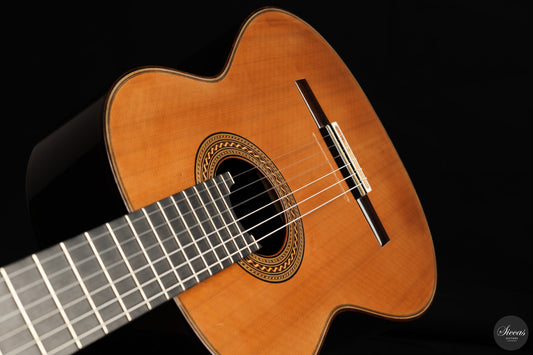
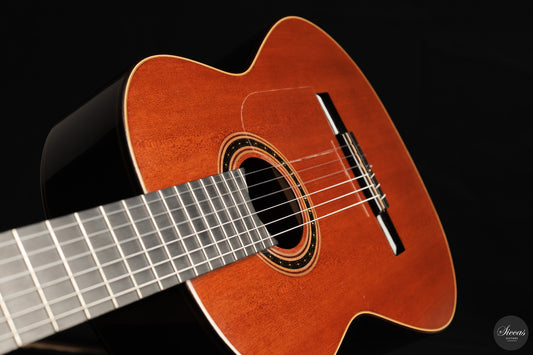
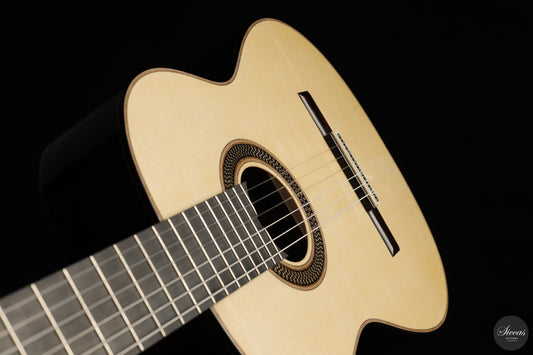
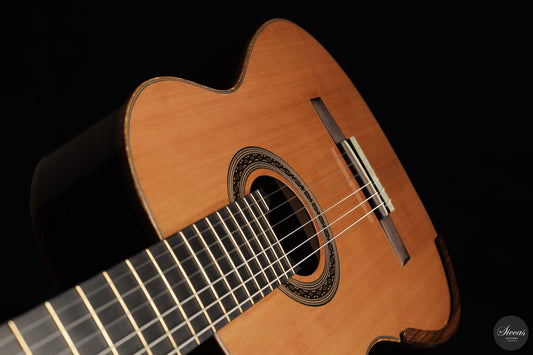
La Catedral rewards a high-quality instrument. The Andante Religioso in particular — with its long melodic lines and rich inner voicing — calls for a guitar with a warm, sustaining tone, clear separation between registers, and a responsive touch. A cedar-top guitar often suits the more intimate, introspective passages beautifully, while spruce can bring additional brightness and projection to the Allegro Solemne. The interplay between these tonal qualities is one reason many advanced players seek instruments that balance warmth and articulation across the full dynamic range.
Explore our full range of classical guitars, or browse our curated selections of cedar-top guitars and spruce-top guitars to find an instrument equal to the demands of the repertoire.
La Catedral as a Musical Experience
Beyond its technical demands and historical significance, La Catedral endures because it communicates something essential and universal. The progression from saudade — that particular ache of longing — through sacred awe to jubilant affirmation is not merely a programme for a guitar piece. It describes something true about human experience: the movement from private grief towards something larger than oneself, and the energy that is released when that encounter is complete.
Barrios composed La Catedral from direct personal experience, standing in one of the great sacred buildings of the world. That origin gives the music an authenticity that listeners feel, even without knowing the story behind it. It is music that was felt before it was written down — and that quality is what has kept it at the centre of the classical guitar repertoire for a century.
If you are new to the music of Barrios and want to understand the full scope of his achievement, our dedicated article on La Catedral and the broader survey of the history of classical guitar will give you the richest possible context for this extraordinary work.