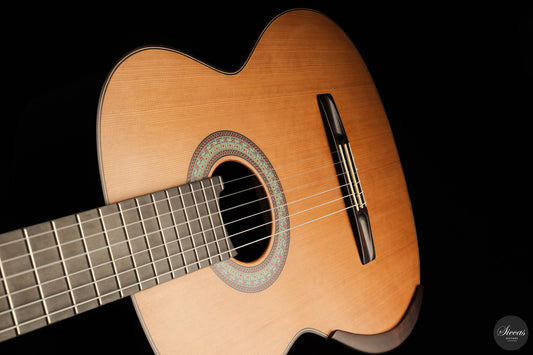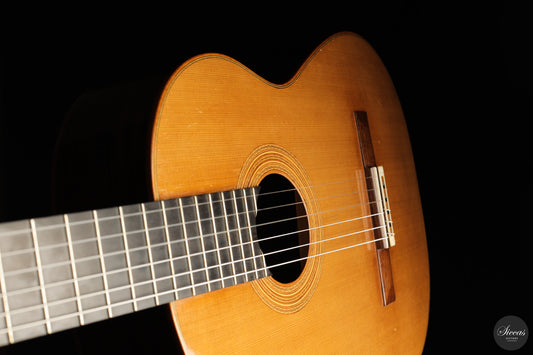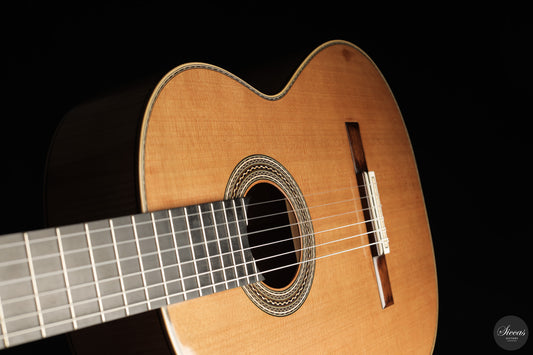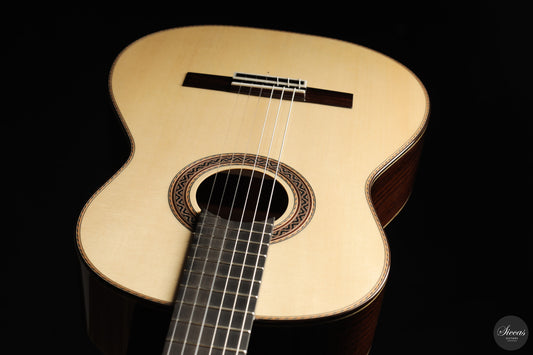

As you climb beyond beginner instruments, you start to meet two terms that can be confusing: master guitar and studio guitar. They are not official categories with fixed definitions, but in the trade they describe two clearly different things — and understanding the distinction can save you a lot of money, or help you decide when it is worth spending more.
What a master guitar is
A master guitar (or "concert guitar") is built entirely by hand by a master luthier — a single craftsperson who designs and makes the whole instrument, often signing each one. These are the guitars played by professional concert artists: makers in the lineage of Hauser, Friederich and Redgate. Each represents hundreds of hours of expert handwork, the finest aged tonewoods, and the maker's individual voice and refinements. A master builder typically produces only a handful or a few dozen instruments a year, which is part of why they cost — and are worth — what they do.
What a studio guitar is
A studio guitar sits one tier below. The term usually means a high-quality instrument that is partly handmade — often built in a workshop, sometimes under a master's name and supervision, or by skilled makers using efficient methods — rather than fully built start-to-finish by one master alone. Studio guitars use good solid woods and aim to deliver much of the tone and playability of a master instrument at a significantly lower price. They are a sweet spot for serious students, teachers and performing amateurs.
How they differ in practice
- Who builds it: a single master, hand-making everything, versus a workshop or shared process.
- Time and exclusivity: master guitars take far longer per instrument and are made in tiny numbers.
- Sound: the best master guitars offer the last degree of refinement — subtle colour, responsiveness and projection — that distinguishes a concert instrument; a good studio guitar gets impressively close.
- Price: master guitars cost considerably more, and renowned names can hold their value.
- Consistency: studio guitars are often more consistent model to model; master guitars are individuals, each with its own character.
Which is right for you?
Be honest about your level and needs. A serious student, teacher or dedicated amateur is often superbly served by a fine studio guitar — it offers most of the musical reward without the master-guitar price. A master guitar makes sense when you can hear and use that last degree of refinement: advanced players, professionals, and those for whom the specific voice and pedigree of a hand-built instrument truly matter. There is no shame in either choice; the right guitar is the one that serves your playing and your budget.
A note on value
Spending more does not automatically mean a better guitar for you. The most expensive instrument in the room may not suit your hands or your music as well as a carefully chosen studio guitar. As always, play before you buy, and let your ears and fingers — not the label — make the final decision.
FAQ
What's the main difference between a master and a studio guitar?
A master guitar is fully hand-built by one master luthier; a studio guitar is a high-quality, partly handmade instrument made more efficiently, usually at a lower price.
Is a master guitar always better?
Not for everyone — it offers the last degree of refinement, but a good studio guitar suits most students and amateurs beautifully.
Who should buy a master guitar?
Advanced players and professionals who can use its subtle responsiveness, projection and individual character.