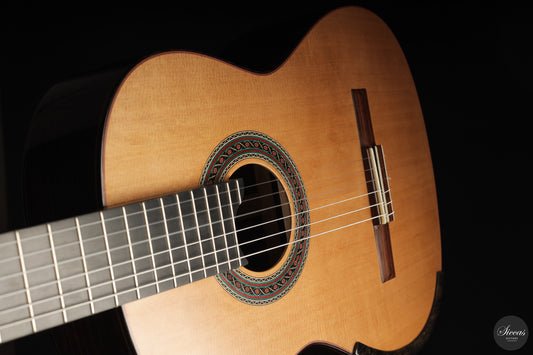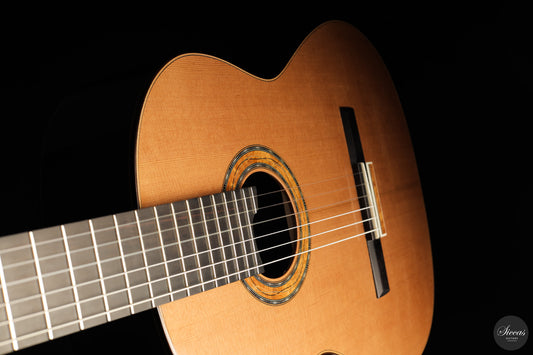

Of all the great Baroque composers whose music guitarists have adopted, none feels more naturally at home on the instrument than Domenico Scarlatti (1685–1757). He never wrote a note for the guitar — his 555 sonatas were composed for the harpsichord — and yet many of them seem to have been waiting all along for six strings, full of strumming chords, snapping rhythms, and the unmistakable colour of Spain.
An Italian in Iberia
Scarlatti was born in Naples on 26 October 1685 — the same year as Johann Sebastian Bach and George Frideric Handel — into one of the most celebrated musical families in Italy. His father, Alessandro Scarlatti, was a towering figure in Baroque opera, and Domenico grew up immersed in professional music-making from the very beginning. He studied in Naples, worked briefly in Florence and Rome, and by his early thirties had established himself as a keyboard virtuoso of the first rank.
The decisive turn of his life came in 1719, when he entered the service of the Portuguese royal court in Lisbon. There he taught the young Princess Maria Barbara of Portugal — a gifted musician who would later become Queen of Spain. When she married into the Spanish royal family in 1729, Scarlatti followed her to Madrid. He spent the remaining 28 years of his life on the Iberian Peninsula, and it transformed his music utterly. He became a Spanish composer in all but name.
The Sound of Spain in Every Sonata
Living in Madrid, Scarlatti absorbed the musical world around him with extraordinary openness. The strummed chords of the Spanish guitar, the rhythms of flamenco and popular dance, the harsh dissonances that imitate open strings clashing against fretted notes — all of it found its way into his harpsichord writing. His sonatas are full of effects that make no obvious sense on a harpsichord: rapid repeated notes that recall the rasgueo of a guitar, sudden angular leaps that sound like the snap of a string, and extended passages that lie beneath the fingers of a guitarist as though written there by instinct.
This is precisely why the sonatas translate so beautifully back to the classical guitar. When a guitarist plays Scarlatti, they are in a sense returning the music to one of its original inspirations. The instrument that Scarlatti heard in the streets and courts of Spain is the direct ancestor of the modern classical guitar, and his harpsichord writing carries its DNA throughout.
555 Sonatas: Structure and Style
The sheer scale of Scarlatti's output is remarkable. He composed 555 keyboard sonatas — a number confirmed by the Kirkpatrick catalogue, the standard reference compiled by the American harpsichordist and musicologist Ralph Kirkpatrick in 1953. Each sonata is a single, compact movement, almost always in binary form: two sections, each repeated, with the first moving away from the home key and the second returning to it. Most are between two and five minutes long.
Within that tightly constrained form, Scarlatti's invention seems inexhaustible. The sonatas range from gentle and songful to brilliant and fiery, from meditative and lyrical to rhythmically ferocious. Many are paired in the manuscripts — a slow and a fast sonata sharing the same key, intended to be performed together. The catalogue numbers (K. numbers, for Kirkpatrick, or L. numbers for the older Longo catalogue) are the standard way guitarists refer to individual works.
The Sonatas Guitarists Love Most
Among the hundreds of sonatas, certain pieces have become staples of the guitar repertoire. The Sonata in E major, K. 380 is probably the most performed on guitar — its singing, expansive melody and gently rocking accompaniment lie perfectly on the instrument, and it has been recorded by generations of classical guitarists. The Sonata in C major, K. 159 (sometimes called "La Caccia" — the hunt) brings vivid rhythmic energy and is enormously satisfying to play.
The lyrical K. 208 in A major is another favourite, moving and introspective in character, while the energetic K. 322 and the fiery K. 391 are popular choices for players who want to show off both speed and articulation. K. 11 in C minor has a dark, improvisatory character that suits the guitar particularly well. Any of these makes an excellent starting point for a guitarist exploring this repertoire for the first time.
Beyond these well-known pieces, the catalogue rewards exploration. Many guitarists have found their own favourite Scarlatti sonatas by working through the less-performed numbers — there is a genuine sense of discovery available to any player willing to dig in.
Andrés Segovia and the Guitar Tradition
The history of Scarlatti on guitar is inseparable from the history of the classical guitar as a concert instrument. Andrés Segovia was among the first major guitarists to champion Scarlatti transcriptions in the early twentieth century, helping establish the sonatas as legitimate and rewarding concert repertoire. His recordings introduced the music to audiences worldwide and demonstrated that the guitar could hold its own in the Baroque repertoire alongside the harpsichord and piano.
Since Segovia, virtually every major classical guitarist has recorded at least some Scarlatti. The sonatas appear on recital programmes alongside Bach, Tárrega, and Barrios, and they remain a touchstone for what the guitar can achieve in Baroque music. Contemporary guitarists continue to find new approaches to the sonatas — period-informed interpretations, fresh transcriptions, and unexpected pairings with other repertoire.
How Difficult Are Scarlatti Sonatas on Guitar?
Difficulty varies considerably across the 555 sonatas. Some — including several of the most popular pieces — are accessible to a solid intermediate player with good technique and a feel for Baroque style. Others are technically demanding, requiring fast scales, precise voice-leading, and clean articulation at high speed. As a general guide:
- Accessible intermediate level: K. 208 (A major), K. 380 (E major). These have moderate tempos, clear textures, and manageable hand positions.
- Advanced intermediate: K. 11 (C minor), K. 159 (C major). More complex rhythms and wider stretches, but still within reach of a serious student.
- Advanced: K. 322, K. 391, and many of the fast, fiery sonatas. These demand real velocity, clean string crossings, and confident ornament execution.
What all Scarlatti requires, at any level, is a feel for Baroque style. Ornaments — trills, mordents, appoggiaturas — should be crisp and well-placed. Rhythms should be buoyant and dance-like, never heavy. Voicing needs to be clear, with the melody always speaking above the accompaniment. These are skills that pay dividends across the entire Baroque guitar repertoire.
Transcription: Returning the Music to the Guitar
Every Scarlatti sonata performed on guitar is a transcription — an arrangement of music written for another instrument. This raises genuine artistic questions. How literally should the original text be followed? Which ornaments transfer well, and which need adaptation? How should the two-manual possibilities of the harpsichord be handled on a single instrument?
Different guitarists have answered these questions differently. Some, like Segovia, made free arrangements that prioritised idiomatic guitar writing and tonal colour. Others follow the harpsichord text as closely as possible, adding only what is necessary to make it work on the guitar. Contemporary guitarists often consult period sources and informed-performance practice, considering how the original harpsichord style might translate into a historically aware guitar reading.
There is no single correct approach. The variety of interpretations available — from Segovia's romantic warmth to more austere period-style readings — is one of the pleasures of exploring this repertoire. Each transcription brings out different aspects of the music's character.
Scarlatti and the Broader Baroque Guitar Repertoire
Scarlatti sits at the heart of the classical guitar's Baroque repertoire, alongside Bach, Handel, and composers who actually wrote for the Baroque guitar such as Robert de Visée and Gaspar Sanz. The Baroque period (roughly 1600–1750) produced an enormous amount of music that transfers well to the modern classical guitar, and Scarlatti's sonatas are among the most rewarding examples.
If you enjoy Scarlatti on guitar, you might also explore Bach's lute and keyboard music in guitar transcription, or the broader classical guitar repertoire. The skills you develop playing Scarlatti — clarity of voice, precise ornament execution, rhythmic spring — will serve you well across the entire early music guitar canon. You can also find many great classical guitarists who have recorded definitive Scarlatti interpretations worth studying.
Where to Find the Sheet Music
Scarlatti died in 1757, which means his music has long been in the public domain. Guitar transcriptions are widely available — both in printed editions from major publishers and as free downloads from public domain music sites. The original harpsichord texts are also freely available, and many guitarists enjoy making their own transcriptions, which is a valuable learning exercise in understanding how the music works.
For players who want edited, fingered editions, several publishers produce guitar-specific Scarlatti collections with careful fingering and editorial guidance. These are particularly useful for students who are new to Baroque style and want help with ornament realisation and phrasing.
Frequently Asked Questions
Did Domenico Scarlatti write for the guitar?
No. Scarlatti wrote all 555 of his sonatas for harpsichord. However, the guitar influences audible throughout the music — particularly the Spanish guitar sounds he absorbed while living in Madrid — mean that many sonatas transcribe exceptionally well to the classical guitar.
How many Scarlatti sonatas are there?
555, as catalogued by Ralph Kirkpatrick in 1953. The K. numbers (Kirkpatrick catalogue) are the standard reference. An older catalogue by Alessandro Longo assigned L. numbers, which are still occasionally used.
Which Scarlatti sonata should a guitarist learn first?
K. 380 in E major is the most popular starting point — it is melodically beautiful, lies well on the guitar, and is not excessively difficult. K. 208 in A major is another excellent choice for players at intermediate level.
Did Andrés Segovia record Scarlatti?
Yes. Segovia was one of the key figures in establishing Scarlatti transcriptions as part of the classical guitar repertoire, and his recordings helped bring the sonatas to a wide audience in the twentieth century.
Is Scarlatti's sheet music free to download?
Yes — Scarlatti's music is in the public domain, and both the original harpsichord texts and many guitar transcriptions are available as free legal downloads from public domain music libraries.
Why does Scarlatti's music suit the guitar so well?
Because Scarlatti spent nearly three decades living in Spain, surrounded by the sounds of the Spanish guitar and flamenco. These influences permeate his harpsichord writing, making it unusually natural to transfer back to the guitar.
Read about Bach on guitar, or browse our classical guitars →
This article is part of our classical guitar repertoire guide. See also the famous classical guitar pieces overview and our guide to Johann Sebastian Bach on guitar.
Hear the music: our guide to Scarlattis guitar works collects the pieces with recordings filmed in our studio.