Joaquín Turina and the Classical Guitar
Joaquín Turina was born in Seville on December 9, 1882, and died in Madrid on January 14, 1949. He belongs to the generation of Spanish composers who studied in Paris under Vincent d'Indy at the Schola Cantorum, absorbed French impressionism, and returned home to write music that sounds unmistakably Andalusian. His guitar output is small — four substantial works — but every piece has held its place in the standard repertoire for nearly a century.
Turina's Formation: Seville, Madrid, Paris
Turina began his musical training in Seville, studying piano and harmony from an early age. In 1902 he moved to Madrid, and three years later to Paris, where he enrolled at the Schola Cantorum. D'Indy's teaching emphasized counterpoint and formal architecture — a discipline that left a permanent mark on Turina's writing. At the same time he was absorbing Debussy and Ravel, whose harmonic language filtered into his textures without displacing the modal colors of southern Spain.
A conversation with Isaac Albéniz and Manuel de Falla in Paris is often cited as a turning point. Both composers urged Turina to anchor his work in Spanish musical identity rather than continue in a generic European late-Romantic direction. He took that advice seriously. From that point his music moved between two poles: rigorous Franckian form on one side, the sound world of Seville — its processions, its cafés, its flamenco cantaores — on the other.
The Fandanguillo, Op. 36
The Fandanguillo is the work most guitarists encounter first. Turina composed it in 1925, and Andrés Segovia gave the premiere. The fandanguillo is a lighter, faster relative of the fandango, and Turina's treatment captures that character: the piece opens with a percussive, rhythmically insistent theme that immediately establishes its Andalusian credentials.
Structurally the Fandanguillo is compact — around four minutes in performance — but densely packed. The middle section introduces a contrasting lyrical melody before the opening material returns. What makes it technically interesting for guitarists is the way Turina writes repeated notes and rapid scale passages that idiomatic guitar technique handles naturally, almost as if the instrument suggested the figuration rather than being made to accommodate it. Segovia's advocacy ensured the piece circulated widely, and it has been recorded by virtually every major classical guitarist since.
The key is A minor, and the modal inflections — particularly the raised seventh and the Phrygian cadences — give the harmony a specifically Andalusian flavor that goes beyond generic "Spanish" pastiche. Turina is not quoting folk music; he is thinking in a tonal language shaped by it.
The Sonata, Op. 61
The Sonata dates from 1931 and represents Turina's most ambitious guitar work. Three movements — Allegro vivo, Andante, Allegro vivo — follow a classical design while deploying the full range of Turina's harmonic vocabulary. The first movement's opening theme is angular, almost fragmentary, and the development section puts it through a series of transformations that show d'Indy's training at work.
The slow movement is the emotional center. Marked Andante, it builds from a simple melodic statement into a passage of considerable expressive intensity before subsiding. The harmonic language here is closer to Ravel than to anything in the flamenco tradition — not a contradiction in Turina's world, but a demonstration of how comfortably he moved between French impressionism and Spanish nationalism within a single piece.
The finale returns to the energy and rhythmic drive of the first movement. The Sonata is one of the few original three-movement sonatas for solo guitar from the early twentieth century, and it remains a cornerstone of the repertoire. Technically it demands clean articulation, tonal control across a wide dynamic range, and the ability to project a long formal argument — qualities that separate the competent from the accomplished.
Homenaje a Tárrega, Op. 69
The Homenaje a Tárrega consists of two pieces: Garrotín and Soleares. Turina composed them in 1932, dedicating them to the memory of Francisco Tárrega, the guitarist and composer from Valencia who had died in 1909 and whose influence on classical guitar technique was foundational. The choice of forms — garrotín and soleares are both flamenco genres — was deliberate: Tárrega had drawn on popular Andalusian music throughout his life, and Turina honored that lineage.
Garrotín is the more extroverted of the two, rhythmically strong and built on a characteristic repeated-bass ostinato. Soleares is slower and more interior, exploiting the guitar's capacity for sustain and for the kind of expressive silence between notes that the flamenco tradition values. Neither piece is a transcription or imitation of flamenco; both use flamenco harmonic and rhythmic material as the foundation for composed concert pieces.
Together the two pieces of Op. 69 run about eight minutes and are often performed as a set. They appear on programs alongside the Fandanguillo and Sonata, making it possible to program an entire Turina group of substantial length.
If you want to understand the broader tradition from which Turina drew, the article on Francisco Tárrega covers the guitarist who shaped the instrument's classical vocabulary in Spain.
Turina and Segovia
Without Andrés Segovia, Turina's guitar music might have remained manuscript. Segovia commissioned or received three of the four major works, premiered them, recorded them, and included them on international tours at a time when the classical guitar was still fighting for acceptance in concert halls. That relationship gave Turina's pieces immediate global reach they would not otherwise have had.
Segovia's approach to the guitar — long lines, rich tone, a quasi-orchestral dynamic range — suited Turina's writing well. The Fandanguillo in particular benefits from a guitarist who can sustain the melodic arch across the repeated-note passages rather than letting the piece collapse into a technical exercise. Segovia's recordings, made in the 1920s and 1930s, set an interpretive standard that later guitarists have worked with and against.
The relationship between composers and Segovia is a recurring subject in early twentieth-century guitar history. The article on great classical guitarists provides context on how Segovia shaped the modern repertoire through these commissions.
Style and Harmonic Language
Turina's harmonic language occupies a specific position in early twentieth-century music. He is not an avant-gardist — there is nothing in his guitar music that challenges tonality the way Bartók or Schoenberg did — but he is not a conservative Romantic either. The impressionist techniques he absorbed in Paris give his harmony a chromatic flexibility, a readiness to move through distantly related keys and to use modal scales, that distinguishes his work from the guitar pieces of the nineteenth century.
The Andalusian cadence — descending from the tonic through the flat seventh and sixth to the dominant — appears repeatedly. So does the Phrygian mode, whose flattened second degree gives Spanish music much of its characteristic tension. Turina deploys these devices without irony, as a composer who grew up hearing them and considers them part of his natural vocabulary.
Rhythm is the other defining element. The fandanguillo, garrotín, and soleares all carry specific rhythmic identities, and Turina preserves those identities even while subjecting the material to classical formal treatment. The result is music that is immediately recognizable as Spanish and Andalusian, but organized with the discipline of a composer trained in Paris.
Turina in the Context of Spanish Nationalism
Spanish musical nationalism in the late nineteenth and early twentieth centuries had several strands. Pedrell, the theorist and teacher, argued that Spanish art music should draw on folk and liturgical sources. Albéniz translated that argument into piano music of enormous sophistication. Falla did the same for orchestra and voice. Turina worked in parallel, applying similar principles to chamber music, piano music, and the guitar.
Unlike Falla, who became increasingly austere in his later work and left the guitar almost entirely aside, Turina continued to write guitar music through the 1930s. The Homenaje a Tárrega dates from 1932, after Falla had effectively stopped composing for the instrument. In that sense Turina extended the tradition longer than his more celebrated contemporary.
The connection between Spanish nationalism and the guitar is a large subject. The article on famous classical guitar pieces covers many of the works that defined the repertoire in this period, placing Turina's contributions alongside those of Falla, Albéniz, and others.
Interpreting Turina Today
The four Turina works appear regularly on recital programs and in conservatory curricula. The Fandanguillo is frequently assigned at intermediate to advanced level because it is technically demanding but not prohibitively so, and because it teaches students how to project a rhythmically driven piece over a sustained musical arc. The Sonata is harder — its formal demands require a mature musical intelligence — and tends to appear on programs by established soloists.
Recorded versions are plentiful. Segovia's originals remain historically important. Among later recordings, those by Narciso Yepes, John Williams, and David Russell each bring different perspectives. Williams's approach is typically precise and transparent; Russell's is warmer and more overtly Andalusian in character. Neither is definitively correct — the pieces sustain multiple valid interpretations.
The question of tempo is worth noting. The Fandanguillo is sometimes played very fast, treating it as a showpiece. Turina's indication, Andante mosso for the opening, suggests a more measured approach that allows the melodic content to register. The middle section, Andante tranquillo, is often rushed in performance; holding the tempo there is one of the interpretive challenges the piece presents.
The Guitar Works in Brief
For reference, the four major works with opus numbers and dates of composition:
- Fandanguillo, Op. 36 (1925) — premiered by Segovia; four minutes; A minor; single movement in modified ternary form.
- Sonata, Op. 61 (1931) — premiered by Segovia; three movements; the most formally ambitious of the four works.
- Homenaje a Tárrega, Op. 69 (1932) — two pieces: Garrotín and Soleares; dedicated to Tárrega's memory; total duration approximately eight minutes.
A fourth piece, the Sevillana, Op. 29, predates the Fandanguillo and is sometimes included in discussions of the guitar output, though it is less frequently programmed.
Turina and the Broader Repertoire
Turina's guitar works are often grouped on programs with music by other Spanish composers of the same generation — Falla's Homenaje pour le tombeau de Debussy, Rodrigo's smaller pieces, occasionally Albéniz transcriptions. That programming makes sense historically: all these composers were working in the same cultural and national context, all had some relationship with Segovia, and all were drawing on Andalusian or broader Spanish musical sources.
The article on Agustín Barrios provides a useful counterpoint: Barrios was working in South America during the same decades, drawing on entirely different folk sources, and his relationship with Segovia was more complicated. Comparing the two composers illuminates how differently guitar music was developing in different parts of the Spanish-speaking world.
Bach is another natural pairing on programs — not for historical or national reasons, but because a Baroque suite and a Spanish nationalist work of the 1930s make for effective contrast. The article on Bach on classical guitar covers the most important transcriptions and original works in that repertoire.
Instruments for Turina's Repertoire
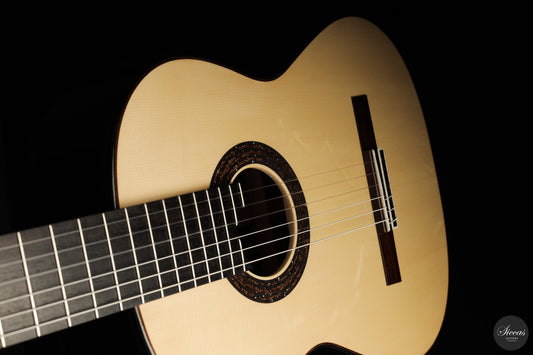
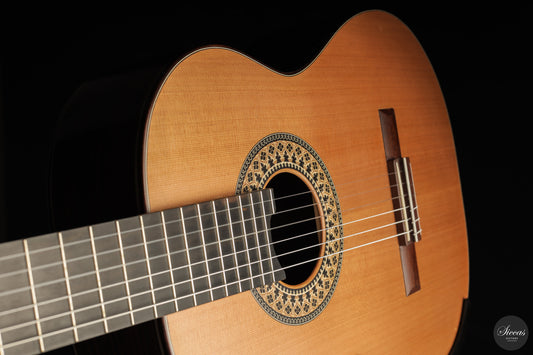
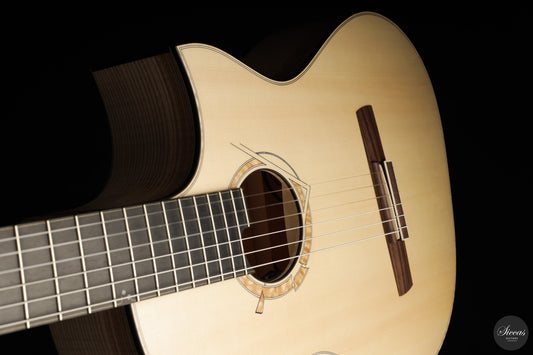
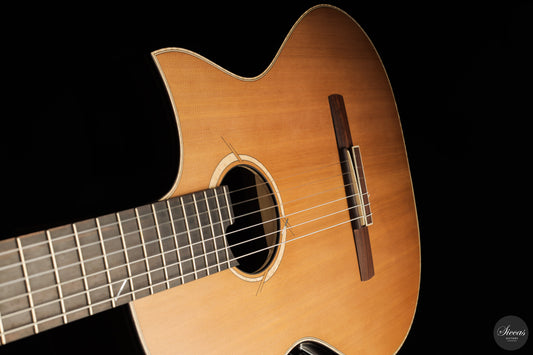
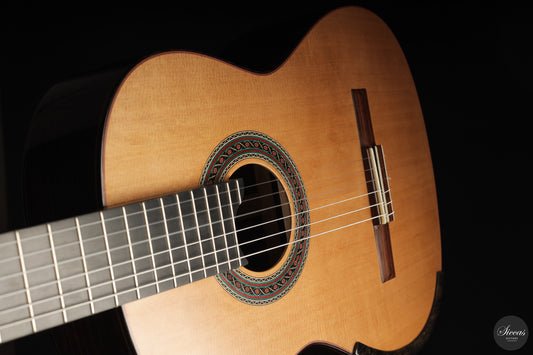
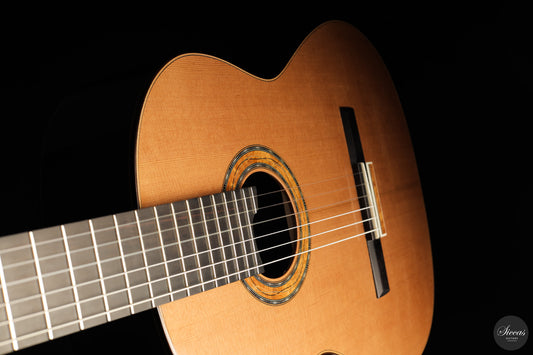
Turina's guitar music was written for the concert guitar of the 1920s and 1930s — instruments with a projection and tonal character suited to recital halls of that size. A modern concert classical guitar with adequate projection and a warm treble register handles the Fandanguillo and Sonata well. The sustained, expressive quality needed for the slow movement of the Sonata and for the Soleares of Op. 69 benefits from an instrument with good note decay and resonance.
If you are looking for instruments suited to this repertoire, the classical guitar collection at Siccas Guitars covers a wide range of luthier-built instruments appropriate for recital use.
Summary
Joaquín Turina produced a small but durable body of guitar music. The Fandanguillo, the Sonata, and the Homenaje a Tárrega are all in active circulation, regularly taught, performed, and recorded. They occupy a specific and identifiable position in the repertoire: Spanish nationalist in orientation, impressionist in harmonic technique, and shaped throughout by the Andalusian musical world in which Turina grew up. Segovia's advocacy gave them their early reach; their musical quality has sustained them since.