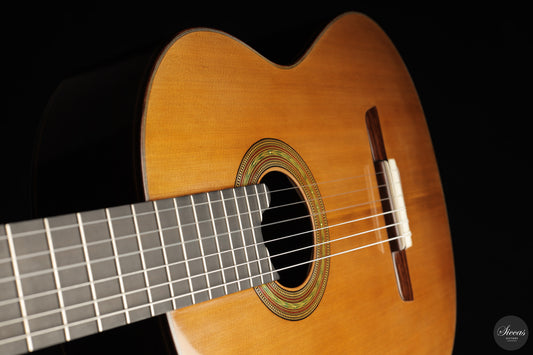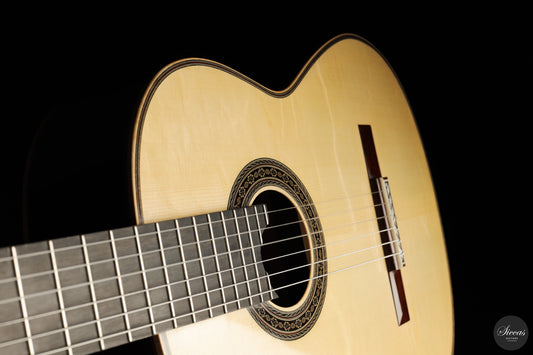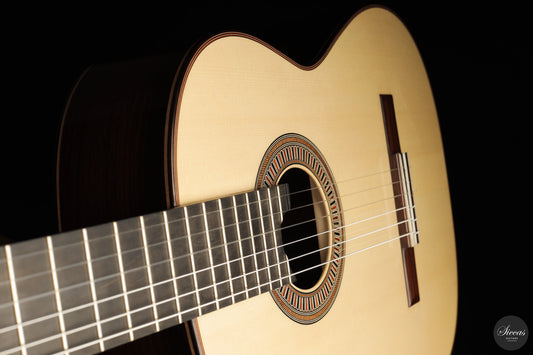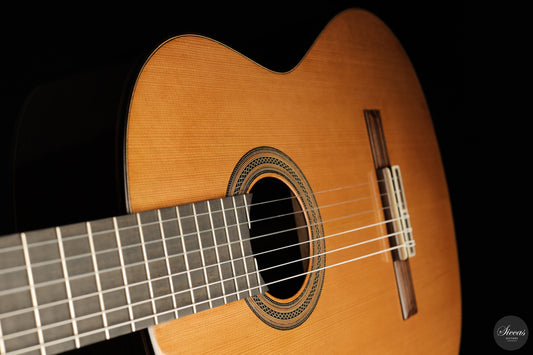

Jialan Chen occupies a rare position in the world of classical guitar: he is both a masterful builder of instruments and a deeply accomplished guitarist in his own right. Based in Guangzhou, China, Chen has spent more than a decade developing a voice as a luthier that draws on the great European traditions of the twentieth century, while his playing — shaped by the same intimate knowledge of tone, resonance, and technique — gives his craft an unusually musical dimension. His guitars are played by professional musicians and collectors across the world, and his workshop has become one of the most closely watched in contemporary lutherie.
Biography & Training
Jialan Chen founded his workshop in 2013, beginning with Torres-style instruments — the foundational language of the Spanish classical guitar tradition. From the outset, his approach was scholarly as well as practical: he travelled extensively through Europe, visiting the workshops of renowned craftspeople and hand-measuring original instruments by historically celebrated makers. This direct contact with the physical reality of great guitars — their graduation, bracing geometry, and tonal archiving — gave Chen a technical vocabulary that goes far beyond what any formal curriculum alone could provide.
The decisive turn in his training came in 2014, when he studied in Italy with Andrea Tacchi and Paolo Coriani, two makers whose influence on the Italian school of lutherie is considerable. Working alongside Tacchi in particular gave Chen direct access to a lineage of refined European craftsmanship, and the experience left a lasting imprint on his aesthetic sensibility. Italian luthier Gabriele Lodi, after examining one of Chen's Torres models, is reported to have told him: "You know everything about Torres" — high praise from a maker steeped in the same tradition.
His development as a classical guitarist ran in parallel with his growth as a builder. Chen's playing reflects the same preoccupations that drive his lutherie: a profound sensitivity to timbre, an ear for tonal balance across registers, and a refined approach to right-hand technique and nail care. It is this dual perspective — maker and performer simultaneously — that distinguishes him from many of his peers and informs every decision he makes at the workbench.
Career & Performances
While Jialan Chen's public profile has been built primarily around his instruments rather than a touring concert career, his musicianship has always been central to his identity and reputation. He plays his own guitars at exhibitions and events, demonstrating their tonal possibilities with a sensitivity that comes from years of serious study. His understanding of how concert guitarists practice and develop their sound is not theoretical — it is lived experience that shapes both his playing and his building.
Chen's guitars have been showcased at leading international guitar festivals and exhibitions, and his presence at these events as both maker and player has made him a distinctive figure in the global classical guitar community. Swedish guitarist Per-Olov Kindgren, one of the most widely followed classical guitarists in the world, has performed using a Chen concert model since as early as 2016 — a significant endorsement that brought Chen's work to a broad international audience.
His reputation has grown steadily through these personal appearances and through the growing community of professional musicians, educators, and dedicated collectors who play his instruments. The workshop in Guangzhou now receives enquiries from players across Europe, the Americas, and Asia, a reach that reflects both the quality of the guitars and the trust that Chen has built through consistent, unhurried craftsmanship.
Guitar Models & Construction
Chen builds several distinct models, each rooted in a different strand of the European classical tradition. His Torres model, the starting point of his career, demonstrates a thorough command of the nineteenth-century Spanish approach to bracing and construction. The Bouchet model pays homage to the extraordinary Parisian maker Robert Bouchet, whose asymmetric bracing philosophy and warm, vocal tone have influenced countless luthiers since the mid-twentieth century. Chen introduced the Bouchet model in 2018, and it has since become one of his most admired offerings.
His "Impressionism" model — also introduced in 2018 — represents a more personal departure from pure historical homage. The name reflects a quality Chen consciously pursues: a painterly richness of colour and shade in the sound, a tonal palette that shifts and breathes under the fingers of a skilled player. The Impressionism has been widely reviewed and praised for its depth of tone and its responsiveness to subtle variations in touch.
More recently, Chen developed the Coclea Thucea "Fibonacci" model, a technically ambitious instrument whose name references the mathematical proportions found in nature and art. The use of a distinctive red and white three-piece back design gives these guitars a striking visual identity to match their sonic ambition. Understanding the different bracing traditions that underpin modern classical guitar construction helps place Chen's varied output in context: he moves fluently between approaches, always guided by the musical result.
Playing Style
Chen's playing is described by those who have heard him as deeply considered and tonally refined. His right-hand technique and attention to nail preparation — areas in which he has invested considerable study — produce a clarity and warmth that demonstrate exactly what his instruments are capable of in skilled hands. There is an argument to be made that Chen's greatest performances are the guitars themselves: instruments that, in the hands of the players who commission them, articulate a musical vision shaped at the workbench as much as on the stage.
His dual mastery is rare in contemporary lutherie. Where many fine makers have never performed professionally, and many fine players have no experience of building, Chen inhabits both worlds with authority. This is not incidental to his reputation — it is central to it. Players who seek out his instruments often cite the sense that the maker truly understands what they need, because he has needed it himself.
For those wishing to explore the broader context of the makers and traditions that have shaped Chen's work, the overview of classical guitar makers at Siccas Guitars offers a valuable starting point. And for a deeper look at the Bouchet tradition that Chen has studied so closely, the profile of Daniel Friederich — another maker whose career was shaped by Bouchet's influence — provides illuminating context.
Browse available Jialan Chen guitars → in the Siccas Guitars collection.