
Kanahi Yamashita: An Exceptional Artist Bridging Worlds
Kanahi Yamashita, born in Nagasaki in 1997, began touring the USA, Europe, and Asia at an early age as part of the Kazuhito Yamashita Family Quintet, which released two CDs, Kasane and Little Henny Penny finds love. At just 13, she made her solo debut during a series of worldwide duo concerts with her father.
Since 2015 Kanahi has been living in Berlin, where she studied at the University of the Arts Berlin with Professor Thomas Müller-Pering. She earned her Bachelor’s degree in 2018 and her Master’s degree in 2021, both with distinction. She is currently pursuing her Konzertexamen with Professor Björn Colell at the Nuremberg University of Music.
Her years of close musical collaboration with Carlo Domeniconi in Berlin led to the release of the CD Carlo Domeniconi Selected Works VIII – Guitar solo: Kanahi Yamashita in 2021. She frequently performs solo and chamber music concerts, including appearances in the Great Hall of the Konzerthaus Berlin, and is invited as a soloist to international festivals.
Kanahi received a three-year scholarship from the Yamaha Music Foundation in 2016 and another from the Rohm Music Foundation in 2020. She was a semifinalist at the 66th ARD Music Competition in Munich in 2017. Her awards include the German Guitar Prize 2019 in Darmstadt and 2nd prize at the 10th International Martinez Guitar Competition Iserlohn 2021.
She performs as a soloist with leading orchestras, including the Tokyo Metropolitan Symphony Orchestra, and appears regularly at international festivals.
Link: https://kanahi.de/
Concerts at Siccas Guitars
Yamashita has played several programmes in our studio, and they reach across four centuries. Alongside John Dowland, Johann Sebastian Bach, Fernando Sor and Francisco Tárrega she has programmed the Swiss composer Hans Haug, whose guitar music is heard far less often than any of them.
The Tárrega is Recuerdos de la Alhambra, built almost entirely on tremolo: a rapid repeated note on one string that has to sound like a sustained singing line above a slower bass. The difficulty is not the pattern itself but holding it even for the length of the piece.
Her most recent concert with us had a different centre of gravity. Bach’s Lute Suite BWV 997, three movements from Tansman’s Inventions and Barrios’ Canción de la Hilandera — six pieces on six different guitars. That Bach-heavy programme is no accident: she took third prize at the European Bach Guitar Award in 2022. Robert Kwiedacz, also on our channel, reached the live semifinal of the same competition in 2025.
The instruments
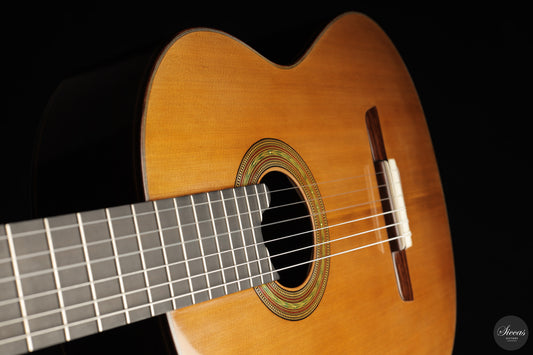
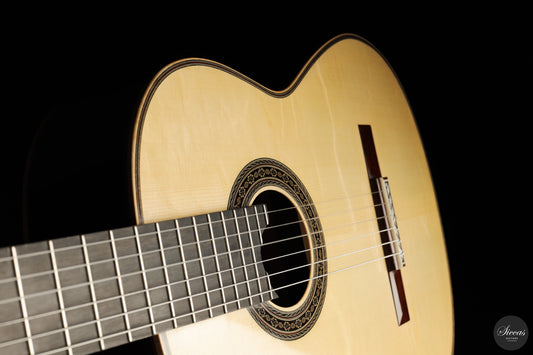
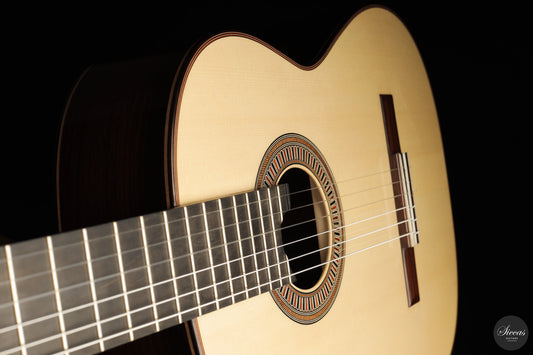
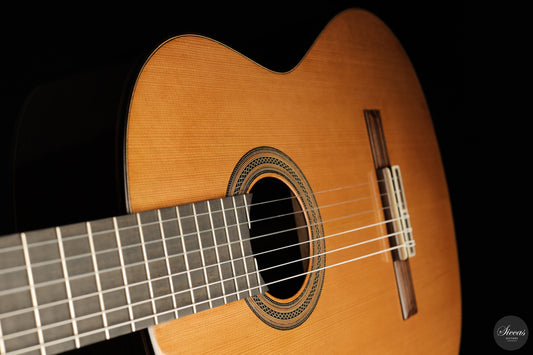
For her earlier programme she played three instruments from three different traditions. The first was a 1982 guitar by José Luis Romanillos, the Madrid-born maker who spent most of his working life in England and built for Julian Bream over many years. A 1982 instrument comes from his mature period.
The second was a 1964 Manuel Reyes from Córdoba. Reyes is best known for his flamenco guitars, and an instrument of that age in concert use is a rare thing to hear.
The third was a Torres 77 by Wolfgang Jellinghaus, built after a specific guitar by Antonio de Torres. Working in that tradition means committing to particular decisions about scale length, top thickness and bracing — and it puts the player in direct conversation with the instrument that defined the modern classical guitar.
Watch
More players in our overview of great classical guitarists, and more repertoire in our guide to famous classical guitar pieces.
The biography. The concert programme and the instruments in detail are in Kanahi Yamashita | Classical Guitarist – Biography & Videos.