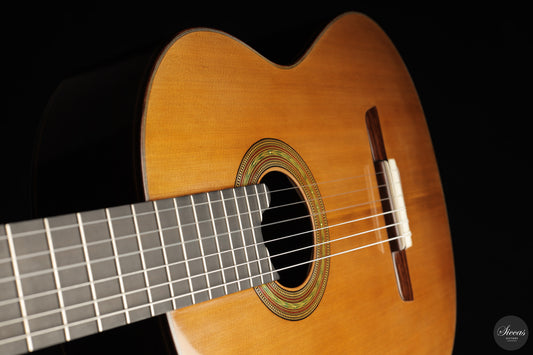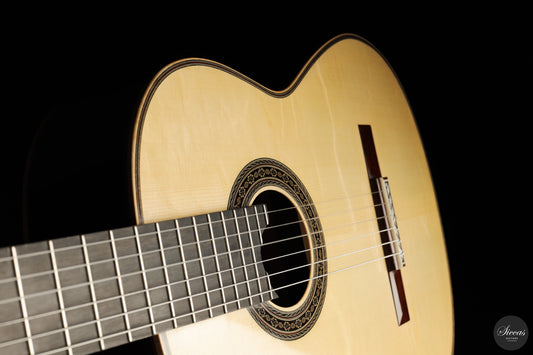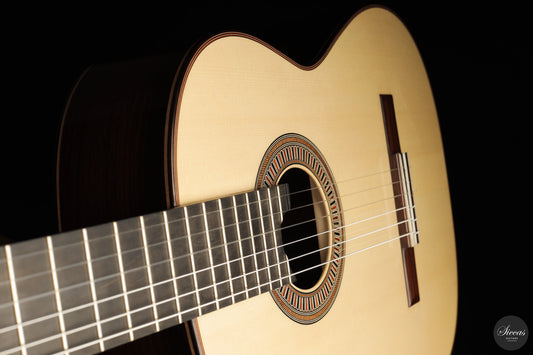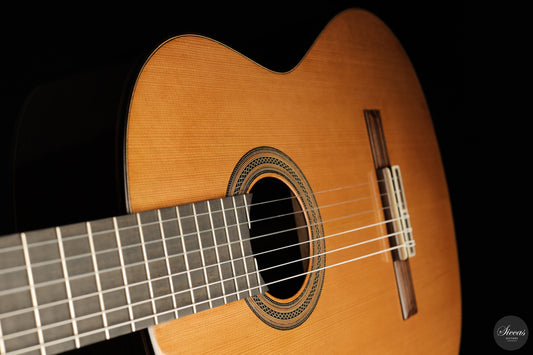

Among the handful of luthiers who have genuinely shaped the modern double-top classical guitar, Dieter Müller occupies a quietly distinguished place. Working from Biedenkopf in the German state of Hesse, Müller has spent decades refining an approach to guitar making that fuses rigorous scientific thinking with deeply felt musicianship. His instruments — prized for their warm, dark tone, extraordinary projection, and feather-light responsiveness — have earned him a loyal following among professional concert guitarists across Europe and beyond. For players in search of a double-top guitar that carries the soul of a traditional Spanish instrument without sacrificing modern performance demands, a Müller is frequently mentioned in the same breath as the finest instruments available today.
Biography and Training
Dieter Müller came to lutherie through an unusual combination of disciplines. From an early age he was immersed in music, taking up both the violin and the classical guitar, and he developed the kind of player's intuition that would later prove invaluable on the workbench. He went on to study physics at the University of Marburg, one of Germany's oldest and most respected academic institutions, and it was there that the foundations of his analytical approach to instrument design were laid. The ability to think carefully about acoustics, materials science, and the behaviour of vibrating structures under tension gave Müller a framework that few self-taught craftsmen possess.
When he turned his full attention to guitar building, Müller drew on a range of influences that spanned both the classical Spanish tradition and the emerging world of high-performance concert lutherie. The legacy of Antonio de Torres — whose deceptively simple structural principles remain the bedrock of the classical guitar — informed his understanding of proportion and resonance. He was also drawn to the work of American luthier Robert Ruck, whose guitars were admired for their tonal richness and dynamic sensitivity. Most significantly, he entered into a productive exchange of ideas with Matthias Dammann, the pioneering German maker who, alongside his colleague Gernot Wagner, is widely credited with developing the modern Nomex double-top construction. Dammann generously shared concepts and theories with Müller, and that relationship proved formative for the direction Müller's work would take. You can read more about the origins of this construction approach in our article on Double-Top Guitar Pioneers.
Construction Philosophy
At the heart of Müller's work is a commitment to what might be called disciplined lightness. The double-top construction he employs places a thin layer of Nomex honeycomb material between two extremely thin sheets of tonewoods — typically cedar — to create a soundboard that achieves a high stiffness-to-mass ratio impossible with a solid top alone. The result is a top that responds with exceptional immediacy to the player's touch, producing a sound that blooms quickly, sustains richly, and carries across a concert hall with ease.
What distinguishes Müller's guitars from many others in the double-top category is their tonal character. Where some makers in this tradition produce instruments that lean bright or glassy, Müller consistently achieves a darker, rounder, more complex sound — one that evokes the warm, resonant quality of fine old Spanish guitars while delivering the volume and projection that the modern concert stage demands. This balance is not accidental. It reflects deliberate choices in wood selection, bracing geometry, and finishing, informed by both his scientific background and years of careful listening. His instruments are notably light in hand, yet they respond to dynamic nuance with a sensitivity that rewards expressive playing.
Müller builds each guitar entirely by hand, working at a pace that prioritises quality over output. This means that his instruments are produced in limited numbers each year, and waiting times for a commissioned guitar reflect the care invested in each one. For a broader overview of how different structural approaches shape the sound of a concert guitar, our guide to fan-braced, double-top, and lattice guitars offers useful context, as does the dedicated double-top guitar guide.
Signature Models and Output
Müller's catalogue centres on the cedar double-top, the model that established his reputation and continues to define his output. These instruments typically feature a cedar soundboard over a Nomex core, with backs and sides in tonewoods selected for their acoustic properties as well as their visual beauty. Over the years he has also produced guitars with spruce tops for players who prefer a slightly brighter, more focused initial attack, though cedar remains the wood most closely associated with the Müller sound. A 63 cm scale-length version has been available for players who find the standard 65 cm demanding, reflecting an awareness of the practical needs of performing musicians.
Each instrument leaves the workshop as a finished concert tool rather than a showpiece. While Müller's guitars are elegant in their appointments, the aesthetic choices are always subordinate to acoustic function. The overall presentation is refined without being ostentatious — a quality that aligns well with the sensibility of serious players who want an instrument that performs rather than merely impresses.
Notable Players
Dieter Müller's guitars have found their way into the hands of a number of professional and semi-professional guitarists. The Swiss guitarist Christoph Borter is among those who has performed on a Müller instrument. The renowned German guitarist Stephan Schmidt has reportedly recorded with a Müller ten-string guitar, exploring the expanded tonal palette the instrument offers for Renaissance and Baroque repertoire. Portuguese-German guitarist Rebeca Oliveira is also noted as a player of a Müller cedar double-top. Ewin Guevara Gutiérrez, based in Spain, has played a Müller guitar from the Biedenkopf workshop. These players represent the kind of informed, discerning audience that Müller's instruments attract — musicians who have tried many guitars and arrived at his door because of what they heard, not because of marketing.
The broader world of classical guitar is populated by makers whose profiles are shaped as much by the players who choose them as by the instruments themselves. For a wider perspective on the tradition within which Müller works, the overview of classical guitar makers provides helpful context, and the profiles of figures such as Daniel Friederich and Robert Bouchet illustrate the lineage of French and European lutherie that has shaped contemporary instrument making.
Legacy and Standing
Dieter Müller is not a luthier who courts attention. He works with the concentration of a craftsman for whom the instrument is the message, and his reputation has grown steadily through word of mouth among players and dealers who have encountered his work in person. In a field where bold claims are common, his guitars have consistently delivered on what his understated profile promises: instruments of genuine concert quality, built with intellectual rigour and musical intelligence.
His place within the double-top tradition positions him as a significant figure in the development of contemporary German lutherie — a tradition that, through makers like Dammann, Wagner, and Müller himself, has produced some of the most technically advanced and tonally compelling classical guitars of the past three decades. For players who value an instrument that thinks as well as sings, a Dieter Müller guitar represents one of the most thoughtful choices available in today's market.
Browse available Dieter Müller guitars → in the Siccas Guitars collection.