Luca Santambrogio – A New Voice from the Brianza Tradition
Among the emerging generation of European classical guitar makers, Luca Santambrogio stands out as a craftsman of rare focus and authenticity. Born in 1995 in Desio, a small town in the Brianza region of northern Italy long associated with fine furniture and artisanal woodworking, Santambrogio grew up absorbing a culture of material precision and patient craftsmanship. Today, working from Milan, he builds classical guitars that draw deeply on the Spanish tradition while reflecting an unmistakably personal sensibility — instruments that are light, responsive, and built to last generations.
Education and Formation
Santambrogio's path to lutherie began with a degree in industrial design — a discipline that sharpened his eye for proportion, material behavior, and the relationship between form and function. He then enrolled at the Civica Scuola di Liuteria di Milano, one of Italy's most respected institutions for the training of string instrument makers. There he studied under master luthier Roberto De Miranda, who introduced him to classical guitar construction with a particular emphasis on traditional Spanish building methods: the solera, the Spanish heel, the fan-braced top. Graduating in 2022, Santambrogio left the school with a thorough grounding in historical and contemporary lutherie techniques.
His formation did not end at graduation. He went on to refine his skills further under the mentorship of Marco Bortolozzo, a respected Milanese luthier, deepening his understanding of tonal balance, structural integrity, and the subtle interplay between wood selection and acoustic result. This layered training — academic institution followed by master-to-apprentice mentorship — gave Santambrogio both breadth and depth at an unusually early stage of his career. The broader Italian luthiery scene he entered has its own distinguished lineage, well represented by figures such as Andrea and Giovanni Tacchi, whose Florentine workshop has long set a benchmark for Italian classical guitar making.
The Workshop and Approach
Santambrogio works from LiutaiLab, the Laboratorio di Liuteria Stefano Bertoli located in Milan's Dergano district, where he joined as a winner of an art residency grant. The workshop functions as both a production space and a place of ongoing dialogue among luthiers — an environment that suits Santambrogio's reflective, research-oriented approach to the instrument. He constructs and occasionally repairs classical guitars and other plucked stringed instruments, but his central focus remains the concert-level classical guitar.
His philosophy is shaped by two commitments that he treats as inseparable: lightness and projection. Working with carefully selected tonewoods, he gravitates toward tops of Italian alpine spruce from Val di Fiemme — the same forests that supplied tonewoods to the great Cremonese violin makers — combined with Indian rosewood for back and sides. Every component is graduated and adjusted by ear and by touch rather than by formula, a working method consistent with the best classical guitar makers of the Spanish and French schools. The result is a guitar with a voice that opens immediately yet develops further under the hands of an experienced player.
The Romanillos Model
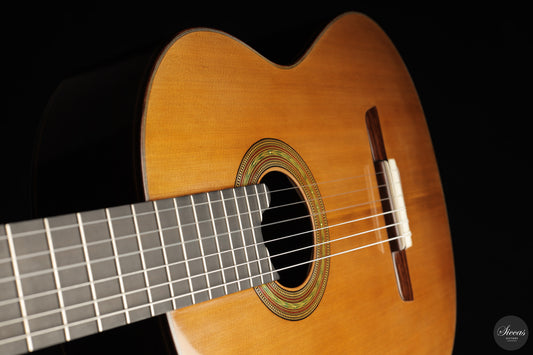
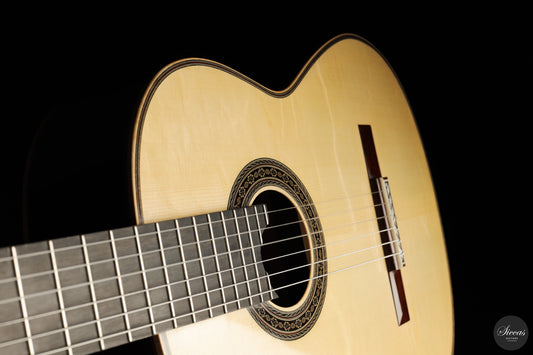
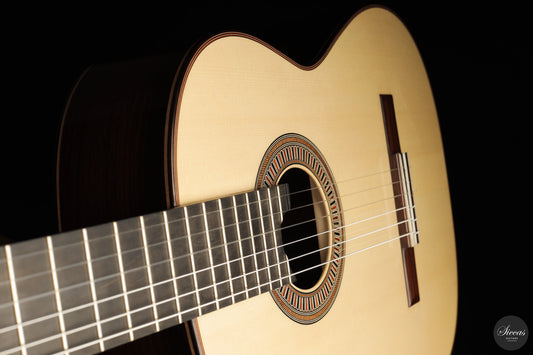
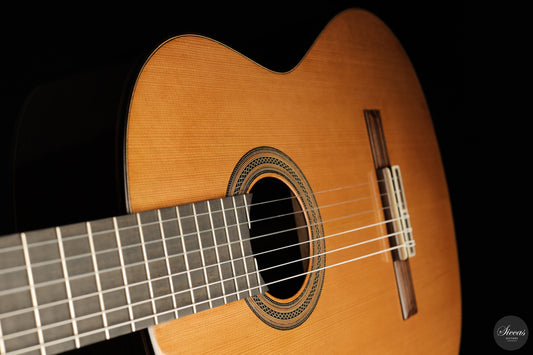
The instrument that has drawn the most attention from players and collectors is Santambrogio's Romanillos Model — a guitar built in direct homage to the work of José Luis Romanillos, the Spanish master whose instruments shaped the sound of Julian Bream and left a permanent mark on the classical guitar world. Santambrogio's version retains the proportions, bracing geometry, and aesthetic restraint that define the Romanillos tradition: a modest but precise decorative scheme, a cedar or spruce top of exceptional stiffness-to-weight ratio, and a tonal profile that favors warmth, clarity, and singing sustain in the upper register.
The Romanillos Model is not an imitation but an interpretation — Santambrogio brings his own graduation philosophy and material choices to a framework he admires. This kind of careful apprenticeship to the historical masters is entirely in keeping with the broader spirit of the Spanish school, which regards the study of great predecessors — from Robert Bouchet to Daniel Friederich — not as imitation but as the essential foundation for developing an original voice. The bracing patterns Santambrogio employs reflect a deep familiarity with fan-braced construction and its acoustic logic, even as he adapts details to suit his own tonal vision.
Legacy in the Making
Luca Santambrogio is, by any measure, still at the beginning of a career that already shows exceptional promise. At an age when most luthiers are still consolidating their technique, he is producing instruments of concert quality that have attracted the interest of serious players. His instruments have been offered through Siccas Guitars, placing them alongside the work of the finest makers in the world — a mark of both the quality of the guitars and the confidence the international community of players and dealers has in his work.
What makes Santambrogio worth watching is not only the quality of his current output but the seriousness of his intellectual engagement with the tradition. He has not arrived at the classical guitar by accident. He has studied its history, trained under its practitioners, and chosen a path that prizes depth over novelty. Whether the coming decades carry him toward experimentation, toward refinement within the Spanish idiom, or toward some synthesis of the two, the foundation is clearly there. Northern Italy has a long tradition of producing world-class makers of stringed instruments, and Santambrogio's early career suggests he intends to honor that tradition at the highest level.
Browse available Luca Santambrogio guitars → in the Siccas Guitars collection.