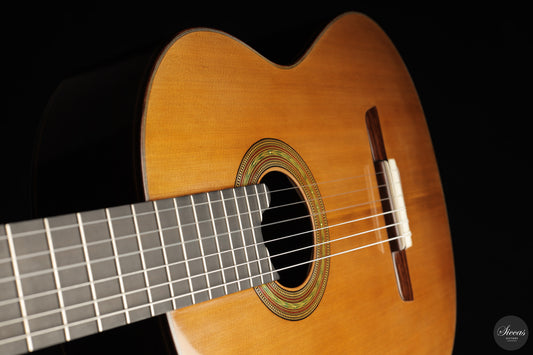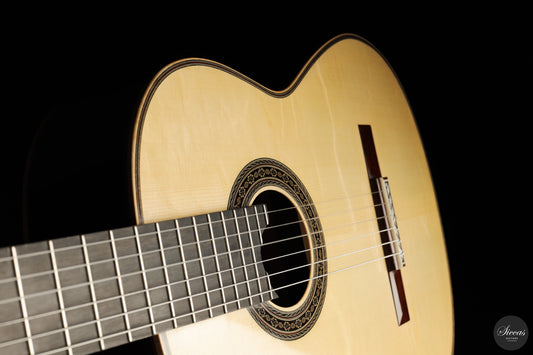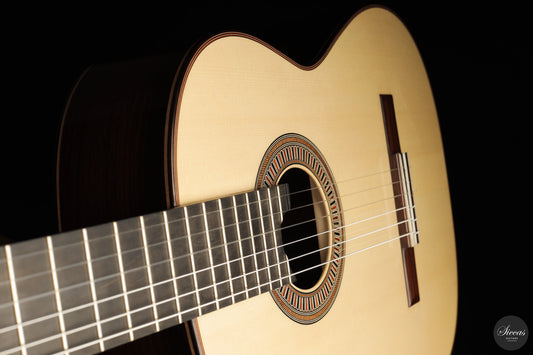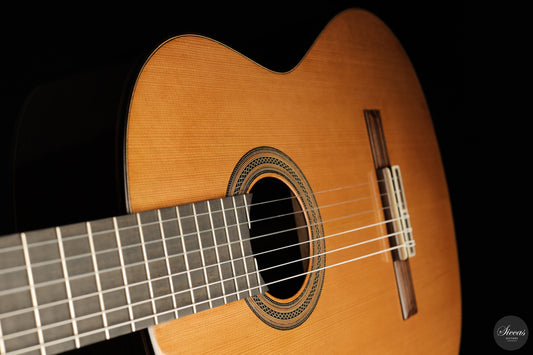

Among the new generation of classical guitar makers emerging from northern Italy, Oreste Lohs stands out as a builder of rare seriousness and sensitivity. Working from his small artisan studio in the Bolognano area near Arco on Lake Garda, Lohs crafts a strictly limited number of instruments each year — each one the product of months of deliberate, unhurried work carried out almost entirely by hand. Though still early in his career, he has already attracted the attention of players and collectors worldwide, and his guitars have appeared at Siccas Guitars to enthusiastic reception. What makes his story particularly compelling is not only the quality of the instruments he produces, but the path he took to arrive at the workbench.
Biography & Training
Oreste Lohs was born in 1994 and grew up near Lake Garda, in the Trentino region of northern Italy — a landscape of alpine forests and mountain air that would later inform both the materials he selects and the tonal character he pursues. His academic background is unusual for a luthier: he holds a degree in anthropology, a discipline that cultivated in him an attentive, questioning relationship with materials, culture, and craft traditions. It was his brother who set him on his current path, gifting him a guitar-making course in Rovereto where he first learned to assemble instruments under the guidance of a local luthier. He completed his first classical guitar in around 2016 or 2017 and, recognising something essential in the experience, committed himself fully to lutherie from that point forward.
The decisive turning point in his technical development came through his encounter with Daniele Chiesa — an acclaimed Italian luthier based in Granada whose instruments are available at Siccas Guitars and who is deeply rooted in the Granadian building tradition. In 2023, Lohs observed Chiesa's work closely, and in 2024 he attended one of Chiesa's advanced guitar-making courses. That immersion in the Granada school — itself shaped by giants such as Paco Santiago Marín and Antonio Marín — gave Lohs a rigorous conceptual framework within which to develop his own voice. The Granada tradition, with its distinctive approach to resonance, weight, and structural balance, became the foundation on which he continues to build.
Construction Philosophy
Lohs has described his approach to lutherie as one guided by the senses rather than by templates and machinery. He works without external or internal molds or jigs, choosing instead a traditionally inspired method that keeps him in constant physical dialogue with the wood. Hand tools dominate his workshop; he minimises the use of electricity deliberately, believing that reducing the mediation between maker and material is essential to producing instruments of genuine character. This is not mere aesthetic preference — it reflects a considered philosophy about where the quality of a guitar ultimately originates. The hand feels what the machine cannot measure.
Central to his building practice is what he calls a search for tension-free construction. Every plate, brace, and joint is worked toward a state of natural equilibrium, avoiding the accumulated stresses that can restrict an instrument's resonance and responsiveness over time. His process is also rigorously controlled in terms of variables: humidity, wood graduation, and assembly sequence are monitored and managed with discipline, ensuring that each guitar emerges from the workshop in precisely the condition he intends. This combination of sensory engagement and analytical rigour is uncommon in so young a maker, and it speaks to the depth of thought he brings to the craft. Those interested in the broader landscape of building approaches — including fan bracing, double tops, and lattice construction — will find useful context in our guide to fan-braced, double-top, and lattice classical guitars.
The materials Lohs selects reflect his northern Italian roots. He is known to favour spruce tops sourced from the alpine forests of his region — the same timber tradition that has shaped European lutherie for centuries — paired with carefully chosen back and sides and necks of Spanish cedar (fragrant cedrella). Each combination is assessed individually, with the acoustic properties of the specific pieces of wood guiding every decision about graduation and bracing.
Awards & Recognition
Despite the short span of his career, Lohs has already received significant formal recognition. One of his handcrafted classical guitars won first prize at the XII International Violin Making Competition ANLAI in Pisogne — a meaningful achievement in a field where competition among Italian makers is particularly fierce. This award placed him in a lineage of recognised Italian lutherie that stretches back through centuries of craft tradition, from Cremona's string instrument makers to the contemporary classical guitar makers working across the peninsula today. His guitars have also been shown and sold through specialist dealers internationally, confirming that the professional world has begun to take notice. The broader context of Italian guitar making is explored in our article on the Italica project, a collaboration among Italian master luthiers that illuminates the richness of the country's current scene.
Lohs has also collaborated with the Scuola Musicale Alto Garda, the music school serving the Lake Garda region, demonstrating a commitment to his local cultural community that goes beyond the solitary work of the workshop. For a young luthier, engagement with the broader musical life of a region is a meaningful signal of long-term seriousness.
Legacy & Place in the Wider Tradition
It would be premature to speak of a legacy for a maker still in the early decades of his career. Yet the trajectory of Oreste Lohs invites genuine attention. He has absorbed the lessons of the Granada school — the tradition that produced some of the most revered instruments of the twentieth century — through direct mentorship, and he has filtered those lessons through an independent intelligence shaped by anthropology, alpine craft culture, and a philosophical commitment to slowness and precision. His instruments are not copies of any model or tribute to any single master; they are the product of a genuinely personal synthesis.
In the wider context of classical guitar makers, Lohs represents a current that values continuity with tradition without being imprisoned by it. Where makers of earlier generations — figures such as Daniel Friederich or Ignacio Fleta — defined their innovations against the backdrop of mid-twentieth-century guitar culture, Lohs inherits a moment when that accumulated knowledge is freely available and the challenge is not to discover new forms but to build with genuine depth and authenticity. The fact that he has chosen to do so with hand tools, without molds, and with an academic's eye for process suggests that his instruments will only grow richer and more distinctive as his career unfolds.
Collectors and players seeking a young Italian voice grounded in Granadian tradition, built with exceptional care and limited in annual output, will find Oreste Lohs to be one of the most promising names emerging from Italy today.
Browse available Oreste Lohs guitars → in the Siccas Guitars collection.