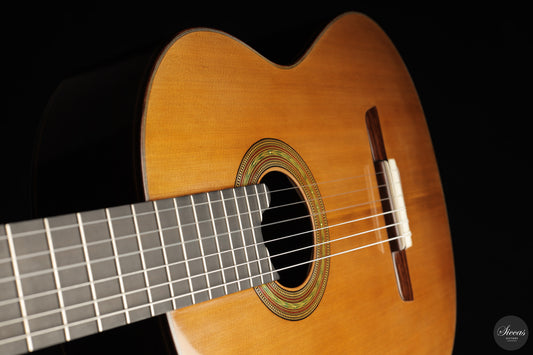
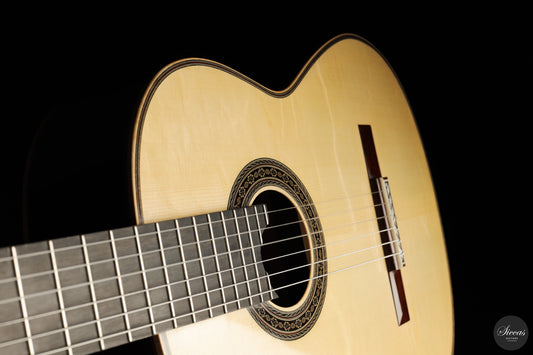
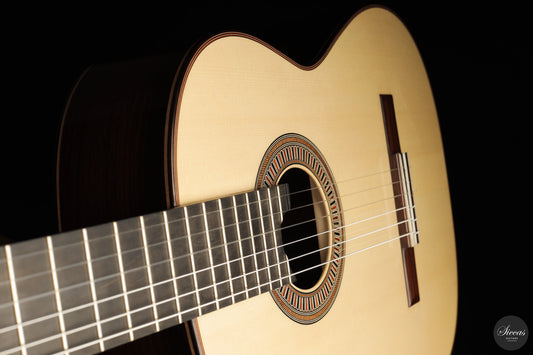
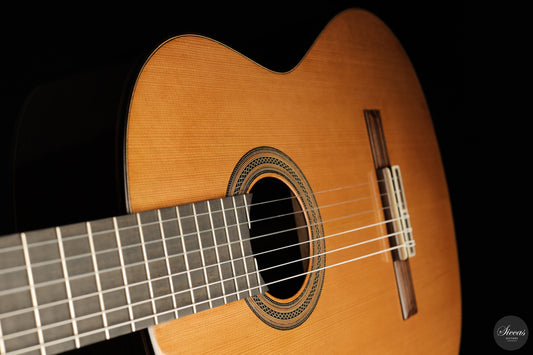
Otto Rauch occupies a singular place among contemporary classical guitar makers. Working quietly from the small town of Obermoschel in the Rhineland-Palatinate region of Germany, he has spent more than four decades crafting instruments of exceptional tonal depth and structural originality. Rauch is widely regarded as one of the German pioneers of double-top construction — a building technique that has redefined what concert-level classical guitars can sound like. His instruments are played by internationally recognised soloists, and his signature model, the Domenico Montagnana – The Sleeping Beauty, has become a benchmark against which other double-top guitars are measured.
Biography & Training
Born in Mainz in 1954, Otto Rauch came to lutherie through an unusually winding path. He began studying classical guitar at the age of nine, but his working life initially took him in an entirely different direction — he trained in insurance sales and business management before becoming a rock guitarist and singer in the late 1970s. It was during this period, in 1977, that the first seed of lutherie was planted: Rauch decided to build a copy of the electric guitar he was playing at the time. The project planted a fascination with instrument construction that would eventually take over his life.
The decisive turning point came in 1979 when Rauch was living on the Spanish island of Ibiza. In an old farmhouse he discovered an aged Ramírez classical guitar. He measured and documented the instrument carefully, and by 1980 he had begun building classical guitars in earnest. His early self-taught work gave way to formal training: from 1985 to 1987 he apprenticed with luthier Klaus Röder, making both classical and jazz guitars, and in 1987 he passed his journeyman examination under Dieter Hopf — one of the most respected names in German guitar making. He subsequently completed his master craftsman examination, establishing the professional foundation for everything that followed.
Construction Philosophy
Rauch's approach to guitar making is rooted in rigorous historical study combined with a willingness to experiment beyond established norms. His range encompasses instruments inspired by some of the most important names in guitar history — the 1930 Hauser I, an 1885 Torres, the Thomas Humphrey model, and instruments by Stauffer, Schmid, and even a Stradivari — making him a builder who bridges the classical tradition and contemporary innovation in a way that few can. For players drawn to the historical lineage of the instrument, these models offer a rare opportunity to explore the tonal ideals that shaped the repertoire. You can learn more about how those traditions relate to each other in this overview of classical guitar makers.
The double-top chapter of Rauch's career opened in the early 1990s after he repaired a guitar built by Matthias Dammann, one of the founding figures of double-top construction in Germany. The experience was revelatory. Rauch began experimenting with his own interpretation of the technique, initially using cedar struts before transitioning to a balsa wood core sandwiched between two ultra-thin cedar or spruce facings — the structural principle that defines the double-top approach. Unlike a conventional soundboard, this composite construction achieves a dramatically reduced mass without sacrificing stiffness, allowing the top to vibrate more freely and respond with greater sensitivity across the dynamic range. The result is a guitar that is both powerful in projection and nuanced in colour. For a deeper exploration of how this technology evolved, the article on double-top guitar construction provides essential context, as does the profile of double-top guitar pioneers Dammann and Wagner.
Signature Models
The model that has most defined Otto Rauch's reputation is the Domenico Montagnana – The Sleeping Beauty. The name itself tells a story. While assisting a friend with a violin-making venture, Rauch encountered the legacy of Domenico Montagnana, the eighteenth-century Venetian luthier whose cellos are celebrated for their dark tone, exceptional volume, and enigmatic construction. Recognising that these three qualities — darkness, power, and structural mystery — described exactly what he sought in his own guitars, Rauch adopted the name. The Sleeping Beauty suffix refers to the instrument's characteristic of revealing its full tonal potential only gradually, as if waking from sleep under the hands of a dedicated player.
Each guitar carries a serial number and is built entirely by hand in Rauch's workshop. The consistency of quality across the series — instruments numbered into the 280s and 290s are in active use by professional soloists — speaks to a maker who has refined his process over decades without compromising the individual attention that distinguishes handcrafted instruments. In 2025 Rauch released a limited edition variant called the Duchess of Cleveland (No. 292), an evolution of the Montagnana concept that demonstrates his continued willingness to push the design forward.
Notable Players
The roster of musicians who have chosen Otto Rauch guitars for professional use reflects the instruments' standing in the concert world. Angel Romero, the celebrated Spanish-American guitarist whose career spans decades of international performance, has played Rauch guitars, lending the maker an endorsement that carries enormous weight in the classical guitar community. Frank Bungarten, one of Germany's most distinguished concert guitarists, is another player whose association with Rauch's instruments has helped establish the maker's profile beyond the German-speaking world. Other players include Stefan Hladek, Benjamin Scheck, and three of the four members of the Barrios Guitar Quartet — an ensemble whose technical demands place the highest possible requirements on any instrument. The breadth of this community of players, spanning different stylistic orientations and repertoires, is itself a testament to the versatility and reliability of Rauch's construction.
Legacy
What makes Otto Rauch's contribution to contemporary lutherie particularly significant is the combination of historical consciousness and genuine innovation. He does not occupy a single niche: he is equally at home building a meticulous Torres replica — in the tradition of builders like José Luis Romanillos, who devoted his career to understanding the Torres legacy — and developing a structurally novel double-top design that has influenced a generation of German luthiers. This dual commitment mirrors the broader arc of guitar making in the twentieth century, described so vividly in the work of makers such as Daniel Friederich, who similarly balanced respect for tradition with a drive to innovate.
Beyond building, Rauch remains an active musician and composer — he has completed a guitar suite titled Suite Christophoro Colombo — and he continues to work in related instrument making, including a Stradivari cello built in his spare time. This sustained engagement with music and making, across more than four decades, gives his work a depth of understanding that is difficult to achieve through craft alone. For players and collectors seeking a contemporary German classical guitar of the highest order, Otto Rauch's instruments represent a compelling choice: historically informed, structurally innovative, and built with the kind of personal commitment that defines the finest lutherie.
Browse available Otto Rauch guitars → in the Siccas Guitars collection.