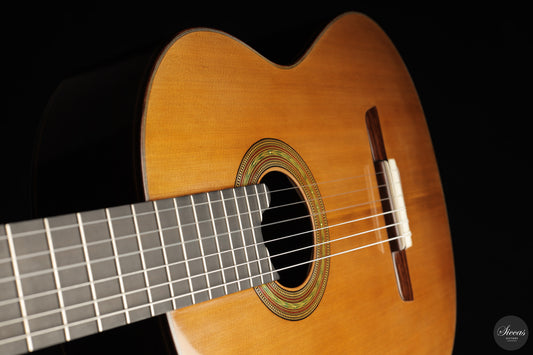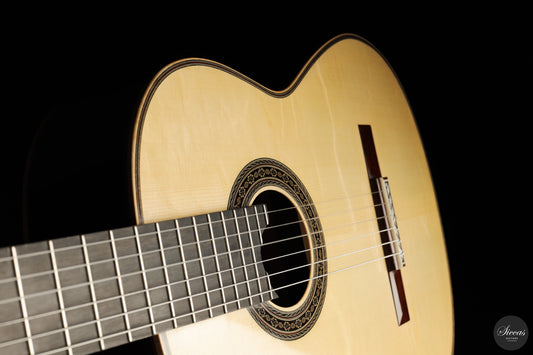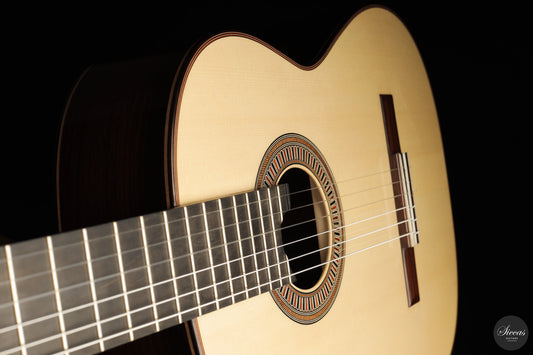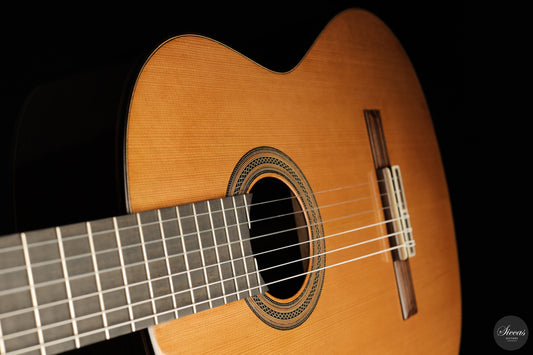

Among the most compelling voices in contemporary classical guitar making, Tan Tan stands out as a builder whose instruments have earned serious attention from players and collectors well beyond his home country of China. Born in 1989, Tan began studying classical guitar at the age of four — a grounding in music that would shape every decision he later made at the workbench. Over more than a decade of devoted lutherie, he has moved from meticulous study of the great historical traditions to a highly personal and technically sophisticated approach to the modern concert instrument. His workshop, operating under the name Hardcore Master Workshop, has produced guitars that draw direct comparisons to the finest double-top instruments in the world.
Biography and Training
Tan Tan grew up immersed in classical guitar from early childhood, beginning his studies at age four in China. This unusually early start gave him a performer's instinct for tone, balance, and playability — qualities that would later prove invaluable when he transitioned from player to maker. After completing his university studies, he committed fully to lutherie, bringing an analytical mind and a musician's ear to the challenges of instrument construction. His training was largely self-directed and research-driven, drawing on the historical record left by the great Spanish and European masters whose instruments had defined the classical guitar repertoire for generations.
In the early phase of his career, Tan focused on traditional construction models, studying the approaches of Antonio de Torres, José Luis Romanillos, and the Hauser family. These makers represent the foundations of modern classical guitar design, and building in their tradition gave Tan the technical vocabulary he needed before he could meaningfully depart from it. This period of study was not merely imitation: it was a rigorous apprenticeship to the accumulated wisdom of the instrument's history, carried out through careful construction, close listening, and patient refinement.
Construction Philosophy
Around 2018, Tan Tan made a decisive pivot. Having absorbed the lessons of the historical tradition, he turned his attention to the possibilities offered by contemporary lutherie, particularly the double-top construction method that had been developed and refined by German and European makers over the preceding decades. The double-top technique — in which two thin layers of tonewood are bonded around a lightweight Nomex honeycomb core — produces a soundboard that is both extremely light and structurally stiff, allowing for a range of tonal responses that a single solid top cannot always achieve. For an overview of how this approach relates to other construction methods, the guide to fan-braced, double-top and lattice guitars provides useful context.
Tan's preferred combination pairs a cedar top with Indian rosewood back and sides, finished in traditional French polish. Cedar's natural warmth and sensitivity make it well suited to the double-top format, where the reduced mass of the soundboard allows even subtle tonal qualities to project clearly. His instruments are finished to a 650mm scale length — a standard concert dimension — and typically weigh around 1,580 grams, reflecting the careful material selection and thin construction that characterise the double-top approach. The resulting sound is described as round, dark, and warm in the trebles, with impressive sustain and a controlled, balanced response across the full register.
What distinguishes Tan's instruments is not simply technical correctness but a particular kind of generosity in the playing experience. His guitars are notably forgiving — responsive to a wide range of right-hand techniques and yielding a full, rich tone without demanding exceptional precision from the player. This quality, which is characteristic of the finest double-top instruments, suggests a sophisticated understanding of how the soundboard's response interacts with player input. It is the kind of outcome that cannot be engineered by specification alone; it requires accumulated experience, careful voicing, and a maker's ear developed through years of listening. Tan's double-top work has been compared favourably to instruments by the pioneers of the double-top format, a standard that few makers outside Europe have been held to.
Signature Models
The centrepiece of Tan Tan's current output is the series produced under the Hardcore Master Workshop designation. The 2025 Hardcore Master Workshop Double-Top is the most visible example of his mature work, combining cedar and Indian rosewood in a double-top construction that showcases the full range of his technical and aesthetic development. The guitar is finished in French polish, a labour-intensive process that allows the wood to vibrate as freely as possible while providing a refined and historically appropriate surface. The specification reflects considered choices at every point: the scale length, the weight, the material pairings, and the voicing of the soundboard all point toward a maker who understands that each decision contributes to the final acoustic result.
The Hardcore Master Workshop name itself communicates something important about Tan's attitude to his work. It suggests a commitment to intensive, uncompromising practice — the kind of approach that defines the workshop cultures of the great European lutherie traditions. For those familiar with the history of classical guitar makers more broadly, it signals an awareness of that lineage and a determination to contribute to it at the highest level.
Place Among Contemporary Makers
Tan Tan's emergence is part of a broader development in the world of classical guitar making, as a new generation of highly skilled craftspeople from outside the traditional European and Spanish centres has begun to produce instruments capable of competing at the concert level. The double-top format, with its roots in German lutherie, has proven particularly receptive to this kind of international development, since it rewards systematic study and careful execution as much as inherited tradition. Tan's guitars have been described as embodying the tonal characteristics of the finest German double-top instruments — a significant assessment for a maker working independently in China.
For players and collectors seeking alternatives to the established European names, Tan Tan's work offers a compelling case: instruments built with deep historical knowledge, technical precision, and a clear aesthetic vision, available through specialist dealers with the expertise to assess and represent them properly. His trajectory — from early grounding in the historical tradition to confident mastery of contemporary construction — mirrors that of other makers who have shaped the instrument's recent development, and suggests a career with considerable further distance to travel. Those interested in the broader context of construction innovation may also find the double-top guitar guide a useful companion resource.
Legacy and Significance
It is still early in Tan Tan's career, and the full arc of his contribution to classical guitar making remains to be written. What is already clear is that he has established a standard of quality that commands respect on its own terms, independent of geography. His Hardcore Master Workshop instruments represent a serious and sustained engagement with the possibilities of the modern concert guitar — one rooted in tradition, technically accomplished, and tonally distinctive. For listeners and players who value the double-top sound, and for those who follow the ongoing evolution of classical guitar construction, Tan Tan is a maker worth knowing.
Browse available Tan Tan guitars → in the Siccas Guitars collection.