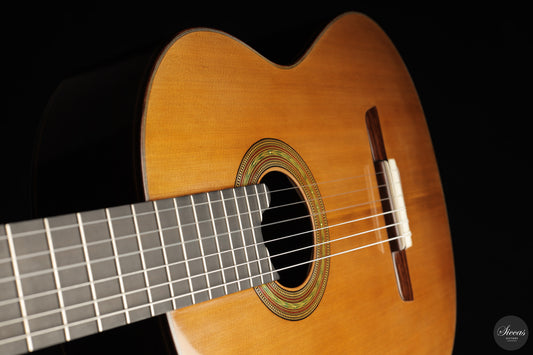
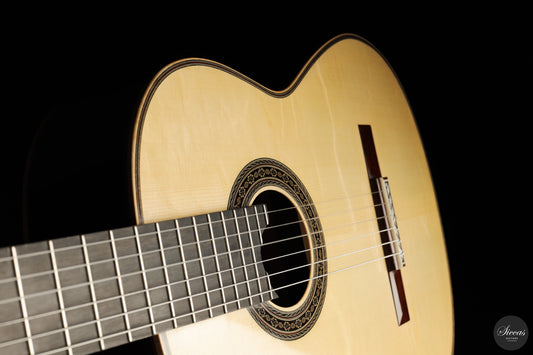
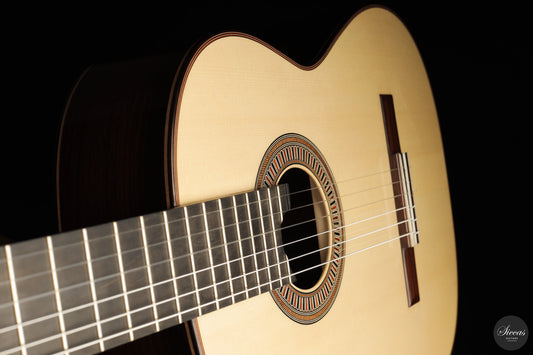
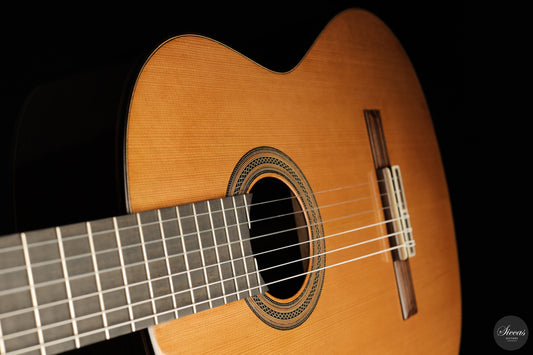
Yan Lei is one of the most compelling voices to emerge from China's growing classical guitar-making scene. Based in Tianjin, he has built a reputation in a remarkably short time — moving from complete self-instruction to international competition recognition within just a few years. What sets him apart is not only the technical precision of his instruments but also the philosophical curiosity he brings to every design decision. His double-top guitars, in particular, have attracted serious attention from players and dealers worldwide who recognise in them an uncommon blend of tonal clarity, dynamic range, and thoughtful structural innovation.
Biography & Training
Yan Lei began making guitars entirely on his own in 2012, driven by a passion for the instrument and a determination to understand it from the inside out. Two years later, in 2014, he joined a local workshop in Tianjin where he could learn alongside other luthiers, refining his technique through direct exchange and shared craft knowledge. The next major step came in 2016, when he travelled to study under British luthier Simon Ambridge — an experience that gave him a rigorous grounding in traditional European methods of construction and deepened his understanding of tonal balance and structural integrity.
By 2018, with only around four years of formal experience behind him, Yan Lei entered the 2nd Antonio Marín Montero International Guitar Making Competition in Granada, Spain — one of the most prestigious luthiery contests in the world. He placed fourth as a finalist, an extraordinary result for a maker of his relative youth in the craft. The competition brought him into contact with the wider international luthiery community and confirmed that his approach was worth developing.
In 2019, he undertook an extended study tour of the United States, visiting and working with three of North America's most respected guitar makers: Jeffery Elliott, R.E. Brune, and Ervin Somogyi. Each of these luthiers brought a distinct perspective — Elliott for his classical rigour, Brune for his deep historical knowledge, and Somogyi for his biomechanical approach to guitar acoustics. The exposure to such a range of thinking left a lasting mark on Yan Lei's own evolving philosophy.
Construction Philosophy
Yan Lei's approach is defined by a restless intellectual curiosity. He works fluently across several construction traditions — including Torres-style fan bracing, the Hauser school, and the methods associated with Daniel Friederich — before increasingly concentrating his energies on the double-top format. You can read more about the broader tradition of fan-braced, double-top, and lattice guitars and how these construction approaches differ in their acoustic goals.
The pivotal moment in his development came in 2021, when he was called upon to repair a double-top guitar built in 2012 by the German luthier Matthias Dammann — one of the pioneers of the form. What struck Yan Lei was Dammann's use of highly asymmetrical bracing and an innovative Nomex sandwich layout, which departed significantly from the more symmetrical designs he had encountered before. That guitar opened a new conceptual door. He began experimenting intensively with diverse bracing configurations and double-top architectures, pushing at the boundaries of what the format could achieve acoustically and structurally. The story of Dammann and other double-top guitar pioneers helps place Yan Lei's innovations in their proper context.
His current instruments feature spruce soundboards constructed using Nomex-core double-top technology, with targeted reinforcement patches placed at the bridge area and above the soundhole to manage local elasticity precisely. The bracing typically employs five parallel struts angled at approximately 15 degrees toward the treble side — a geometry intended to promote even vibration across the entire soundboard surface. The sides are built as a multi-layered laminate that combines rigidity with a low overall mass, while the back in solid Indian rosewood is cross-braced to optimise acoustic reflection. These are not arbitrary choices: each element reflects a specific acoustic intention arrived at through experimentation and careful listening.
His aesthetic sensibility is equally considered. The three-layer rosette found on instruments such as the 2025 Doubletop No. 69 is inspired by Chinese landscape scrolls — a visual metaphor, in his words, for "spontaneity and continuity." It is a reminder that Yan Lei sees his work not merely as acoustic engineering but as an expression of a continuous artistic identity shaped by both Eastern and Western traditions. Those interested in how this relates to wider debates about double-top guitar construction will find much to consider in the technical and aesthetic choices he makes.
Signature Models
Yan Lei's output to date has concentrated on concert-level double-top guitars, each numbered sequentially and representing a step in an ongoing investigation. The 2025 Doubletop No. 69 — available through Siccas Guitars — is among his most resolved instruments to date. Built with a spruce Nomex double-top soundboard and solid Indian rosewood back and sides, it exemplifies the asymmetric bracing philosophy he has refined since 2021. The instrument has received strong praise for its clarity in the upper register, its warm and present bass response, and the ease with which it projects in concert settings.
Earlier instruments, including those in the No. 50s series, have also attracted attention from major dealers in Europe and North America, with examples appearing at galleries in the United States that specialise in fine concert instruments. His instruments are increasingly sought after by professional performers looking for a guitar that combines modern acoustic efficiency with a refined, individual voice.
Notable Players & Recognition
While Yan Lei is still relatively early in his career, his guitars have reached the hands of players and collectors with serious professional credentials. His placement at the Antonio Marín Montero competition in 2018 brought him visibility in the European luthiery world, and his subsequent collaborations with leading American makers expanded his profile in North America. The rapid pace at which his instruments have been acquired by specialist dealers on both continents is itself a form of recognition from the most discerning buyers in the market.
For context on the wider tradition he is working within, it is worth exploring the legacies of masters such as Daniel Friederich and the other great luthiers who shaped the modern concert guitar. Yan Lei is in many ways a product of that tradition — absorbing it deeply before finding his own departure point.
Legacy
Yan Lei represents something genuinely significant: the emergence of a world-class classical guitar-making tradition in China. He is among a small group of Chinese luthiers who have not only matched international standards but contributed meaningfully to the development of the instrument. His willingness to study across cultures — British training, American mentorship, European competition — while maintaining a distinctly personal vision rooted in Chinese aesthetics, makes his work a fascinating case study in how the classical guitar continues to evolve globally.
At an age when many luthiers are still finding their footing, Yan Lei has already built instruments that are played and valued at the highest level of the classical guitar world. His future output will be followed closely by players, collectors, and fellow makers alike.
Browse available Yan Lei guitars → in the Siccas Guitars collection.