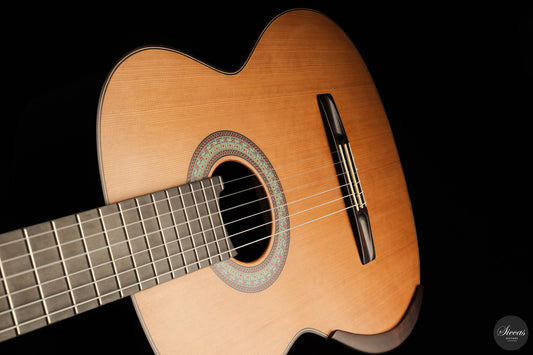
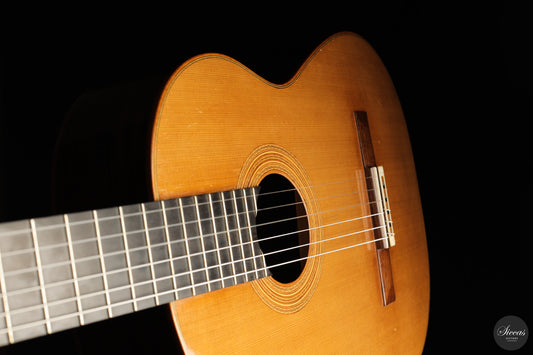
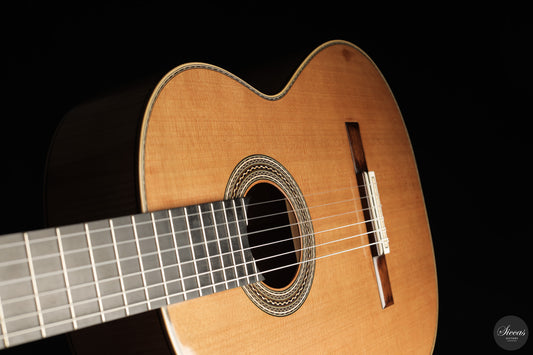
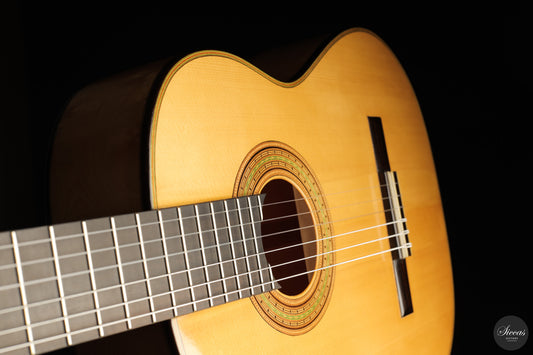
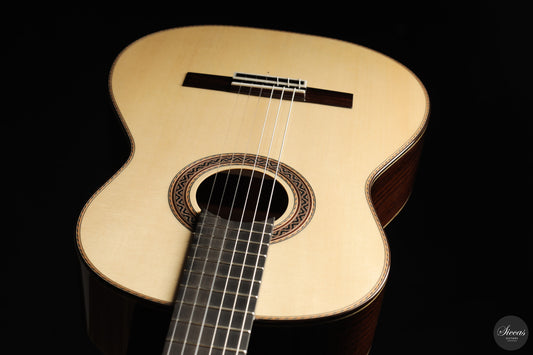
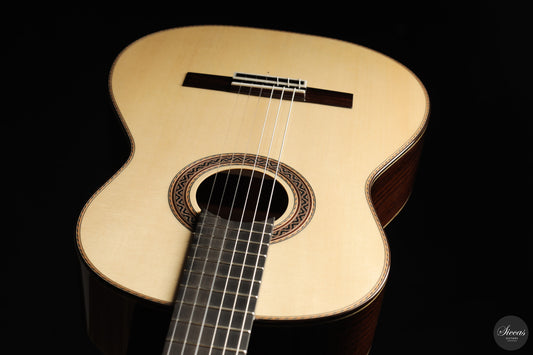
When a film needs intimacy, memory or heartbreak, directors reach again and again for one sound: the warm, human voice of the nylon-string guitar. Across decades of cinema it has carried some of the most unforgettable moments on screen. From the dusty plains of Spaghetti Westerns to the drawing rooms of Hollywood epics, the classical guitar has become cinema's most intimate voice. Here is a guided tour — and where to explore each one.
Why Classical Guitar Belongs in Cinema
The classical guitar occupies a unique position among orchestral instruments: it is both intimate and expressive, capable of enormous dynamic range yet always personal in tone. When a director needs a single note to carry the weight of a scene, the nylon string delivers without the full apparatus of a symphony orchestra. The guitar's soft attack and quick, warm decay feel close and human — perfect for a close-up, a moment of memory, or the quiet aftermath of loss.
Historically, the instrument entered the film score through composers who understood its folk roots and its capacity for vulnerability. The six strings of a classical guitar can whisper a lullaby, cry out in grief, or trace the melody of a half-remembered dream. No electronic instrument yet invented has replicated that quality. That is why, from the 1950s to the present day, the most emotionally devastating scenes in cinema have so often been carried by a single guitarist playing in a recording booth, very close to the microphone.
What follows is a survey of the most important moments in the history of classical guitar film music — composers, films, and the specific role the guitar played in making each one unforgettable.
Narciso Yepes and Forbidden Games (1952)
The story of classical guitar in cinema begins, in many accounts, with a single film: René Clément's Jeux Interdits — Forbidden Games — released in 1952. The score was performed by the Spanish guitarist Narciso Yepes, who was commissioned to record a soundtrack built almost entirely around solo guitar. The result was a revelation.
Yepes performed a traditional Spanish romance — the piece now universally known as Romance Anónimo or simply Spanish Romance — and the film's opening scenes of wartime France, grief, and childhood innocence became inseparable from those notes. The melody is simple, descending and cyclical, yet it carries an enormous emotional charge. Audiences in 1952 had rarely heard the classical guitar used this way in mainstream cinema, and the effect was striking.
Forbidden Games won the Academy Honorary Award for Best Foreign Language Film and is now considered a landmark of European cinema. Yepes' contribution introduced millions of viewers to the nylon-string guitar as a vehicle for cinematic emotion, and it opened a path that composers would follow for decades. The film demonstrated that a solo instrument — requiring no orchestra, no choir, no elaborate production — could score an entire feature with conviction and depth.
Narciso Yepes went on to record an enormous catalogue of classical guitar repertoire and remained one of the instrument's great advocates until his death in 1997. His work on Forbidden Games remains the foundational moment for guitar in movies.
Ennio Morricone and the Spaghetti Western
No composer used the nylon-string guitar more strategically — or more memorably — than Ennio Morricone. Beginning in the mid-1960s, Morricone developed a distinctive sonic palette for the Spaghetti Westerns directed by Sergio Leone, and the classical guitar was central to that palette from the start.
In scores for films such as A Fistful of Dollars (1964), For a Few Dollars More (1965), and The Good, the Bad and the Ugly (1966), Morricone layered acoustic and electric guitars against whistling, choral voices, and unusual percussion. The nylon guitar provided warmth and humanity in contrast to the stark, violent landscapes on screen. It was a deliberate choice: the classical guitar humanised the anti-heroes at the centre of these films, lending them a melancholy the script rarely allowed them to express directly.
Morricone's approach to the guitar was not purely decorative. He used it structurally, building themes that return transformed as characters develop. The guitar melody that opens a scene of quiet longing will recur, altered, at the moment of violence — creating the sense that beauty and danger inhabit the same world. This technique became one of the defining features of the Spaghetti Western genre.
Later, Morricone applied the same sensitivity to Cinema Paradiso (1988), co-composed with his son Andrea. The love theme, played on guitar, became one of the most widely recognised pieces of classical guitar cinema music, transcribed and recorded by guitarists worldwide.
The Godfather — Nino Rota
Nino Rota's haunting main theme for The Godfather (1972) is one of the most recognisable pieces of film music ever written. With its yearning guitar melody tracing a Sicilian melancholy through a few elegantly simple bars, the theme established the emotional register for Francis Ford Coppola's entire trilogy.
The theme opens on a solo instrument — that unmistakable guitar line — before the orchestra enters. This structural choice places the guitar as the voice of memory and family, the intimate human element against which the violence of the narrative is set. Rota understood that the guitar carried specific cultural meaning in the context of the film's Sicilian-American world: it is the sound of the old country, of a way of life being lost even as it is defended.
The Godfather theme has been transcribed for solo classical guitar and is now a staple of the recital repertoire. Its apparent simplicity conceals a sophisticated harmonic language, and guitarists who attempt it discover quickly that making those three notes speak with the required weight is a matter of touch, not technique alone.
Read about the Godfather theme →
The Deer Hunter — Cavatina by Stanley Myers
Stanley Myers' Cavatina, composed in 1970 and made internationally famous by Michael Cimino's The Deer Hunter (1978), became one of the best-loved guitar melodies of the twentieth century. Performed by the British guitarist John Williams — not to be confused with the American film composer of the same name — the piece is tender, simple, and almost unbearably moving in context.
The Deer Hunter centres on a group of friends whose lives are shattered by the Vietnam War. Cavatina is played during moments of quiet before and after the war, anchoring the film's emotional argument: that the world these men inhabited — beautiful, ordinary, irretrievable — has been destroyed. The guitar makes that loss audible.
Myers' melody is technically accessible to intermediate guitarists, which accounts for its enormous popularity in teaching contexts. Yet it demands a quality of tone and phrasing that takes years to develop. The challenge of Cavatina is not the notes — it is making each phrase sound inevitable.
John Williams — Composer and Arranger
The American composer John Williams — responsible for the scores of Star Wars, Jaws, Indiana Jones, Schindler's List and dozens of other defining films — has used the nylon-string guitar as a colour in his orchestral palette throughout his career. For Schindler's List (1993), Williams wrote a score of extraordinary restraint, and within it the guitar provides some of the most intimate moments: the instrument's voice against the strings suggests a private grief that the full orchestra could not achieve.
Williams has also spoken about the guitar's role in his compositional thinking. He studied under the guitar pedagogue Andrés Segovia during his formative years, and that background informs his instinctive understanding of what the instrument can and cannot do. His guitar writing is idiomatic, grateful to play, and unmistakably his.
Separately, the British guitarist John Williams — who performed Cavatina for The Deer Hunter — is one of the foremost classical guitarists of the twentieth century, trained by Segovia and celebrated for his precision and musical intelligence. The coincidence of names has caused confusion, but both have contributed significantly to the relationship between the classical guitar and cinema.
Forrest Gump and the Guitar as Innocent Voice
Alan Silvestri's score for Forrest Gump (1994) uses the acoustic guitar — and guitar-adjacent textures — to evoke the film's central quality: a kind of uncomplicated, wondering innocence. The main theme, gentle and lilting, has been widely transcribed for solo classical guitar and is among the most played film pieces in teaching contexts.
Silvestri's use of the guitar here is deliberately naive in the best sense: the instrument sounds like a child picking out a tune, curious and unhurried. Against the film's panoramic historical backdrop — the Kennedy assassination, Vietnam, Watergate — that naivety becomes a form of moral clarity. Forrest hears what others have learned not to hear, and the guitar says so.
Gustavo Santaolalla — Brokeback Mountain and The Last of Us
The Argentine composer and musician Gustavo Santaolalla represents the most recent major chapter in the story of classical guitar in screen music. His approach is distinctive: he favours raw, dry guitar tones with minimal reverb, close-mic'd so that every finger movement is audible. The result is a sound of almost uncomfortable intimacy.
For Ang Lee's Brokeback Mountain (2005), Santaolalla wrote a spare score built around solo guitar — mostly fingerstyle playing in open tunings, with occasional slide elements. The music won the Academy Award for Best Original Score, one of the few guitar-centred scores in Oscar history to receive that recognition. The guitar in Brokeback Mountain carries the things the characters cannot say: longing, shame, the awareness of irreversible choices. It is a masterclass in what a single instrument can accomplish when the surrounding space is left quiet.
Two decades later, Santaolalla brought the same sensibility to The Last of Us — first the video game (2013) and then the HBO television series (2023). The main theme, performed on a ronroco (a small South American instrument related to the charango, often confused with the guitar), uses a guitar-like fingerpicking technique to create a sound that is immediately recognisable: post-apocalyptic, grieving, and deeply human. In a world of electronic scores and orchestral spectacle, Santaolalla insisted on the imperfect, organic voice of a string instrument played close and plain. The success of The Last of Us — both as a game and as a television series — introduced that sound to a new generation of listeners.
The Classical Guitar in Context — What These Scores Share
Looking across these films and composers, several patterns emerge.
Intimacy Over Scale
Every composer discussed here chose the guitar precisely because it sounds small. Against the scale of cinema — the enormous screen, the immersive surround sound, the spectacle of production — a single guitar forces the audience into a more private register. It signals: pay attention, this is personal. Directors have learned to trust that signal.
Memory and Loss
The classical guitar is, in film music, almost always associated with the past. Forbidden Games mourns a world ended by war. The Godfather recalls a Sicilian heritage already fading. Cinema Paradiso is explicitly about memory — the film is a memory. Brokeback Mountain is about a life not lived. The guitar, with its quickly decaying notes, sounds like something passing. Each note begins to fade as soon as it is struck. That quality makes it a perfect instrument for loss.
The Human Body
Unlike a piano, the guitar is held against the body. Unlike a violin, it is cradled in both arms. The instrument's physical relationship to the player is visible and intimate, and that intimacy is audible in the sound. Film music made for guitar carries a bodily presence that synthesised or orchestral music cannot replicate. Directors and composers return to the classical guitar because it sounds like a human being, not a machine.
Simplicity as Complexity
The great guitar themes of cinema — Romance Anónimo, the Godfather theme, Cavatina, Brokeback Mountain — are all, on paper, simple. Few notes. Accessible melodies. Yet each one is extremely difficult to perform with the required conviction, and each one rewards sustained attention. The simplicity is the point: it allows the listener to bring their own grief, memory or longing to the music. The guitar outlines the space; the audience fills it.
Playing These Pieces — What Guitarists Should Know
For guitarists who want to explore the film repertoire, these pieces offer a rewarding path into music that already has emotional resonance for most audiences. A few practical observations:
Tone Production Matters Most
In every case, the quality that makes these pieces work — in the film and in live performance — is tone. Cavatina played with a brittle, harsh sound loses its effect entirely. The Godfather theme requires a warm, slightly veiled quality in the upper register. These are pieces that demand a guitar capable of nuance, and a right-hand technique capable of sustaining it across an entire performance.
Tempo and Breathing
Film scores for guitar are, without exception, played slowly. The tempos that work in the cinema — where the music supports a visual narrative — translate directly to live performance. Do not rush. The pauses between phrases are as important as the notes themselves. Listen to how Yepes breathes between the phrases of Romance Anónimo, how John Williams allows Cavatina to settle before the next section begins.
Transcriptions and Arrangements
Most of these pieces were not originally written for solo classical guitar. Cavatina was composed for guitar, but many of the others — Morricone's themes, Santaolalla's work — exist in published transcriptions of varying quality. Seek out editions made by experienced guitarists who understand the instrument's technical requirements, not simply note-for-note reductions from a piano or orchestral score.
For more on the broader classical guitar repertoire, see our overview of famous classical guitar pieces, and for context on the tradition from which these composers drew, the article on Francisco Tárrega — the composer who established the modern classical guitar — is essential reading.
Choosing a Guitar for Film Music
The tonal qualities required for this repertoire — warmth, sustain, a soft attack, clarity in the bass — describe the characteristics of a well-made cedar or spruce-top classical guitar. The light touch that film scores demand is best served by an instrument with low, even action and a responsive top that amplifies the player's dynamics without forcing them.
If you are working on pieces from this repertoire, or if the sound of these scores is what drew you to the classical guitar in the first place, the right instrument will make a significant difference to your experience. A guitar that resonates easily at soft volumes — that speaks clearly even when played gently — allows you to focus on phrasing and expression rather than on producing sound.
Browse our selection of classical guitars to find instruments suited to this kind of playing, or explore our profiles of great classical guitarists for more on the performers who brought this music to the screen.
How Long Does It Take to Learn These Pieces?
Students often ask about the film repertoire specifically — they come to the guitar because they heard Cavatina or the Godfather theme, and they want to know how long before they can play it. The honest answer depends on the piece and on the standard you hold yourself to.
Romance Anónimo is genuinely accessible at an intermediate level — perhaps two to three years of consistent study. Cavatina takes longer: the piece is technically simple, but the musicianship required to perform it convincingly takes time. The Godfather theme in a full solo arrangement is an intermediate-advanced piece. Santaolalla's The Last of Us theme, in its simpler versions, can be approached by beginners, but a fully realised performance requires control that only comes with experience.
For a detailed look at the learning timeline, see our article on how long it takes to learn classical guitar.
The Future of Classical Guitar in Film
The classical guitar's place in contemporary film and television scoring is secure. Santaolalla's work on The Last of Us demonstrated that the instrument remains capable of anchoring a major production in the 2020s. The trend in screen music toward intimacy — smaller ensembles, exposed solo instruments, the prioritisation of texture over spectacle — plays directly to the guitar's strengths.
Younger composers working in film and television have grown up hearing these scores, and many have turned to the guitar as a result. The instrument's accessibility — it requires no studio, no ensemble, no elaborate setup — makes it a natural first choice for composers who want to sketch emotional ideas quickly. Some of those sketches end up in the final film.
The classical guitar entered cinema through a single film in 1952. Seventy years later, it remains indispensable — not despite its limitations, but because of them. The quick decay of each note, the physical intimacy of the instrument, the vulnerability it seems to express: these are not weaknesses. They are the reason it keeps appearing at the most important moments on screen.
More famous guitar pieces → · Browse our classical guitars · Recuerdos de la Alhambra →