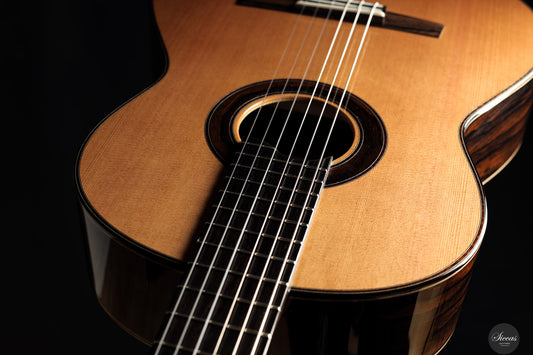
João Gilberto (1931–2019) did not simply play the guitar. He reinvented what the guitar could mean. With a single album released in 1959, he changed Brazilian music, redefined the nylon-string instrument's role in modern popular music, and created a sound so quiet, so internally precise, and so harmonically rich that the rest of the world spent decades trying to understand it. Bossa nova, the genre he invented, is today one of the most recognised and studied musical movements of the twentieth century. At its centre, always, was a man with a nylon-string guitar and a voice barely above a whisper.
From Juazeiro to Rio: The Making of a Guitar Revolutionary
João Gilberto Prado Pereira de Oliveira was born on 10 June 1931 in Juazeiro, a city in the interior of Bahia in northeastern Brazil. His early encounters with music came through radio broadcasts and local popular music, particularly the romantic vocal style of bolero and traditional samba-canção. He received a guitar as a teenager and quickly became absorbed by it, often retreating for hours to practise on his own. Those around him described his dedication as eccentric, even obsessive — he would lock himself in bathrooms to work on chord voicings, seeking a clarity and resonance he could not yet fully articulate.
As a young man, Gilberto moved to Rio de Janeiro seeking to break into the music scene. The 1950s Rio scene was commercially dominated by samba and the lavish orchestral arrangements of artists like Dick Farney and Lúcio Alves. Gilberto worked briefly with the vocal group Garotos da Lua but found little success and struggled financially. He returned to Bahia for a period, widely considered by others to have failed. It was during this time of apparent withdrawal that he refined what would become his signature batida — the rhythmic guitar pattern that would define bossa nova.
By the mid-1950s, Gilberto had returned to Rio and made contact with the composer and pianist Antônio Carlos Jobim and the poet and lyricist Vinícius de Moraes. The three became the nucleus of the movement that would be named bossa nova — literally "new trend" or "new wave" in Brazilian Portuguese. Gilberto's guitar was not an accompaniment to their songs. It was the rhythmic and harmonic architecture on which everything else rested.
The Batida: A New Rhythmic Language for the Nylon-String Guitar
To understand João Gilberto's significance, you must understand what the batida is — and what it replaced. Traditional Brazilian samba was driven by percussion, and guitar players typically provided rhythmic strumming patterns that broadly followed the percussive accents of the rhythm section. It was energetic, communal, and outward-facing in its expression.
Gilberto's batida was something fundamentally different. Using his thumb and fingers simultaneously, he created a pattern in which the thumb played bass notes on the lower strings while the fingers provided rhythmic chordal accents on the upper strings — but in a syncopated, internally shifting pattern that moved against the implied downbeat. The result was a rhythm that seemed to breathe on its own, independent of external percussion. It was not simply anti-samba in attitude; it was structurally asymmetric in a way that demanded attentive listening.
Crucially, this batida was conceived entirely for the nylon-string guitar. The sustained resonance of nylon strings, the warm bass response of the classical guitar body, and the ability to achieve a hushed, intimate tone without sacrificing harmonic complexity — all of these qualities were essential to the effect Gilberto was after. A steel-string guitar would have been too bright, too percussive in attack. The nylon string allowed him to blend the thumb bass line and the chordal punctuation into a single, internally coherent texture. It was one of the clearest cases in twentieth-century music of an artist choosing a specific instrument not by convention but by necessity.
The chord voicings Gilberto used were equally distinctive. Drawing on the harmonic language that Jobim was developing — itself influenced by French impressionism, particularly Debussy and Ravel, as well as American cool jazz — Gilberto played chords with added ninths, major sevenths, and altered dominants that gave the music a floating, unresolved quality. These voicings, combined with the batida, meant that his guitar playing occupied a space between rhythm and harmony in a way that had no real precedent in Brazilian popular music.
Chega de Saudade: The Album That Launched a Movement
In July 1958, Gilberto recorded the song "Chega de Saudade," written by Jobim and Vinícius de Moraes, for Odeon Records. The single was not an immediate commercial success, but it circulated among musicians and music journalists and generated significant discussion. The following year, in March 1959, he released his debut album of the same name. The album contained ten tracks, all featuring his nylon-string guitar and intimate vocal style, supported by orchestral arrangements by Jobim that framed rather than overwhelmed Gilberto's playing.
"Chega de Saudade" (often translated as "No More Blues" or "Enough of Longing") is now recognised as the founding document of bossa nova. It was the first time the batida appeared on a full album recording, and it made audible in a definitive way the difference between what Gilberto was doing and everything that had come before. The dynamics were lower, the tempo more restrained, the harmonic language more sophisticated, and the vocal delivery — almost spoken in places, always rhythmically precise — perfectly matched the guitar's internal complexity.
The album did not launch bossa nova through commercial dominance. It launched it through the force of its originality. Brazilian musicians heard it and immediately understood that something new had arrived. Within months, a generation of artists was attempting to absorb and extend what Gilberto had introduced. Jobim continued to compose music in the bossa nova idiom, and other guitarists — Roberto Menescal, Baden Powell, Luiz Bonfá — began developing their own approaches to the nylon-string within the new framework.
The International Breakthrough: Carnegie Hall and Stan Getz
Bossa nova reached international audiences with extraordinary speed. In November 1962, a concert at Carnegie Hall in New York — featuring Gilberto, Jobim, and several other Brazilian artists — brought the music to the American press and public. The concert was not universally praised at the time; some critics found the sound too quiet, too restrained for a large concert hall. But the recordings circulated widely and generated enormous interest among jazz musicians who heard in bossa nova a harmonic and rhythmic sophistication that aligned with the directions cool jazz had been exploring.
The following year, 1963, brought the recording that would make bossa nova a global phenomenon: the collaboration between João Gilberto, his wife Astrud Gilberto, the saxophonist Stan Getz, and Jobim on the album "Getz/Gilberto." The album was recorded in New York in March 1963 and released that same year. It became one of the best-selling jazz albums in history, winning four Grammy Awards including Album of the Year — the first time a non-American album had won that award.
At the centre of "Getz/Gilberto" was "The Girl from Ipanema" ("Garota de Ipanema"), composed by Jobim with lyrics by Vinícius de Moraes. The song featured João Gilberto singing the Portuguese verse and Astrud Gilberto — in her recording debut — singing the English verse. Getz's saxophone solo gave the song an international accessibility without diluting its Brazilian identity. It became one of the most recorded songs in history, second only to "Yesterday" by The Beatles in the twentieth century.
Throughout these recordings, João Gilberto's nylon-string guitar remained the rhythmic and harmonic foundation. Even in the company of a world-class jazz saxophonist and professional studio musicians, the guitar was not a supporting element. It was the engine. This was the mark of a truly original conception: when you stripped everything away, the music was still entirely itself in the guitar alone.
The Nylon-String Guitar in Gilberto's Artistic Identity
Throughout a career spanning more than six decades, João Gilberto never abandoned the nylon-string guitar. This was not simply a matter of preference or habit. It was a statement of identity and a creative necessity. Where many Brazilian popular guitarists experimented with electric guitars and later with acoustic steel-string instruments as musical fashions changed, Gilberto remained committed to the instrument that had shaped his conception of music.
The nylon-string guitar — often called the classical guitar in the European tradition — has specific acoustic properties that made it ideal for what Gilberto was doing. The lower string tension compared to steel strings makes it possible to fret complex chord shapes cleanly with less physical effort, which supported the relaxed, unhurried quality of his playing. The warmth of the nylon treble strings blended with the warmth of his voice in a way that created a single unified timbre. And the decay characteristics of nylon strings — slightly longer and more legato than steel — allowed his chordal punctuations in the batida to float rather than percuss.
His choice of the nylon-string guitar also placed him in dialogue with the broader classical guitar tradition, even though his musical language was entirely his own. The care he brought to tone production, the attention to left-hand positioning and right-hand articulation, the concern with the internal balance of a chord voicing — these are attitudes that classical guitarists will recognise immediately. Gilberto approached the popular guitar with a classical guitarist's sensitivity to the acoustic properties of the instrument, and the result was a sound that was unlike anything else in popular music.
For those who play or study classical and concert-level nylon-string guitars today, listening carefully to Gilberto's recordings is an education in what the instrument can do in the hands of someone who has fully internalised its possibilities. The classical guitars and flamenco guitars in the Siccas Guitars collection represent this same tradition of lutherie precision — instruments built to reveal, not obscure, the player's intention.
Gilberto's Perfectionism and Artistic Philosophy
João Gilberto was legendary for his perfectionism. Recording sessions with him were famously difficult. He was known to stop sessions over the slightest imprecision, to demand dozens of takes, to refuse to release material he considered unready. His discography is consequently small relative to his importance: a handful of studio albums and a small number of live recordings represent the public output of a sixty-year career.
This perfectionism was not merely temperamental. It reflected a coherent artistic philosophy in which the relationship between the guitar's rhythm, the harmonic voicing of each chord, and the placement of vocal syllables in the rhythmic stream was a system of extraordinary precision. Any imprecision in one element disturbed the whole. Gilberto's music sounded effortless — and that effortlessness was the product of absolute technical control.
He described his approach to the guitar in terms of a kind of internal economy: the less movement, the less effort, the more clearly the essential musical information would be communicated. This is a philosophy recognisable to students of classical technique, where tension in the body is the enemy of tone and clarity. Gilberto arrived at this understanding not through formal classical training — he was largely self-taught on the guitar — but through years of solitary practice focused entirely on the question of how to make the instrument speak with maximum clarity and minimum interference.
This makes him an important figure not just in popular music history but in the broader history of the nylon-string guitar. His example demonstrates that the technical and expressive possibilities of the instrument extend beyond the classical repertoire into forms and traditions that the instrument's European history did not anticipate. If you are interested in the full range of what great repertoire for the classical guitar encompasses, Gilberto's work is a reminder that the tradition is not closed.
Later Career and Legacy
After the initial international success of bossa nova in the early 1960s, Gilberto largely withdrew from public life. He gave concerts rarely, released albums infrequently, and became increasingly private. His personal life was turbulent; he was married multiple times and struggled with mental health difficulties in later years. There were extended periods during which he gave no concerts at all.
Yet his reputation among musicians and serious listeners never diminished. When he did perform, the concerts were events of cultural significance. His 2004 concert tour of Europe and Brazil, documented on the live album "João Voz e Violão," demonstrated that at over seventy years old, the precision and intimacy of his guitar playing remained completely intact. The album title — "João, Voice and Guitar" — was a declaration of his essential minimalism: everything that mattered was in the relationship between his voice and his nylon strings.
His influence on guitarists is enormous and extends across genre boundaries. Classical guitarists study his tone production and his approach to chord voicing. Jazz guitarists absorbed the batida into their rhythmic vocabulary. Singer-songwriters from all traditions have drawn on the emotional precision of his phrasing. Brazilian MPB (Música Popular Brasileira) artists of subsequent generations — Caetano Veloso, Gilberto Gil, Maria Bethânia — all acknowledged their debt to him directly.
He is also central to any understanding of how Brazilian music came to occupy the place it does in global popular culture. Bossa nova opened the door through which Brazilian music entered the international consciousness, and that door was opened by a man with a nylon-string guitar in a small recording studio in Rio de Janeiro. The history of great guitarists cannot be fully told without him.
João Gilberto and the Guitar's Place in Music History
The nylon-string guitar has had many defining moments in its history. The classical tradition gave it the solo repertoire of Sor, Giuliani, Tárrega, and Segovia. Flamenco gave it the rhythmic power of the compás and the emotional intensity of the cante. Latin American classical composers — Villa-Lobos, Ponce, Castelnuovo-Tedesco — wrote for it as a serious concert instrument. But bossa nova, and specifically João Gilberto's batida, gave it something else: a role as the rhythmic and harmonic centre of a modern popular music that would become one of the most globally recognised musical languages of the twentieth century.
This is not a small claim. Consider that the guitar in most popular music functions primarily as either a melodic lead instrument or a chordal accompaniment. In both roles, it is typically subservient to the voice or the rhythm section. In Gilberto's conception, the guitar was neither lead nor accompaniment in the conventional sense. It was a self-sufficient musical organism that contained within itself the rhythm, the harmony, and the implied counter-melody of the song. The voice and any other instruments were elements added to something already complete.
This conception had no real precedent in popular music, and it has had few true successors — not because musicians have not tried, but because what Gilberto achieved required a combination of technical mastery, harmonic sensitivity, and rhythmic originality that is very rare. Those who have come closest to his ideal — the guitarist and composer Baden Powell, for instance, or certain recordings by Caetano Veloso — all point back to him as the source.
For players who are serious about the nylon-string guitar, understanding Gilberto's contribution is as important as understanding Francisco Tárrega's influence on classical technique or the significance of Recuerdos de la Alhambra in the concert repertoire. These are different traditions, but they share an instrument, and the instrument's full history encompasses all of them.
The Guitar Sound: Tone, Touch, and Instrument Choice
One aspect of Gilberto's recorded legacy that repays careful attention is the guitar sound itself — the actual acoustic character of the instrument as captured in recordings from different periods of his career. His recordings from the late 1950s and early 1960s were made with relatively simple microphone setups that allowed the natural resonance of his nylon-string guitar to be heard with great clarity. The body resonance, the string attack, the decay of individual notes — all of these are audible in a way that reveals much about how he produced his sound.
He played fingerstyle exclusively, using his right-hand thumb for the bass notes and his index and middle fingers for the chordal accents. His nail length and the angle of his right hand relative to the strings were adapted to produce a warm, slightly muted attack — not the bright, projecting tone that classical concert technique aims for, but a more intimate, close-miked sound appropriate to the recording studio and to rooms of modest size. He understood that his music was fundamentally a recorded music, conceived for listening rather than for projection into a large concert hall.
The choice of instrument mattered enormously to him. While specific details of the guitars he owned and recorded on at different periods are not all documented, it is known that he played high-quality Brazilian-made instruments, particularly in his early recordings, and that he was attentive to the tonal character of individual guitars. The cedar or spruce top, the rosewood back and sides, the string action, the nut width — all of these affected the quality of the batida and the blend of bass and treble that his technique required.
This attentiveness to instrument quality is something that serious players will recognise. The difference between a well-made, acoustically responsive nylon-string guitar and an ordinary production instrument is enormous in the context of Gilberto's style, because his technique depends on the guitar providing a naturally balanced, warm, and sustaining tone without forcing. Players learning his approach today who work with a high-quality instrument will find that the technique is more accessible, and the musical results more convincing, than the same approach on a less responsive instrument.
Learning from Gilberto: Rhythm, Restraint, and the Nylon String
For students of the guitar, João Gilberto offers lessons that are relevant well beyond the specific context of bossa nova. The first is rhythmic independence: the ability to maintain a steady, internally complex rhythmic pattern in the right hand while managing harmonic changes in the left. This requires the kind of practice that is familiar to classical students — hands-separate work, slow practice, meticulous attention to the evenness of the pattern — applied to a rhythmic context that is entirely different from the classical repertoire.
The second lesson is harmonic patience. Gilberto's chord voicings are sophisticated, but he never rushed through them or used them as displays of technical knowledge. Each chord was placed with rhythmic precision and held for exactly as long as the music required. This is a discipline that comes from understanding harmony as a sonic experience rather than as a theoretical system — something that all serious guitar students eventually need to develop, regardless of the tradition they work in.
The third lesson is the lesson of restraint. Gilberto's music is famous for what it does not do: it does not project loudly, does not employ dramatic dynamics, does not use ornamentation or vibrato in the way that flamenco or classical music does. This restraint is not the absence of expression. It is a specific expressive choice — a decision that the music's meaning lives in the internal relationships of rhythm, harmony, and pitch, not in externally imposed drama. For many guitarists trained in more overtly expressive traditions, learning this restraint is genuinely difficult. But it is one of the most valuable lessons the instrument's history has to offer.
João Gilberto's Enduring Significance
João Gilberto died on 6 July 2019 in Rio de Janeiro at the age of 88. His death was mourned across Brazil and internationally as the passing of one of the truly original musical minds of the twentieth century. Brazilian President Jair Bolsonaro declared three days of national mourning — a recognition of the cultural significance of a man who had spent the last decades of his life in near-total isolation.
His work endures not only as a historical achievement but as a living influence on musicians working today. The bossa nova tradition he created continues to be studied, performed, and extended by guitarists and composers around the world. His recordings remain the primary reference point for anyone seeking to understand what the style requires. And his example — of a musician who arrived at a completely original conception through years of solitary work with his guitar, without formal training, and against the expectations of the commercial music scene around him — remains one of the most compelling stories in the history of the instrument.
The nylon-string guitar, in his hands, was revealed to be capable of something that no one had previously imagined. That revelation is the measure of his importance. It places him alongside the great figures who have extended the expressive and technical possibilities of the instrument — not in spite of working in a popular music tradition, but precisely because he took that tradition seriously enough to reimagine it from the inside.
Bossa Nova as a World Language: Gilberto's Global Reach
Few musical movements have achieved such global reach in so short a time as bossa nova. Within a few years of the release of "Chega de Saudade" in 1959, Gilberto's music was being heard, performed, and extended across the world. This was not accidental: the harmonic language of bossa nova — with its jazz elements and impressionist colouring — was immediately legible to international listeners, while the rhythmic approach retained an unmistakably Brazilian character through its origins in samba.
The influence of Gilberto's batida is detectable in genres and musical traditions that at first glance appear to have little to do with Brazilian music. Fingerstyle guitarists worldwide have absorbed elements of his right-hand motion. Jazz guitarists from Joe Pass to Pat Metheny integrated the harmonic density of his chord voicings into their playing. And the simple idea that a solo singer with a guitar can express something deeply complex and mature — without orchestral support or electronic amplification — has influenced countless singer-songwriters who feel committed to this line of thinking.
It is particularly striking that Gilberto's influence has remained undiminished even though bossa nova as a commercial movement was relatively short-lived. The original wave of the genre lasted perhaps ten years — from the late 1950s through the late 1960s, when Tropicália and other currents steered Brazilian popular music in new directions. But Gilberto himself remained a constant presence, a living reminder that the foundations he had laid were far more durable than any ephemeral fashion.
The Legacy of the Nylon-String Guitar in Brazilian Music
João Gilberto's choice of the nylon-string guitar had far-reaching consequences for Brazilian popular music. Before bossa nova, the guitar in Brazilian music was primarily a rhythmic instrument — important, but rarely at the centre of musical interest. Gilberto changed that fundamentally. He demonstrated that the guitar could be the sole centre of a sophisticated, adult musical expression — not as a virtuoso showpiece, but as a complete musical statement in itself.
This realisation had direct consequences for generations of Brazilian guitarists. Baden Powell, one of the most significant Brazilian guitarists after Gilberto, developed an approach that combined Gilberto's harmonic sophistication with the energy of the Afro-Brazilian tradition. Egberto Gismonti extended the possibilities of the nylon-string guitar in directions that wove together classical music, jazz, and indigenous Brazilian elements. Toninho Horta created pieces in which the guitar achieved a harmonic density that recalled orchestral music.
All these developments are difficult to imagine without Gilberto's pioneering work. He opened a space — a conceptual and sonic space — in which the nylon-string guitar could be perceived as a fully valid means of expression in modern popular music. That is a legacy deeply embedded in Brazilian musical culture and alive to this day.
Gilberto and the Classical Guitar Tradition: Parallels and Differences
It is instructive to compare João Gilberto's approach with the classical guitar tradition — not to establish hierarchies, but to understand what his work means for the broader understanding of the instrument. Classical guitarists like Francisco Tárrega — whose influence on modern classical guitar technique can scarcely be overstated — aimed for a particular kind of tonal beauty and technical perfection defined by the classical repertoire. Works like Recuerdos de la Alhambra are touchstones of this tradition: they demand extreme technical control and deep musical understanding.
Gilberto demanded something similar of himself — but in a completely different musical context. Where Tárrega pursued a particular sound ideal in solo guitar music, Gilberto pursued a particular rhythmic-harmonic balance in accompanied vocal music. Both were perfectionists in their respective domains; both had an infallible ear for what the instrument could express; both left behind a body of work that became normative for subsequent generations of guitarists.
The difference lies in the context of use and the sonic goal. Classical guitarists often aim for a broad, projecting tone capable of filling a concert hall. Gilberto aimed for the opposite: an intimate, restrained tone that worked best in the close-up of a studio recording. Both approaches represent legitimate and demanding responses to the question of what a guitarist can do with his instrument. And both deserve study by serious guitar players — not as competing alternatives, but as complementary aspects of the full potential of the instrument.
Those wondering about the full range of the nylon-string repertoire and how long it takes to develop real command of the instrument will find that studying Gilberto's music is a valuable complement to any classical training. The technical demands are different, but the depth of understanding required to play convincingly in his style is comparable to what classical repertoire demands.
João Gilberto Today: A Living Reference
More than five years after his death in July 2019, João Gilberto remains a living musical reference. His recordings continue to be reissued, studied, and discovered by new generations of listeners. The algorithmic recommendation systems of modern streaming services have given his work a new reach: a teenager in Seoul or Jakarta discovering jazz or Brazilian music can in moments encounter "Chega de Saudade" or "Getz/Gilberto" — and then has access to exactly the same musical experience that listeners in Rio de Janeiro had in 1959.
This timeless quality of his music is not accidental. It is the result of a musical conception untouched by passing fashion, whose internal logic proves coherent in any historical period. Music created from deep musical understanding — that does not depend on external effects or time-bound aesthetics, but on the internal relationship between rhythm, harmony, and sound — tends to endure.
For guitarists interested in the broader history and possibilities of their instrument, studying Gilberto's work is an enrichment. It demonstrates that the history of guitar music is not a closed chapter but a living discourse to which artists from the most diverse traditions have contributed and continue to contribute. And it shows that the nylon-string guitar — the instrument Gilberto chose for his life's work — is an instrument of extraordinary versatility and depth, still capable, in the right hands, of surprising the world.
The Siccas Guitars collection of classical guitars is assembled with exactly this breadth in mind.