




This guitar is sold – but we may have something similar.
Our experts know every guitar in the house and are happy to advise you personally.
Ask about similar guitarsCurt Claus Voigt - 2008 - Torres
Details
Details
Overview
Overview


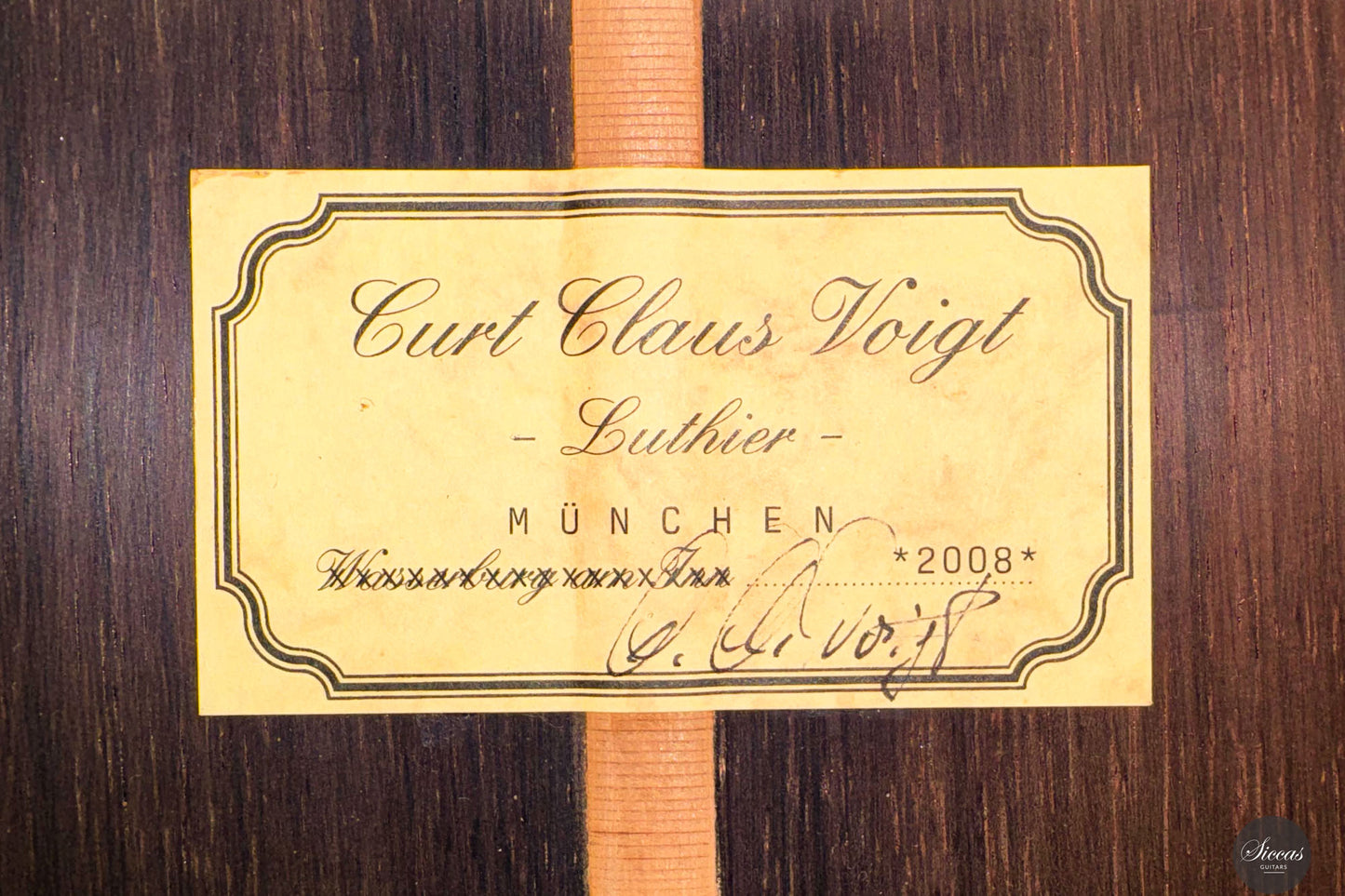
Video overview


More details about the guitar
About the luthier
Curt Claus Voigt began his apprenticeship in Markneukirchen, at the company Marma, Karl Bauer KG, a small factory with 8-10 guitar makers, which manufactured almost all types of guitars, including classical, jazz, and Hawaiian, as well as electric guitars and basses, mandolins and banjos. He was trained by his grandfather Kurt Voigt, his father Günter Voigt, and the master violin maker Hans Zölch to deepen his understanding of historical instruments. Curt Claus passed his master’s examination in 1980 and began to work freelance as a restorer of historical plucked instruments for museums and private collectors (Grassi Museum Leipzig, Erfurt Anger Museum, City Museum Meiningen; Volkskundemuseum Teodone, Brunico, South Tyrol and others). In 1988 he took over the company Kurt Voigt & Son from his father and moved to Wasserburg am Inn, Upper Bavaria. Curt Claus continued his education through workshops with Jose Romanillos (in 1991 and 1994) and with numerous studies of historic instruments in museums and private collections throughout France, England, Czech Republic, Austria, Italy and Spain.About the guitar
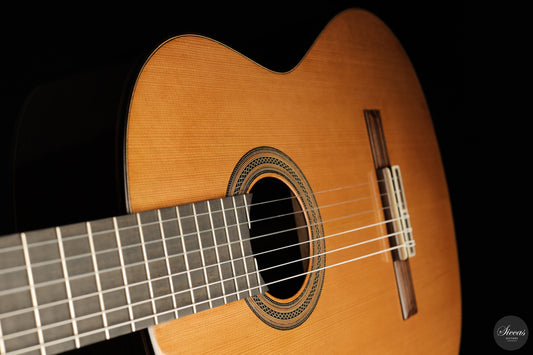
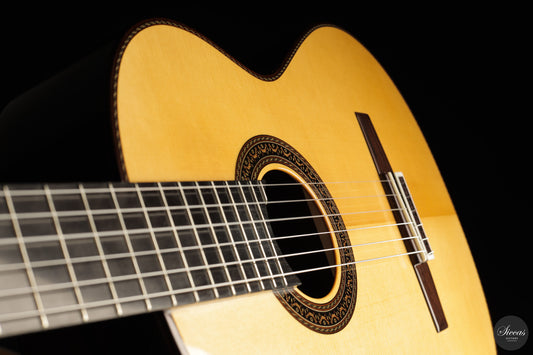
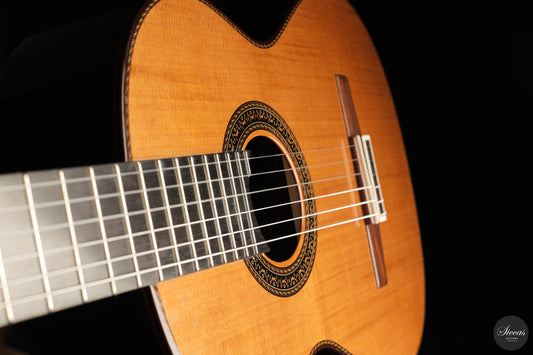
This beautiful guitar is inspired by the work of Antonio de Torres. Aesthetically, it features many ornamental elements reminiscent of Torres’s original instruments, while also incorporating modern touches such as an elevated fingerboard. The spruce soundboard is visually striking, adorned with prominent bearclaw figures. The back and sides are made from straight-grained Brazilian rosewood of the highest quality. Tonally, the guitar offers excellent balance between basses and trebles, with great clarity and warmth. It is easy to play and responds exceptionally well to the right-hand attack. The volume is impressive—an essential characteristic of a modern concert guitar.Condition
The guitar is in excellent condition with no structural issues. It has only a typical string mark behind the bridge, which is purely cosmetic.
While this one is sold, these are ready for you
-
Classical Guitars
The classical guitar, with its soft nylon strings and characteristic timbre, has become a symbol of chamber music, Spanish tradition, and concert repertoire. Its modern form was shaped by Antonio de Torres in the 19th century, setting the standard for the body, fan bracing, and the 65-centimeter scale length that are still used today. Instruments in this category open up a rich palette from the refined Romantic miniatures of Tárrega to the majestic concertos of Rodrigo. Here you will find guitars that preserve historical continuity and at the same time inspire new interpretations.Look all products of the collection -
Lorenzo Frignani - 2026 Classical Guitar No. 275
Price: 13.990 €Unit price per Tax free (0% DE)Luthier: Lorenzo Frignani -
Dragan Neshic - 2026 Especial No. 3
Price: 7.490 €Unit price per Tax free (0% DE)Construction Type: Double-Top Guitars -
Oren Myers - 2026 No. 149
Price: 8.990 €Unit price per Tax free (0% DE)Luthier: Oren MyersConstruction Type: Traditional -
Francisco Gil Romero - 2026
Price: 4.990 €Unit price per Tax free (0% DE)Luthier: Francisco Gil RomeroConstruction Type: Traditional -
Hans and Alexander Herb - 2003 Concert
Price: 3.990 €Unit price per Tax free (0% DE)Luthier: Hans-Hermann Herb -
Giorgio Amorella - 2026 "La Gentile"
Price: 4.490 €Unit price per Tax free (0% DE)Construction Type: Traditional -
Erez Matzrafi - 2026 "Thucea"
Price: 5.890 €Unit price per Tax free (0% DE) -
Kevin Aram - 2026 Torres "Dua"
Price: 8.990 €Unit price per Tax free (0% DE)Luthier: Kevin AramConstruction Type: Traditional -
Vicente Carrillo - 2026 Gabriela II - Spruce 63 cm
Sale price 5.590 € Price:Unit price per Tax free (0% DE)5.890 €Save: 300 €ReservedLuthier: Vicente CarrilloConstruction Type: Double-Top Guitars -
Vicente Carrillo - 2026 Gabriela II - Cedar 64 cm
Sale price 5.590 € Price:Unit price per Tax free (0% DE)5.890 €Save: 300 €ReservedLuthier: Vicente CarrilloConstruction Type: Double-Top Guitars

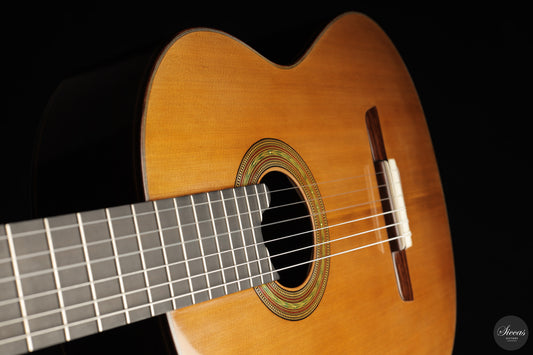

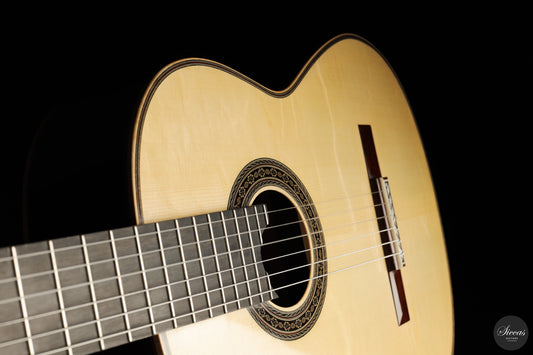

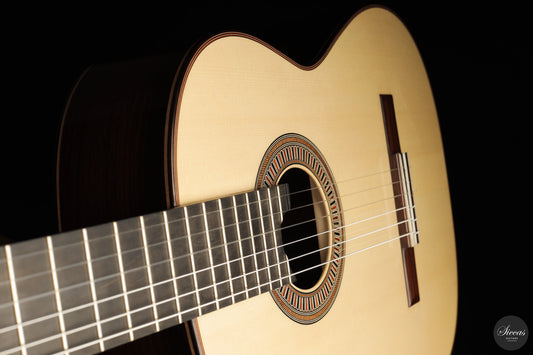






Related guitars
Frequently Asked Questions About Classical Guitars
How do I choose the right classical guitar for my level?
Choosing the right classical guitar depends on your playing level, musical goals, and budget. Beginners benefit from studio-model guitars from renowned workshops, while advanced players and professionals often choose a handmade master guitar. We are happy to advise you personally and can send detailed sound samples and videos on request.
What is the difference between a master guitar and a studio guitar?
Master guitars are built entirely by hand in the workshop of a single luthier, using only high-quality, well-aged tonewoods. Studio guitars are made in small series, often under the supervision of the master luthier, and offer excellent value for students and ambitious amateur players.
Can I try a classical guitar at home for 14 days?
Yes — every guitar you purchase from us comes with a 14-day home approval period. This complimentary trial applies worldwide to all orders, whether you are in Germany, Europe, the USA, Asia or anywhere else. We ship your instrument fully insured in a high-quality case so you can play it under your own acoustic conditions. If the guitar is not the right one for you, simply send it back and receive a full refund of the purchase price.
Can I try a classical guitar before purchasing?
Absolutely. You are warmly invited to visit our showroom in Karlsruhe, Germany, and test the instruments at your leisure. We are happy to schedule a personal appointment. If a visit is not possible, we send detailed videos and sound samples, and offer extensive consultation by phone or video call.
What payment methods and financing options do you offer?
We accept bank transfer, PayPal, major credit cards, and Klarna. For high-value instruments, we offer individual installment plans on request. Please contact us directly — we will find a suitable solution for every budget.
How do I properly care for my classical guitar?
A classical guitar requires constant humidity between 45 and 55 percent. Store the instrument in its case with a humidifier, avoid direct sunlight and large temperature fluctuations. Change the strings regularly and clean the guitar with a soft microfiber cloth.