
Julia Lange is a German classical guitarist who has been featured on the Siccas Guitars platform, where her performances have introduced a wide international audience to her refined musical approach and expressive sound. As a representative of the contemporary German classical guitar scene, she brings together technical discipline and musical sensitivity in her playing. Siccas Guitars has presented her work as part of its ongoing commitment to showcasing exceptional classical guitar artistry, making her recordings accessible to guitar enthusiasts around the world.
Julia Lange and the Classical Guitar Tradition
The classical guitar occupies a unique place in the world of concert music. Unlike many other instruments, it asks the performer to simultaneously manage melody, harmony, and bass lines — all with the ten fingers of two hands, and without the amplification or sustain that other instruments take for granted. Players who succeed at the highest level of classical guitar performance must combine the precision of a pianist with the expressive phrasing of a vocalist, and the architectural thinking of a chamber musician.
Julia Lange approaches this instrument with the care and commitment that the repertoire demands. Her association with Siccas Guitars has allowed listeners to experience her playing in high-quality recordings, presenting the full tonal richness of classical guitar concert performance. The Siccas Guitars platform specifically seeks out artists whose playing reflects both technical mastery and genuine musical depth, and Lange's inclusion in this community reflects the esteem in which she is held.
The German classical guitar tradition has a long and distinguished history. Germany has produced significant guitar luthiers, pedagogues, and performers over the centuries, and today continues to be a country where the classical guitar is taken seriously both in conservatory training and in concert life. Julia Lange is part of this living tradition, contributing to it through her performances and her presence on international platforms such as Siccas Guitars.
The Siccas Guitars Weekly Guitar Meeting
The Weekly Guitar Meeting is one of the signature formats developed by Siccas Guitars to bring classical guitar performance to audiences worldwide. In this format, a featured guitarist performs a piece or programme in a focused, high-quality video recording, allowing viewers to watch and listen closely to every nuance of the performance. The format is deliberately intimate: rather than the distance of a large concert hall, viewers are brought close to the instrument and the performer, hearing every overtone, every articulation, and every expressive decision with exceptional clarity.
Julia Lange's appearance in the Weekly Guitar Meeting series is a testament to the quality of her artistry. The series has featured a wide range of classical guitarists from across the world, and being selected for inclusion places her among a community of serious, accomplished performers. For audiences who may not have the opportunity to hear her perform live, these recordings serve as a compelling introduction to her playing.
The Weekly Guitar Meeting format also reflects a broader philosophy at Siccas Guitars: that exceptional guitar music deserves to be heard, shared, and appreciated as widely as possible. Whether you are new to classical guitar or a long-time enthusiast, these recordings offer something of genuine value — a chance to witness a performer at work, fully engaged with a piece of music and communicating it with skill and conviction.
Classical Guitar Repertoire and Performance
The classical guitar repertoire spans several centuries and encompasses an extraordinary range of styles, forms, and emotional registers. From the Renaissance lute music transcribed for guitar, through the Baroque contrapuntal works of Johann Sebastian Bach, to the Romantic character pieces of Francisco Tárrega and Agustín Barrios Mangoré, and onwards into the twentieth and twenty-first centuries — the classical guitarist has access to a vast and continuously expanding body of music. Each era presents its own interpretive challenges and rewards.
For listeners coming to classical guitar for the first time, the breadth of this repertoire can be both exciting and slightly overwhelming. It helps to understand that classical guitar performance is always about the communication of musical ideas: the way a phrase rises and falls, the way a bass note resonates beneath a singing melody, the way silence can be just as expressive as sound. These are the qualities that define great classical guitar playing, and they are the qualities that the Siccas Guitars platform looks for when selecting artists to feature.
If you are interested in exploring the wider classical guitar repertoire, you might start with some of the most famous classical guitar pieces that have defined the tradition. Works such as Recuerdos de la Alhambra and Capricho Árabe by Francisco Tárrega offer an ideal entry point, combining technical brilliance with deeply satisfying musical content. The music of Bach on classical guitar opens up an entirely different world — one of architectural counterpoint and inexhaustible melodic invention.
The Instrument: Classical Guitars at Siccas Guitars
One of the distinguishing features of Siccas Guitars as a platform is that it connects classical guitar artistry directly with exceptional instruments. The guitars available through Siccas are built by some of the world's leading luthiers, and the connection between great playing and great instrument-making is one that Siccas takes seriously. When you watch a performance by Julia Lange or any of the other featured guitarists, you are also hearing what a fine classical guitar can do in the hands of a skilled performer.
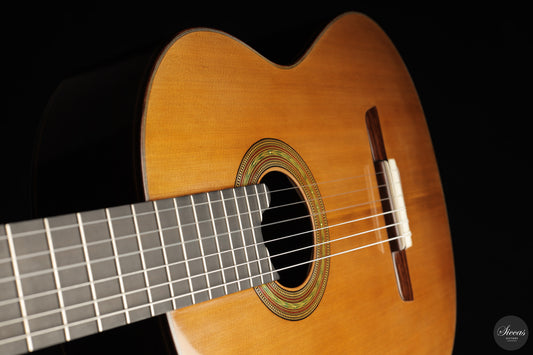
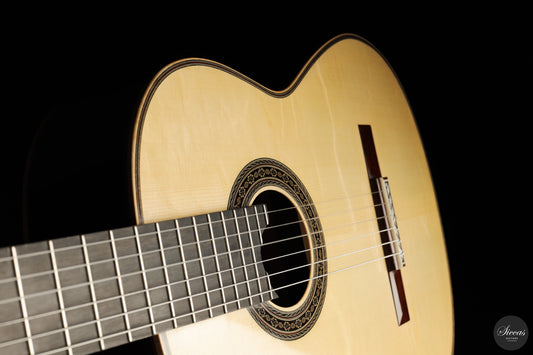
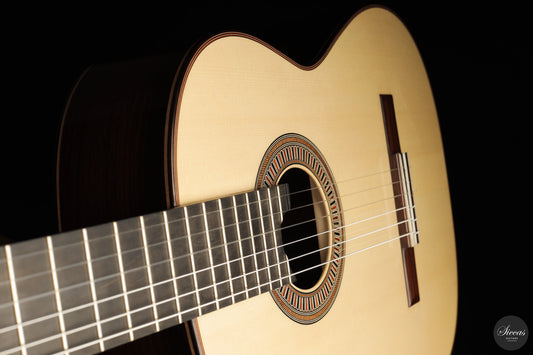
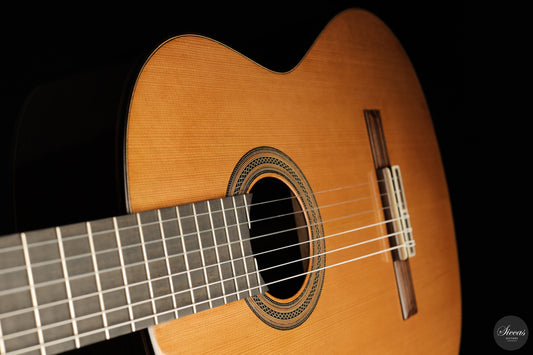
The choice of instrument has a profound effect on the sound that a classical guitarist can produce. The tonal character of the guitar — warm or bright, focused or expansive, intimate or projecting — depends on a complex interaction between the woods used in its construction, the design of the luthier, and the playing style of the performer. The two most common woods used for the soundboard (the top of the guitar, which is the primary sound-producing surface) are spruce and cedar, each of which has its own characteristic tonal qualities. If you are curious about how these differences sound and feel in practice, the detailed comparison of spruce vs cedar classical guitars available on this site is an excellent place to start.
Siccas Guitars offers a carefully curated selection of classical guitars from leading luthiers, as well as specialist instruments such as double-top guitars, which use innovative construction techniques to achieve exceptional projection and tonal clarity, and flamenco guitars, which have their own distinct character and playing tradition. Exploring these instruments is itself a form of musical education, helping you to hear and understand what different construction choices mean for the sound and feel of the guitar.
Learning the Classical Guitar
Watching a performance by an accomplished classical guitarist can inspire many listeners to want to learn the instrument themselves. The classical guitar is genuinely learnable at any age, though it does require consistent practice and a willingness to develop new physical habits — the posture, hand position, and right-hand technique of classical guitar are quite specific, and developing them takes time and patience.
If you are wondering whether to take up the classical guitar, or if you are unsure whether it is different from the acoustic guitar you may already be familiar with, it is worth reading about the key differences between acoustic and classical guitars. The instruments share a family resemblance but differ significantly in their construction, playing technique, and musical context. Understanding these differences will help you make a more informed choice about which instrument is right for you.
For those who have already decided to pursue classical guitar, the question of how long it takes to reach a meaningful level of competence is a common one. The answer depends on many factors, including the amount of time available for daily practice, the quality of instruction, and individual aptitude — but it is encouraging to know that many of the most beautiful pieces in the repertoire are accessible to players at a relatively early stage. You can find a realistic and encouraging overview of how long it takes to learn classical guitar on this site, along with a selection of beginner-friendly classical guitar pieces that actually sound beautiful even when played simply.
Discovering More Classical Guitarists
Julia Lange is one of many exceptional classical guitarists whose work is showcased on the Siccas Guitars platform. The broader community of great classical guitarists featured here spans multiple generations and nationalities, reflecting the truly international character of the classical guitar world. From pioneering historical figures to contemporary performers pushing the boundaries of the instrument's possibilities, the range of artistry on display is remarkable.
Exploring the work of different guitarists is one of the most rewarding ways to deepen your appreciation of the classical guitar. Each performer brings a different personality, different influences, and a different approach to the repertoire. Listening widely — comparing how different players approach the same piece, noticing what each one emphasises and what each one leaves in shadow — develops your ear and your understanding in ways that no amount of theoretical study can fully replicate.
The Siccas Guitars platform is built around the belief that great classical guitar playing deserves a great audience. By presenting high-quality performances, detailed articles, and a carefully chosen selection of exceptional instruments, it aims to serve both the performers who make this music and the listeners who love it. Julia Lange's presence on this platform is part of that larger project — and her performances are an invitation to listen, to be moved, and to discover more.
Watch Julia Lange Perform
The video embedded at the top of this page captures Julia Lange in performance as part of the Siccas Guitars Weekly Guitar Meeting series. We encourage you to watch it attentively — not just as background sound, but as a focused listening experience. Notice the clarity of individual notes, the way phrases are shaped, the dynamic range from the softest pianissimo to a more sustained and resonant tone. Classical guitar performance at this level is a precise and expressive art, and close listening rewards the listener with details that a more casual hearing might miss.
If you enjoy what you hear, explore the wider range of performances available on the Siccas Guitars YouTube channel and on this website. The classical guitar world is rich and deep, and there is always more to discover. Whether you come to it as a listener, a student, or someone considering their first instrument purchase, the Siccas Guitars platform is here to guide and support your journey into one of the world's most beautiful musical traditions.
The full portrait. Her performance filmed in our studio is in Julia Lange.