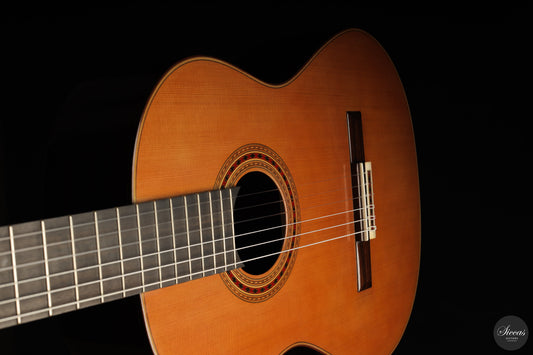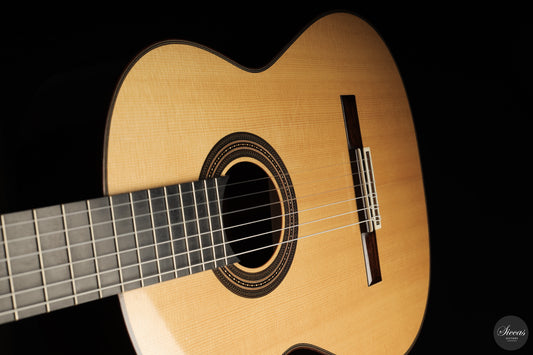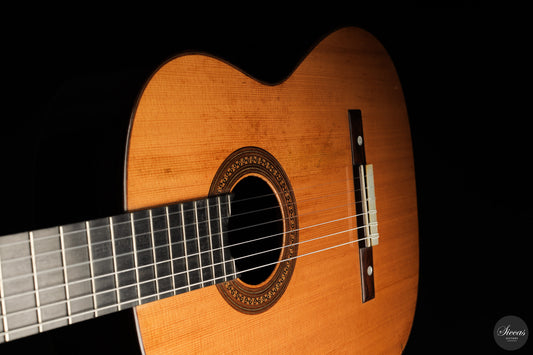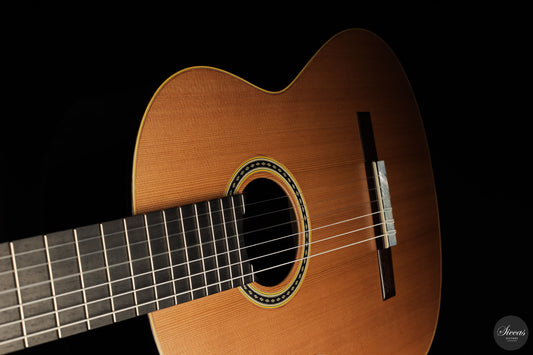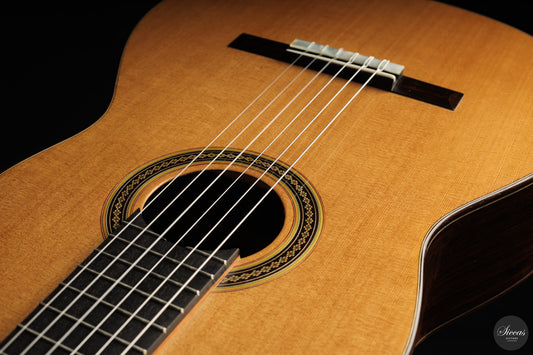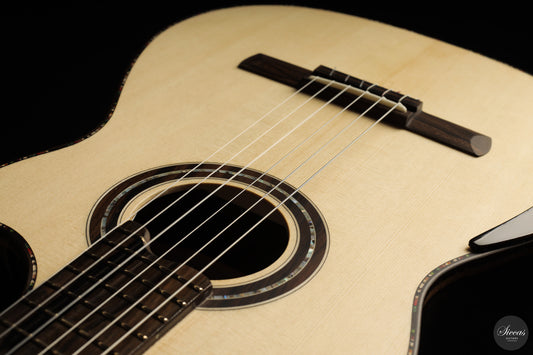

The Recital Traditional is the classical guitar in its essential form. It is built from solid woods, braced in the Spanish manner and voiced for the sound that most of the repertoire was written for. Within our Siccas Luthiers line it is the model for players who want a traditional instrument without any modern construction. You can choose it with a cedar top or a spruce top, and both are available with shorter scales as well.
In this guide you find how the Recital Traditional is built, how the cedar and spruce versions sound, what the shorter versions offer and which recordings let you hear the model in real repertoire.
How the Recital Traditional Is Built
The Recital Traditional is made entirely of solid woods. Under the top sits a fan bracing in the style of Ramírez This bracing gives the notes definition and keeps the registers in natural balance.
The back and sides are Indian rosewood. The guitar is finished entirely in polyurethane, which is durable and easy to maintain, and it comes in a hardshell case. It has Der Jung tuners and Knobloch EDC 34.0 strings, a 650 mm scale and a 52 mm nut. The air resonance of the body lies around G to G sharp.
The Recital Traditional Cedar
The cedar version has a warm and punchy character with a slightly nasal, haunting quality that gives it a distinctive presence. Each note, bass or treble, stays clear and focused, and the colours follow your phrasing. As your right hand moves, the sound shifts from rich and rounded to an open, expressive brightness.
The basses are firm, well shaped and resonant without becoming overpowering. The texture is more blended and atmospheric than in the spruce version, warm and inviting, and the trebles have depth and layered overtones.
The Recital Traditional Spruce
The spruce version gives the attack a bright, lively and immediate character with an open, articulate response. Notes speak clearly and with focus in every register. As the right hand moves, the response develops from a round, warm sound into a fresh, singing brightness.
Its clarity and separation are very good, so every register keeps a clean outline. The basses remain silky yet strong, and the trebles reveal depth with several layers of colour.
Cedar or Spruce?
Choose the cedar version if you are drawn to warmth, a blended and atmospheric sound and that slightly nasal colour that makes a phrase sound sung. Choose spruce if you want a brighter attack, more separation between the voices and a sound that opens up the more you put into it. Our article on spruce versus cedar explains the differences between the two woods in more depth.
Shorter Scale Versions
The Recital Traditional is available with a 64 cm and a 63 cm scale, both with a 51 mm nut. The body dimensions stay identical to the 65 cm version, so the structural and acoustic concept of the model is preserved. The shorter scale makes wide left-hand stretches more comfortable and gives the right hand a softer touch in intricate passages and long practice sessions.
- Cedar: Recital Traditional Cedar 64 cm and Recital Traditional Cedar 63 cm
- Spruce: Recital Traditional Spruce 64 cm and Recital Traditional Spruce 63 cm
You can hear the spruce version with 63 cm scale in our review on YouTube. Our guide to classical guitar scale length explains how to find the right length.
Heard in Repertoire
Several guitarists have recorded on the Recital Traditional for our channel. Vera Danilina plays Bach's chorale prelude Ich ruf zu dir, Herr Jesu Christ on the cedar version. Cristina Galietto plays Schubert's Ave Maria on the spruce version, and Valeria Galimova and Justus Bien play the Ghostbusters theme as a duo on two Recital Traditional guitars, and Violaine Sananes plays Samba em Prelúdio by Baden Powell on the cedar version.
Who the Recital Traditional Is For
The Recital Traditional suits players who love the sound of the Spanish guitar and want a traditionally built instrument in solid woods for study, teaching and performance. It stays true to the classical tradition while reflecting the precision and consistency we aim for in the whole line. If you would like a traditional guitar with a darker, more atmospheric voice, have a look at the Halo Traditional. If you want more projection, the Recital Contemporary takes the Recital idea into double-top and lattice construction.
Set Up in Karlsruhe
Siccas Luthiers is our own line of classical guitars, founded by the brothers Mirco and Manuel Sicca, whose late father Mario Sicca was a soloist, a professor at the Stuttgart Musikhochschule, a luthier and a collector. The models are developed in-house by a team of experienced luthiers and players. Each Siccas Luthiers guitar undergoes a careful setup and final inspection in our workshop in Karlsruhe before being shipped to our customers. You are welcome to try the guitars in our showroom in Karlsruhe.
The Other Models in the Line
Siccas Luthiers currently has eight models. Besides the Recital Traditional these are the Origin Lattice, Recital Contemporary, Halo Traditional, Creation Doubletop, Legacy Doubletop, Continuum Lattice and the Synthesis Doubletop. Our overview of Siccas Luthiers guitars explains the idea behind the line, and our guide to fan-braced, double-top and lattice guitars sets out how the three ways of building a soundboard differ.