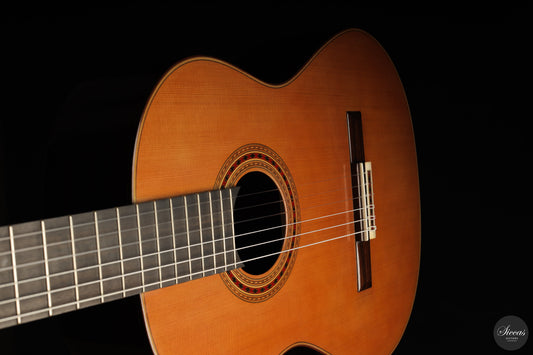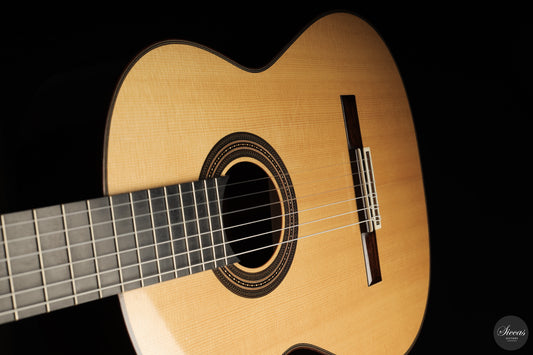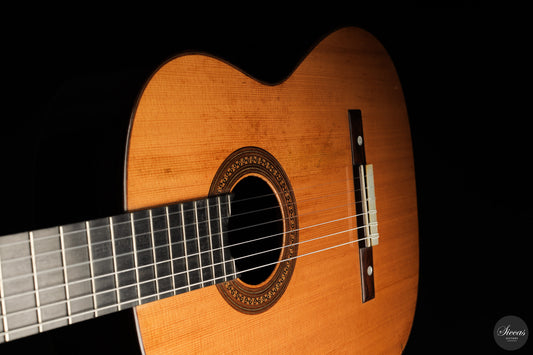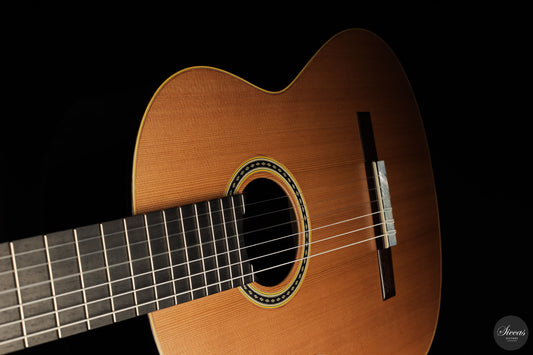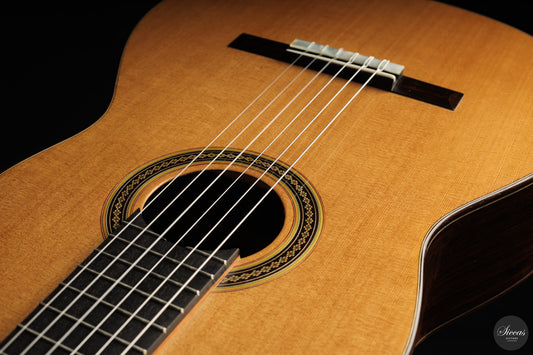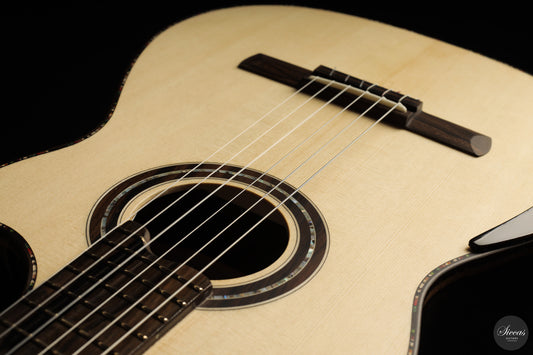

The Halo Traditional is the newest traditional model in our Siccas Luthiers line, and it exists because players kept asking for it. It takes the Spanish guitar as its musical and aesthetic foundation without trying to copy a particular historical instrument. You can choose it with a cedar top or a spruce top, and both are available with a 63 cm scale.
This guide explains the idea behind the Halo, how the cedar and spruce versions sound, what the shorter version offers and where you can hear it.
The Idea Behind the Name
The name describes the concept. Tradition stands at the centre, and around it lies a contemporary approach to detail, refinement and playing response. The Halo keeps the open, colourful character people associate with traditional Spanish guitars, and it adds the immediacy and control expected from a contemporary concert instrument. Tradition and modernity are not set against each other. One frames the other.
How the Halo Traditional Is Built
The Halo follows a traditional construction concept, without the lattice or double-top soundboards of most of our other models. The back and sides are Indian rosewood, the finish is polyurethane, and the guitar has Der Jung tuners and Knobloch EDC 34.0 strings. The full-size version has a 650 mm scale and a 52 mm nut, the familiar proportions of a classical concert guitar, and comes in a hardshell case.
One measurement shapes the character of both versions. The air resonance of the body lies low, around F to F sharp. This gives the Halo a warm, well-supported foundation, and the sense of depth carries on into the upper register instead of staying in the basses.
The Halo Traditional Cedar
With a cedar top the Halo becomes darker, deeper and more atmospheric. The basses have considerable depth and presence, and the low resonance gives the whole voice a spacious, enveloping quality. Against this darker foundation the trebles keep their clarity and definition. Notes stay well separated while the surrounding resonance gives them warmth and colour.
What sets the cedar Halo apart is how strongly its own colour takes part in the music. Its darker resonance and slightly mysterious character become part of the phrasing, giving single notes and harmonic changes an atmospheric quality without blurring their shape.
The Halo Traditional Spruce
With a spruce top the Halo gains clarity, immediacy and definition. The trebles are round and airy, with a creamy quality that keeps notes supple rather than sharp. The basses unfold with depth and warmth and a slightly darker colour.
The low body resonance stays perceptible well into the upper range, so you can explore the high trebles without the sound becoming thin or detached. The result combines openness with substance. Lines stay articulate, and each note is supported by a broad field of resonance that gives colour changes and phrasing room to develop.
Watch the Introduction
In this video we introduce the Halo Traditional, the guitar many musicians had asked us for.
More about how the model came about in our article The Siccas Luthiers Halo Traditional, our new Spanish-rooted model.
Cedar or Spruce?
The cedar Halo is the darker and more atmospheric of the two, a guitar whose colour shapes the music. The spruce Halo is clearer and more immediate, with an airy treble over a warm bass. If you love a sound that sings in a dark room, choose cedar. If you want openness and definition with substance behind it, choose spruce. Our article on spruce versus cedar explains the general differences.
Shorter Scale Versions
Both versions are available with a 63 cm scale and a 51 mm nut. The shorter distances make wide stretches and shifts easier for the left hand, and the lower string tension gives a softer feel under the right hand.
Our guide to classical guitar scale length helps you find the right length.
Heard in Repertoire
The first extended piece recorded on the Halo was Fernando Sor's Fantaisie Op. 30, played by Donia Foglia on the spruce version. Thirteen minutes of classical writing show very clearly how a traditionally built guitar speaks.
Who the Halo Traditional Is For
The Halo suits players whose programmes live in the Spanish and classical repertoire and who want a traditional instrument with a warm foundation and a responsive, contemporary feel. Compared with the Recital Traditional, the Halo has a lower body resonance and a darker, more spacious voice.
Set Up in Karlsruhe
Siccas Luthiers is our own line of classical guitars, founded by the brothers Mirco and Manuel Sicca, whose late father Mario Sicca was a soloist, a professor at the Stuttgart Musikhochschule, a luthier and a collector. The models are developed in-house by a team of experienced luthiers and players. Each Siccas Luthiers guitar undergoes a careful setup and final inspection in our workshop in Karlsruhe before being shipped to our customers. You are welcome to try the guitars in our showroom in Karlsruhe.
The Other Models in the Line
Siccas Luthiers currently has eight models. Besides the Halo Traditional these are the Origin Lattice, Recital Traditional, Recital Contemporary, Creation Doubletop, Legacy Doubletop, Continuum Lattice and the Synthesis Doubletop. Our overview of Siccas Luthiers guitars explains the idea behind the line, and our guide to fan-braced, double-top and lattice guitars sets out how the three ways of building a soundboard differ.