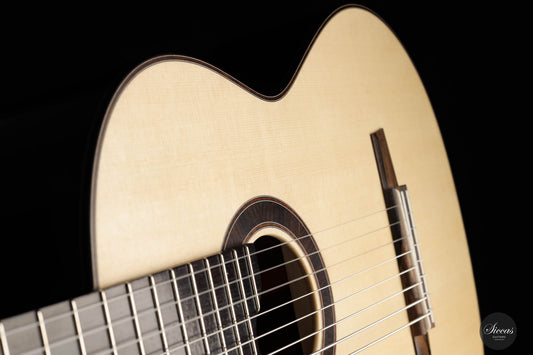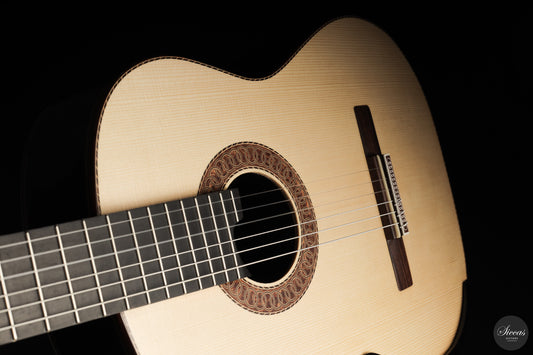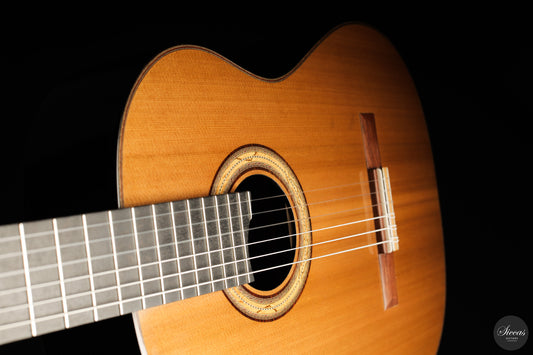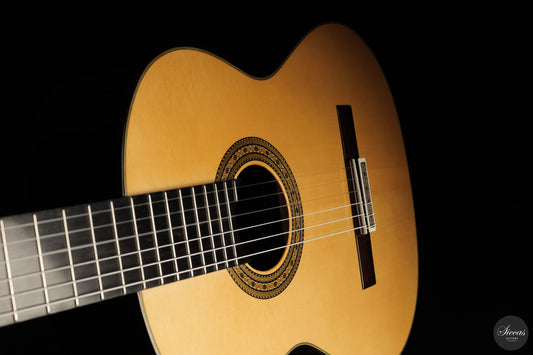

Choosing a classical guitar means weighing your playing level, the size of the instrument, the top wood, the bracing, the back and sides, the setup and your budget. Each of these changes how a guitar sounds and feels. This guide takes them one at a time and ends with a short checklist and an FAQ.
The short answer for most players: buy a guitar with a solid top that fits your hands, is properly set up and responds when you play softly and loudly. For an intermediate player, an all-solid instrument or a well-made double-top is the natural next step. The rest of this guide explains why, and how to narrow down the choice.
Start With Your Level and Your Goals
Your experience and what you want to play are the foundation of the decision. A beginner's guitar will hold back a player who already controls tone and dynamics, while a concert instrument is not what a beginner needs first.
Beginners
If you are starting out, playability matters more than anything else. Look for low, even action, a neck that feels comfortable and a solid top if your budget allows it. A guitar that is hard to press down discourages practice, and that costs you more than any difference in tone. Our guide to the best classical guitars for beginners goes into this step in detail.
Intermediate Players
Once you play pieces with real dynamic range and start to shape tone with your right hand, the guitar becomes either a limit or a help. This is where solid woods, a careful setup and a responsive soundboard pay off, as the next section explains.
Advanced Players and Professionals
Professional instruments are usually built by individual luthiers with tonewoods selected for each guitar. At this level the choice depends less on technical data and more on how a particular guitar answers your touch, your repertoire and the rooms you play in.
The Best Classical Guitar for Intermediate Players
There is no single best intermediate classical guitar, but there are clear criteria. An instrument that meets them will carry you through years of development.
- A solid top. A top cut from solid spruce or cedar vibrates more freely than a laminated one. The tone is rounder and more complex, and it reacts to changes in touch.
- Ideally solid back and sides. All-solid construction adds resonance and sustain. Laminated back and sides are acceptable on a budget, as long as the top is solid.
- A proper setup. String height, nut slots and saddle should be adjusted so the guitar plays cleanly in every position without buzzing.
- Response to dynamics. Play a phrase very softly and then with full force. A good intermediate guitar keeps its tone at both ends and changes colour as you move your right hand.
- A scale and neck that fit you. If wide stretches tire your left hand, a 640 mm or 630 mm version of the same model may serve you better than a full 650 mm guitar.
Siccas Luthiers Guitars for This Step
Siccas Luthiers is our own range of classical guitars. Each Siccas Luthiers guitar undergoes a careful setup and final inspection in our workshop in Karlsruhe before being shipped to our customers. Several models in the range are designed for exactly the step from first guitar to serious instrument:
- Recital Traditional is built with all solid woods and Ramírez-style fan bracing, with Indian rosewood back and sides and a spruce or cedar top. It is the choice for players who want a traditional Spanish sound. Besides the 650 mm version, it is available with 640 mm and 630 mm scales, both with a 51 mm nut, and the 630 mm version keeps the same body dimensions as the full-size model.
- Creation Doubletop uses a Nomex core between an inner cedar layer and an outer top of cedar or spruce, supported by five fan braces and a transverse harmonic bar. The back and sides are wenge, the top is shellac polished, and a slightly raised fingerboard makes the upper register easier to reach. It suits players who want a wider dynamic range and more projection.
- Recital Contemporary Doubletop Lattice combines a double top (spruce or cedar outer layer, Nomex core, cedar inner layer) with lattice bracing made entirely of wood. A soundport in the upper bout helps you hear yourself while playing.
- Origin Lattice is the most accessible model in the range, with a solid top, lattice construction, a carbon-reinforced neck and three-layer Indian rosewood back and sides. It is the only Siccas Luthiers model with laminated back and sides, which keeps it within reach for players who are moving up from a student guitar.
You can compare all current models and scale lengths in our Siccas Luthiers collection. The models listed here come with a hard case.
What Size Classical Guitar Should I Get?
The size of a classical guitar is described by its scale length, the vibrating string length from nut to saddle. It decides how far apart the frets are and how much tension the strings carry.
650 mm, the Standard Size
Most full-size classical guitars have a 650 mm scale and a nut around 52 mm wide. This is the reference for most adult players and for most method books and teachers. If you have average-sized hands and no discomfort on a full-size guitar, 650 mm is the right starting point.
640 mm and 630 mm for Smaller Hands
A 640 mm or 630 mm scale brings the frets closer together and lowers string tension slightly. Wide left-hand stretches become easier, and the strings feel a little softer under the right hand. These sizes are not student sizes. Many experienced players choose them for comfort, especially in demanding repertoire with large stretches. Shorter-scale models often come with a slightly narrower nut, for example 51 mm. Our guide to the 630 mm scale length explains who benefits most, and you can browse current instruments in our 63 to 64 cm collection.
Fractional Sizes for Children
For children there are smaller fractional sizes, such as 7/8, 3/4 and 1/2 guitars, with shorter scales and smaller bodies. Which size fits depends on the child's height and arm length rather than age alone, so it is best to try a few sizes together with the teacher.
Tip: If full-size necks regularly feel uncomfortable, try a shorter scale before assuming the problem lies with your technique. Left-handed players face an extra question of fit; our left-handed classical guitar guide covers the options.
Top Wood: Cedar or Spruce
The soundboard is responsible for most of a guitar's acoustic character. The two main choices are cedar and spruce, and each has its own voice.
Cedar Tops
Cedar produces a warm, immediate and expressive tone. It responds easily at lower playing forces, which suits players with a lighter touch or a lyrical style. A cedar guitar tends to sound open soon after it is built.
Spruce Tops
Spruce gives a brighter, more articulate sound with a wide dynamic range and clear separation between voices. It rewards a firmer attack and tends to open up further over years of playing. Spruce is the traditional choice for concert instruments. Our detailed cedar vs spruce comparison explores the differences in depth.
Hear the Difference: Cedar vs Spruce on the Same Guitar
Listening is the most direct way to understand what a top wood does. In the video below, we compare the two versions of the Siccas Luthiers Creation Doubletop, one with a cedar top and one with a spruce top. Both share the same construction: a Nomex core with an inner cedar layer, five fan braces and a harmonic bar, and wenge back and sides. The top wood is the only real variable, so the comparison is a fair one.
Listen for how the cedar version speaks a little more immediately, with a warm, punchy and slightly nasal colour, and how the spruce version gives the trebles a clearer, singing quality.
Bracing: Fan, Lattice and Double-Top
The bracing under the top shapes how the soundboard vibrates, and with it how the guitar projects and responds. Three designs dominate today.
Traditional Fan Bracing
Fan bracing is the standard of the Spanish tradition. A set of braces radiates across the lower part of the top, supporting it while letting it vibrate freely. The result is a warm, balanced and versatile voice, and most classical guitars use it in some form.
Lattice Bracing
Lattice bracing was developed in Australia in the 1980s. It replaces the fan with a grid of wood or carbon fibre strips, which allows a very thin, light top that stays stiff. Lattice guitars are known for strong projection, long sustain and an even response across the registers. Our guide to lattice-braced classical guitars explains the design and its history.
Double-Top Construction
A double top consists of two thin wood layers with a Nomex honeycomb core between them. The top is light but rigid, similar in principle to lattice bracing, and many players hear a more familiar, rounded voice from it. Double-tops are valued for projection and sensitivity. Read more in our double-top guitar guide or browse the double-top guitar collection.
For a first guitar, fan bracing is the usual choice. Lattice and double-top instruments become interesting once you want more volume or a more modern response.
Back and Sides
The top dominates a guitar's voice, but the back and sides shape sustain, resonance and colour.
- Rosewood. The traditional choice for concert guitars, with a deep bass, a rich midrange and long sustain.
- Cypress. The classic wood for flamenco guitars, with a drier, more percussive sound and a quick attack. It also appears on traditional Spanish-style classical guitars.
- Maple. Bright and articulate with a focused midrange, used by some luthiers looking for a different palette from rosewood.
- Wenge and other dense hardwoods. Used on some modern designs for a balanced response. The Creation Doubletop uses wenge.
Whether the back and sides are solid or laminated matters as much as the species. Solid wood adds resonance, laminated wood keeps a guitar affordable.
Setup, Action and Strings
Action is the height of the strings above the frets. Low action makes pressing easier but can cause buzzing, while higher action allows a stronger attack and asks more of the left hand. A good setup plays cleanly in every position. If you buy online, ask whether the guitar has been set up before shipping.
Strings change the sound of a guitar more than many players expect. Normal tension suits most players, high tension gives more volume but asks more of the left hand, and low tension is easier to play. Replace strings when the tone turns dull or the intonation becomes unreliable. Never fit steel strings to a classical guitar: their tension can damage the top and the neck.
Other Choices: Pickup, Flamenco and Used Guitars
Acoustic or Acoustic-Electric
Most classical guitars are purely acoustic. A built-in pickup makes sense if you play regularly in amplified settings, but a weak system flattens dynamics and colour. For practice at home and small recitals, an acoustic guitar is almost always the better choice. If you are still deciding between steel-string and nylon-string guitars, our comparison of acoustic vs classical guitar explains the basic differences.
Classical or Flamenco
Flamenco guitars look similar but are built lighter, often with cypress back and sides and lower action, and they produce a drier, more percussive tone. You can play classical repertoire on a flamenco guitar and the reverse, but neither is ideal. If you study flamenco, buy a flamenco guitar.
Used and Vintage Guitars
An older guitar can offer a mature tone, but check for cracks, worn frets and changes in neck angle. Buying from a dealer who has inspected the instrument lowers the risk. When buying privately, ask a luthier to look at the guitar first.
Budget Levels: What to Expect
Entry Level
Entry-level guitars are factory-made and often have laminated tops. They are useful for building basic technique and are the right starting point if you are not yet sure you will stay with the instrument.
Mid-Range
At this level a solid top becomes standard and solid back and sides appear more often. The gain in tone and resonance over laminated instruments is audible straight away, and many players stay with a guitar from this range for years.
Professional and Handmade Instruments
Professional guitars are built by individual luthiers, who adjust bracing, top thickness and finish for each instrument. They offer the projection, separation and range of colour needed on stage.
Trying a Guitar Before You Decide
Nothing replaces playing a guitar yourself. In our showroom in Karlsruhe you can compare instruments side by side, by appointment. If you buy online, you have 14 days after delivery to play the guitar at home. If it is not the right instrument, you can withdraw from the purchase and send it back. The return shipping is at your cost, and we refund the purchase price and the original shipping.
Essential Accessories
- Case. A hard case protects best. A well-padded gig bag is a lighter option for short trips.
- Tuner. A clip-on chromatic tuner or a tuning app works well for classical guitar.
- Footstool or guitar support. Classical posture raises the guitar. A footstool is the traditional solution, while a support that attaches to the side of the guitar avoids raising the foot.
- Spare strings. Nylon strings wear out with regular playing, so keep a fresh set at hand.
What to Look for When Buying a Classical Guitar
- Level. Decide whether you need a first guitar, an intermediate instrument or a concert guitar.
- Size. Check the scale length and nut width. 650 mm is standard, 640 mm and 630 mm suit smaller hands.
- Top. Choose a solid top. Cedar for warmth and quick response, spruce for clarity and range.
- Construction. Solid back and sides if possible, laminated if the budget requires it.
- Bracing. Fan bracing for a traditional sound, lattice or double-top for more projection.
- Setup. Clean notes in every position, no buzzing, comfortable action.
- Response. Play softly and loudly and listen for colour and balance across the strings.
- Trial. Compare instruments side by side, in a showroom or at home.
FAQ
What is the best classical guitar for intermediate players?
The best classical guitar for an intermediate player has a solid top, ideally solid back and sides, a careful setup and a clear response to changes in dynamics and touch. In our own range, the all-solid Recital Traditional and the Creation Doubletop are built for this step. The Origin Lattice, with a solid top and laminated back and sides, is the more accessible option.
What size classical guitar should I get?
Most adults play a full-size guitar with a 650 mm scale. If you have smaller hands or find wide stretches tiring, try a 640 mm or 630 mm scale, often with a 51 mm nut. Children need smaller fractional sizes such as 3/4 or 1/2, chosen with the teacher based on height and arm length.
How do I choose a classical guitar?
Start with your level and the music you want to play, then choose the size that fits your hands. Decide between cedar and spruce, pick a construction (fan bracing, lattice or double-top) and make sure the guitar is well set up. Finally, compare a few instruments side by side and choose the one that responds best to your touch.
Is cedar or spruce better for beginners and intermediate players?
Neither wood is better in general. At beginner and intermediate level, a solid top matters more than the species. Cedar responds quickly and sounds warm with a light touch. Spruce is brighter, more articulate and offers more room to grow as your technique develops. Try both and choose the sound you prefer.
Which classical guitar is right for me?
The right guitar fits your hands, suits your level and sounds the way you want to sound. If you are unsure, compare a cedar and a spruce version of the same model and try a shorter scale.
Explore our full selection of classical guitars, from Siccas Luthiers instruments to guitars by leading luthiers from around the world.