

Famous Classical Guitar Pieces
The essential repertoire.
From Tárrega's tremolo to Bach's Chaconne — the most famous classical guitar pieces ever written, with history, difficulty ratings and recordings.
Why these pieces matter
What makes a classical guitar piece truly famous?
The classical guitar has one of the richest solo repertoires of any instrument — spanning four centuries, two continents of primary origin, and an extraordinary range of styles. Yet certain pieces rise above the rest. They appear on concert programmes year after year, generation after generation. Students learn them, professionals record them, and audiences recognise them within the first few bars.
What earns a piece that status? Usually a combination of factors: an immediately memorable melodic idea, a perfect match between the music and the natural resonance of the instrument, a compelling story behind its creation, and — often — a single legendary performance that imprinted the work on the collective memory. Recuerdos de la Alhambra by Francisco Tárrega has all four. So does the Adagio from Rodrigo's Concierto de Aranjuez, which the composer wrote while in grief after the loss of a child and which became one of the most performed concertos of the twentieth century.
This guide covers the most famous classical guitar pieces ever written or arranged for the instrument — from the Baroque suites of Johann Sebastian Bach to the tango-inflected miniatures of Roland Dyens. For each work we provide historical context, a note on difficulty, and links to deeper reading where available. Use it as a map: wherever you are in your playing journey, there is something here worth exploring.
If you are new to the instrument and looking for a place to start, our guide to the easiest classical guitar pieces for beginners is the natural companion to this page. And if you want to understand how the repertoire connects to the history of the instrument itself, the article on famous classical guitar pieces provides the broader context.
Francisco Tárrega — the father of modern classical guitar
No composer did more to shape the modern classical guitar repertoire than Francisco Tárrega (1852–1909). He elevated the instrument from a parlour curiosity to a vehicle for serious musical expression, and the pieces he left behind remain the backbone of the repertoire to this day.
Recuerdos de la Alhambra
Written around 1896 and inspired by the Moorish palace in Granada, Recuerdos de la Alhambra is probably the single most recognised classical guitar piece in existence. Its continuous tremolo — a technique in which the melody note is repeated rapidly by the fingers a, m, i while the thumb carries the bass line — creates a shimmering, fountain-like texture that perfectly captures the atmosphere of the Alhambra's water features. The piece is technically demanding (it requires a reliable tremolo at a steady dynamic for several minutes) but musically it is not complex: the harmonic language is straightforward, and the emotional message is immediate. Read the full story in our dedicated article: Recuerdos de la Alhambra.
Capricho Árabe
Written in 1892, Capricho Árabe is sometimes described as a serenata — a character piece in a dreamy, orientalist style that was fashionable in late nineteenth-century Spain. The piece opens with a hypnotic ostinato in the bass and builds through a series of increasingly ornate variations. It is one of Tárrega's most emotionally expressive works, and a favourite of intermediate to advanced players looking for a piece with immediate audience impact.
Lágrima
Lágrima (meaning "teardrop") is a short prelude, barely two pages long, but it is among the most played pieces in the entire repertoire. Its gentle alternation between E major and E minor gives it a bittersweet quality that is easy to appreciate and not too difficult to execute — making it a favourite first Tárrega piece for advancing students. Our detailed tutorial covers every aspect of the performance: how to play Lágrima by Tárrega.
Johann Sebastian Bach on the classical guitar
Bach never wrote for the guitar — the instrument as we know it did not exist in his lifetime. Yet his music translates to the classical guitar with remarkable naturalness, and several of his lute and solo violin/cello works have become cornerstones of the guitar repertoire. The connection between Bach and the classical guitar is one of the most fascinating chapters in the history of the instrument.
Chaconne from Partita No. 2, BWV 1004
Originally composed for solo violin around 1720, the Chaconne is widely regarded as one of the greatest single movements in all of Western music. At around fifteen minutes in performance, it is a set of variations over a repeating harmonic pattern (the chaconne form) that builds from contemplative simplicity to towering complexity and back again. Andrés Segovia's arrangement for guitar, made in the 1930s, brought the work to a new audience and remains the standard guitar text. Playing the Chaconne is considered a rite of passage for serious classical guitarists.
Bourrée in E minor, BWV 996
This compact dance movement from the Lute Suite in E minor is one of Bach's most immediately recognisable pieces — and one of the most frequently learned by students at intermediate level. Its clear two-voice texture makes it an ideal introduction to baroque counterpoint on the guitar. Many players encounter it early in their studies and return to it throughout their career, discovering new interpretive possibilities each time.
Prelude from Cello Suite No. 1, BWV 1007
The flowing arpeggios of this prelude make it one of the most played pieces across all guitar levels. Originally written for solo cello around 1720, it sits comfortably in the guitar's range and idiom. The challenge is not in the notes themselves — the pattern is simple — but in maintaining an even tone, a singing melodic line within the arpeggios, and a sense of long-form musical direction across the sustained, unfolding phrase.
Joaquín Rodrigo — the most famous concerto ever written for guitar
Joaquín Rodrigo (1901–1999) was blind from the age of three, yet he became one of the most celebrated Spanish composers of the twentieth century. His Concierto de Aranjuez, premiered in Barcelona in 1940, transformed the classical guitar's status in the concert hall overnight.
Concierto de Aranjuez — Adagio
The slow movement of the Concierto de Aranjuez is among the most emotionally affecting pieces in the entire orchestral repertoire. Rodrigo reportedly wrote it as a response to a personal tragedy — the death of his and his wife's first child. The guitar's plaintive melody, answered and surrounded by a chamber orchestra of strings, winds and brass, creates a sustained atmosphere of longing and grief that crosses every cultural boundary. Miles Davis famously adapted the theme for his 1960 album Sketches of Spain, introducing the melody to a global jazz audience. In solo guitar transcriptions, even without the orchestra, the melodic line retains its immense power.
Isaac Albéniz — piano music that found its true home on the guitar
Isaac Albéniz (1860–1909) wrote almost exclusively for piano, yet much of his most celebrated music sounds more natural on the guitar than on its intended instrument. The reason is straightforward: Albéniz was deeply influenced by the sounds of flamenco and Spanish folk music — sounds that originate on the guitar. His piano writing is full of guitar idioms: rasgueado-like chords, campanella melodic lines, and bass patterns derived from the guitarist's thumb.
Asturias (Leyenda)
Asturias is probably the most performed Spanish piano piece in the guitar repertoire. Originally the Prelude of a suite for piano, it was later grouped into the Suite española under the name Leyenda. The guitar arrangement — attributed to various hands but popularised above all by Andrés Segovia — transforms the piece into one of the most viscerally exciting works in the repertoire. The opening and closing sections use an insistent, buzzing triplet pattern in the bass that mimics flamenco rasgueado; the middle section introduces a lyrical melody of aching beauty. Difficulty: advanced.
Agustín Barrios Mangoré — the genius from Paraguay
Agustín Barrios Mangoré (1885–1944) is increasingly recognised as one of the greatest composer-guitarists in history — a figure comparable to Paganini in the world of the violin. His output is vast (over 300 works), stylistically eclectic, and technically formidable. During his lifetime he was relatively unknown outside South America; today his music is standard concert repertoire worldwide.
La Catedral
La Catedral is Barrios's most famous work and one of the most programmed pieces in all of classical guitar. It exists in two versions: an early two-movement form (Preludio and Andante Religioso) and the later three-movement version that adds an opening Preludio Saudade. The Andante Religioso was reportedly inspired by Bach's music playing inside a cathedral in Montevideo — and the piece does indeed have a luminous, chorale-like quality in its middle section, flanked by more overtly virtuosic outer movements. Difficulty: advanced.
Carlo Domeniconi — East meets West
Koyunbaba, Op. 19
Koyunbaba (meaning "father of the sheep" in Turkish — a reference to a dervish in Turkish folklore) is one of the most distinctive works written for the classical guitar in the twentieth century. Italian composer Carlo Domeniconi composed it after extensive travel in Turkey, and the piece reflects a deep engagement with Turkish modal music, particularly the makam system. It is written in an open scordatura tuning (C–G–D–F–A–D from low to high) that gives it a uniquely resonant, haunting timbre. In four movements, the work ranges from meditative to wildly dramatic. Difficulty: advanced.
Anonymous and traditional — pieces without a named composer
Not every famous piece in the classical guitar repertoire has a confirmed composer. Some of the most-played works exist in a grey zone of attribution that has been debated for decades.
Romanza (Spanish Romance)
Spanish Romance — also known simply as Romanza — is one of the most widely recognised pieces associated with the classical guitar, familiar to millions of people who have never attended a classical concert. Its composer is unknown. The piece appears in various manuscript sources from the nineteenth century without attribution. Various guitarists and scholars have proposed names (including Rubira and Antonio Rubinstein) but none has been confirmed. The piece consists of two contrasting sections: a gentle arpeggiated E major theme and a dramatic E minor middle section. It is often among the first pieces an advancing student learns. Difficulty: intermediate.
Johann Pachelbel — the most famous arrangement in the repertoire
Canon in D
Pachelbel's Canon in D was composed around 1680 for three violins and basso continuo. It became one of the most widely performed pieces of music in the world during the twentieth century — and the guitar arrangement, in which the repeating harmonic sequence of the original is realised as a set of evolving variations, is among the most requested pieces any guitarist will encounter. The piece is also an excellent study in voice leading and in maintaining musical interest across a simple, endlessly repeating harmonic progression. Difficulty: intermediate.
The broader repertoire — what to explore next
The works above represent the most famous classical guitar pieces by name recognition, but the repertoire extends far beyond them. Here are the key areas worth exploring:
- Fernando Sor's Studies and Mozart Variations — Sor (1778–1839) was the first great composer to write extensively and seriously for the guitar in the classical era. His studies are played by students worldwide; his Mozart Variations are one of the earliest virtuoso showpieces for the instrument.
- Heitor Villa-Lobos's Préludes and Études — Villa-Lobos wrote his twelve études and five préludes for Andrés Segovia, and they remain the most important body of twentieth-century guitar music in the standard repertoire.
- Manuel Ponce's Sonatas — The Mexican composer Manuel Ponce wrote extensively for Segovia, producing works that blend Spanish Romanticism with twentieth-century harmonic language. His Sonatina Meridional and Folía de España are particular favourites.
- Leo Brouwer's Études Simples — These twenty compact studies, composed in the 1970s and 1980s, have become the standard modern equivalent of Sor's études — technically progressive, musically inventive, and frequently performed in concert.
- Roland Dyens's Tango en Skai — This short, witty homage to Django Reinhardt is one of the most frequently performed contemporary pieces in the repertoire. Its combination of jazz harmony and classical guitar technique makes it an ideal introduction to the twentieth-century crossover repertoire.
For players just beginning to navigate the classical guitar world, our article on how long it takes to learn classical guitar is a useful reference point. And for those curious about the composers behind the repertoire, the great classical guitarists section of our library profiles the performers who shaped how we hear these works today.
Choosing a guitar to play this repertoire
The classical guitar pieces described on this page make very different demands on the instrument. The delicate filigree of Lágrima or Romanza can be played beautifully on a good student instrument; the Chaconne or La Catedral will reward a concert-level guitar that can sustain a singing tone through long dynamic arcs and project clearly in a large room.
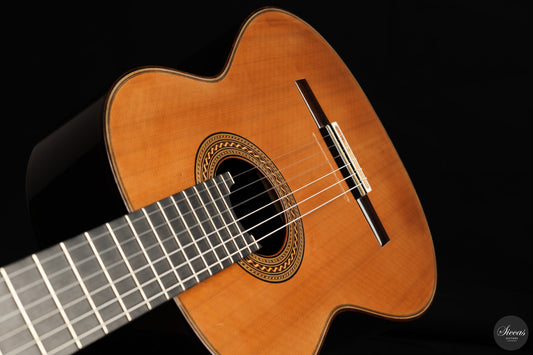
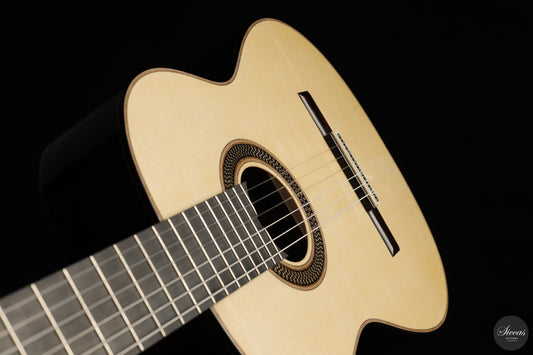
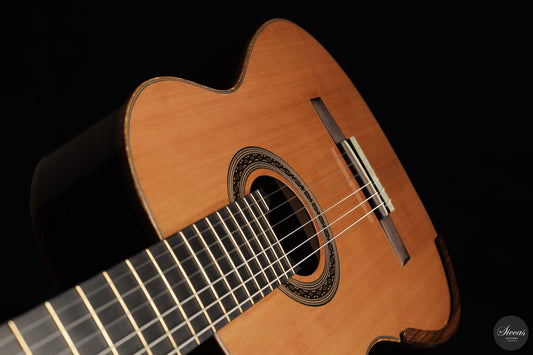
One of the most relevant choices for tone is the top wood. Spruce versus cedar is the central debate: spruce tops tend to have more dynamic range and brightness, cedar tops more immediate warmth and responsiveness at lower volumes. For the Spanish Romantic repertoire — Tárrega, Albéniz, Rodrigo — many players prefer cedar; for Bach and the Baroque repertoire, spruce is often favoured for its clarity of articulation.
If you are ready to explore, you can browse our curated selection of classical guitars, including specialist collections of spruce-top guitars, cedar-top guitars, and the extraordinary double-top guitars that represent the cutting edge of contemporary lutherie. Every guitar in our collection comes with a professional video review so you can hear it before you decide.
The full archive
Works by composer
Agustín Barrios Mangoré — Julia Florida · La Catedral
Astor Piazzolla — Las Cuatro Estaciones Porteñas · Oblivion
Claude Debussy — Clair de Lune
Dua Lipa — Houdini (Dua Lipa)
Federico Moreno Torroba — Sonatina · Torija
Fernando Sor — Mozart Variations, Op. 9 · Studies
Francisco Tárrega — Capricho Árabe · Lágrima · Recuerdos de la Alhambra
François Couperin — Les Barricades Mystérieuses
Franz Schubert — Ave Maria · Standchen
George Frideric Handel — Lascia ch'io pianga
Heitor Villa-Lobos — Études · Prelude No. 1 · Préludes
Isaac Albéniz — Asturias (Leyenda) · Sevilla
Joaquín Rodrigo — Adagio from Concierto de Aranjuez · Concierto de Aranjuez
Joaquín Turina — Sevillana · Sonata, Op. 61
Johann Kaspar Mertz — Fantaisie Hongroise · Tarantella
Johann Pachelbel — Canon in D
Johann Sebastian Bach — Air on the G String · Cello Suite No. 1, Prelude · Chaconne, BWV 1004 · Prelude, Fugue & Allegro, BWV 998
John Williams — Schindler's List Theme
Ludwig van Beethoven — Für Elise
Luigi Legnani — Fantasia Op. 19
Manuel de Falla — Homenaje pour le tombeau de Debussy
Manuel Ponce — Folía de España · Sonatina Meridional
Mario Castelnuovo-Tedesco — Capriccio Diabolico · Sonata (Omaggio a Boccherini)
Stanley Myers — Cavatina
The Beatles — Yesterday
Traditional — Greensleeves
Vic Mizzy — The Addams Family Theme
William Walton — Five Bagatelles
Wolfgang Amadeus Mozart — Rondo alla Turca
Led Zeppelin — Stairway to Heaven
From the library to the showroom
Ready to find your instrument?
Every guitar in our collection comes with a professional video review — hear before you decide.